Sara Carmen

Why do grand apologies fail while small, boring habits work? The answer lives in how your brain predicts safety.
Key Takeaways
- How to rebuild trust in a relationship starts with predictability: your partner’s alarm system wants boring evidence, and grand gestures rarely register.
- Drip-fed confessions reset the wound to day one, so one complete disclosure beats months of painful surprises.
- Transparency works as a temporary bridge with a review date; permanent surveillance keeps both partners in guard mode.
Quick answer: To rebuild trust in a relationship, offer consistent, verifiable evidence over time: one full disclosure of the breach, small promises kept daily, non-defensive responses to pain spikes, and temporary transparency with review dates. Plan on months of repeated behavior from both partners, because a single apology cannot carry this weight.
Contents
Table of Contents
The phone sits face-down at dinner again. It has been six months since the lie, and the conversation sounds normal, yet your eyes keep drifting to that small rectangle of plastic. You want to believe your partner. Your body keeps filing objections.
We tend to picture trust as a vase: dropped once, glued forever, never quite the same. Your nervous system treats it more like a weather forecast, constantly predicting whether the person closest to you is safe to lean on. Betrayal rigs that forecast toward storms.
That is the unspoken tension: you love this person and you scan them for danger at the same time. The American Psychological Association reports that betrayal can produce reactions resembling PTSD, including intrusive thoughts and hypervigilance, the constant scanning for the next bad surprise.
This guide covers how to rebuild trust in a relationship through seven specific moves: what to disclose, what to schedule, what to measure, and how to know when rebuilding is the wrong project.
Why Trust Rebuilds Slowly: The Prediction Problem

Secret 1: Win the micro-promises before the grand gestures
John Gottman’s research found that trust forms in what he calls “sliding door moments”: the tiny daily forks where you turn toward your partner or away from them (Gottman Institute, 2021). A hundred kept micro-moments teach the forecast to expect sun. One weekend getaway teaches it almost nothing.
This is where most advice on how to rebuild relationship trust goes wrong. It leads with the apology and the romantic reset. Those open the door. Predictability is what walks through it.
Pick three recurring, checkable commitments and treat them as sacred for two weeks:
- “I’ll text when I land, every trip.”
- “Home by 6:30, or a call before 6:15 if that changes.”
- “The card payment goes through every Friday, and you’ll see the confirmation.”
Notice the pattern: each promise is small, specific, and easy to check. “I’ll never lie again” fails all three tests, which is why sweeping vows often increase anxiety instead of settling it.
When you miss one, name it before your partner catches it. Self-reported misses build more safety than perfect records, because they prove the reporting channel works even when the news is bad.
Secrets 2-4: How to Rebuild Trust After Cheating
Secret 2: One complete disclosure beats a slow drip
Recovery communities call it “trickle truth”: the affair comes out in slices, and every new slice returns the hurt partner to day one. Each reveal forces a full re-reading of history.
Was the vacation real? Was the late shift real? The brain reopens every file.
Consider a different structure: one scheduled, complete disclosure, ideally prepared in couples therapy. Cover the timeline, who knew, money spent, and whether contact has truly ended. Facts belong on the table. Graphic sexual comparisons stay off it, because those details feed intrusive images that can haunt a partner for years.
The same rule applies when rebuilding trust after lying about money, drinking, or hidden debt. One honest inventory hurts once. A drip of discoveries hurts on installments.
Secret 3: Give the hard questions a schedule
Interrogation at midnight helps nobody. Containment does: two 20-minute question windows a week, plus a shared note where the hurt partner parks questions between sessions. The betrayer answers everything on the list, in order, without a sigh.
Here is the trade-off most guides skip. A schedule can feel like a gag order, so the hurt partner keeps an emergency brake: any acute trigger earns a 10-minute check-in on the spot. Containment works when it protects both people’s sleep, and it fails the moment it becomes a tool for dodging accountability.
Secret 4: Transparency with a sunset clause
Voluntary openness calms an alarmed nervous system. Forced policing keeps it humming. The difference shows up in who offers, who checks, and when it ends.
| Bridge transparency | Permanent surveillance | |
|---|---|---|
| Who initiates | The partner who broke trust offers access | The hurt partner demands and enforces it |
| Timeline | Reviewed every 30 days, tapered as calm returns | No end date, no review |
| Typical effect | Checking fades as evidence accumulates | Checking becomes a ritual that feeds doubt |
| Watch-for | Openness offered before it is requested | New hiding places appearing as old ones close |
Privacy and secrecy are different animals. Privacy is a closed bathroom door. Secrecy is a second phone. A workable bridge respects the first and dismantles the second.
Shift work or long distance? Replace location babysitting with predictable check-in windows, because the goal is a reliable pattern, and a pattern travels.
Secrets 5-6: How to Regain Trust in Ordinary Moments
Secret 5: Answer the pain spike without defending yourself
Three weeks of calm, then a song in the grocery store detonates everything. Your partner asks, “Were you thinking about her on that trip?” and your instinct is to produce evidence like a defense attorney.
The question under the question is simpler: do you see what this cost me, and am I emotionally safe with you again? Gottman’s research calls the skill attunement: turning toward the emotion with curiosity, listening without defensiveness, and making room for feelings that are uncomfortable to hear (Gottman Institute, 2021).
Regret says “I hate the consequences for me.” Remorse says “I see the damage in you.” Hurt partners recover faster when they hear the second one, repeatedly, without a counterattack attached.
Secret 6: Rebuild your own trust meter
Betrayal breaks two trusts. The obvious one is in your partner. The quieter one is your self-trust: I used to believe my read on people, and my read missed this.
Attachment research, the tradition John Bowlby started, describes the alarm that fires when a close bond turns unsafe. That alarm settles as evidence piles up, and you can collect it on purpose. Once a day, log one line: a promise kept, a hard truth volunteered, a defensive moment owned. Review the log weekly.
If the entries trend toward emotional safety, let them argue with your 3 a.m. brain. If they keep collecting red flags, believe the data instead of the promises.
Secret 7: Know When Rebuilding Is the Wrong Project
Some breaches are events. Others are patterns wearing an event costume. A trauma-based recovery model for infidelity, described in the same American Psychological Association article, starts with containment: the outside relationship ends before deeper repair begins. That ordering gives you clean decision rules:
- If contact with the affair partner continues, then repair has not started yet, whatever the promises say.
- If new lies surface during recovery, then the clock resets to disclosure, or the exit conversation begins.
- If every question meets contempt or stonewalling, then try individual therapy first, because repair needs two willing participants.
- If there is abuse or coercive control, then rebuilding trust is the wrong goal entirely; safety planning comes first, with individual support.
Forgiveness stays optional in every scenario. Clinical psychologist Janis Spring’s work, covered in that APA article, makes the case that healing is possible even when forgiveness is never granted. Some patterns belong on a list of deal breakers in relationships instead of a repair plan, and naming that early saves years.
What to Do Next: Four Practices With Word-for-Word Scripts
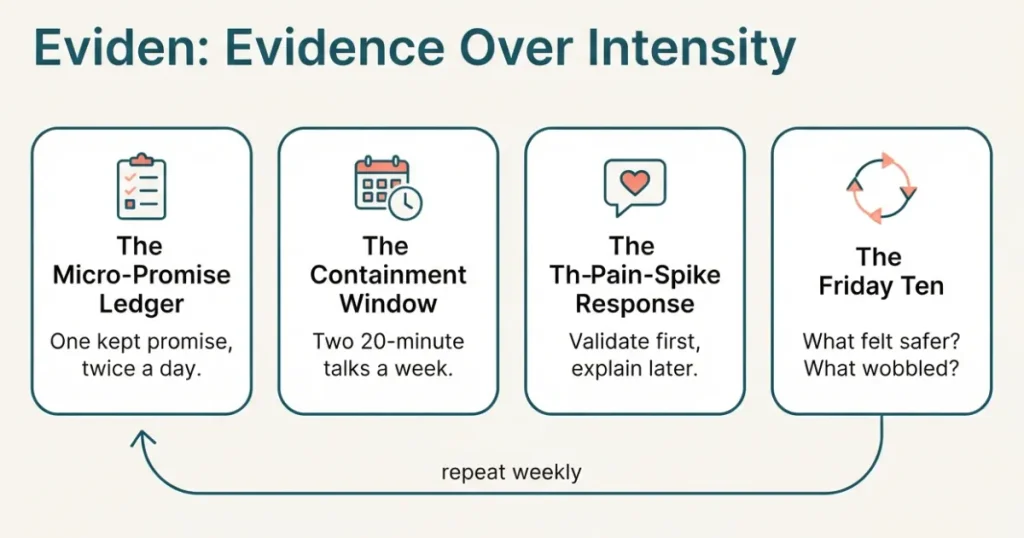
One place to begin is tonight, small. These four practices turn the secrets into reps.
1. The Micro-Promise Ledger. Each morning, name one specific commitment for the day. Each evening, confirm it or own the miss before being asked. Try: “Today I’ll call at 12:30 like I said. If the meeting runs over, you’ll hear from me by 12:25.” Ten seconds of predictability, twice a day.
2. The Containment Window. Propose the schedule yourself, especially if you broke the trust: “I want to answer everything, and I want us both to sleep. Can we try two 20-minute talks a week, plus my promise to take any urgent question the moment it hits?” Notice what shifts when the betrayer owns the structure instead of resisting it.
3. The Pain-Spike Response. When the wave hits your partner, try three sentences in this order: “You’re thinking about it again. That makes sense. I’m here, and I’ll stay in this conversation as long as you need.” Skip “again?” and “how long is this going to take,” which read as invoices for patience.
4. The Friday Ten. Ten minutes, same time weekly, three prompts: What felt safer this week? What wobbled? What is one adjustment for next week?
Transparency tapers and schedule changes get decided here, by agreement, so neither partner plays jailer or parolee.
Frequently Asked Questions
How long does it take to rebuild trust after cheating?
No verified universal timeline exists, and specialists describe recovery unfolding over many months to years. Track markers instead of dates: fewer intrusive thoughts, less checking, faster calm after triggers.
Should we share passwords and location tracking?
Voluntary, temporary access can lower the alarm early on. Permanent policing tends to keep it switched on. Set a 30-day review and let the evidence decide what fades.
How do you rebuild trust when your partner won’t talk about it?
Offer a small scheduled window instead of an open-ended marathon, since stonewalling starves repair. If refusal continues for weeks, treat the refusal itself as information about where this relationship is headed.
Back to that face-down phone at dinner. You still notice it. The difference is that you now hold a map: one complete disclosure, questions with a home, micro-promises that stack into evidence, and a clear line where repair ends and a decision begins. You stop guessing whether things are working and start reading what the days actually show.
Trust comes back the way it left: through small moments, one honest choice at a time.
My Closing Remarks
If I could sit beside you while you read this, I would say the hardest part is the unfairness. The person who broke the trust does the heaviest lifting, and the person who got hurt has to keep living inside the repair. Both jobs are exhausting. Be gentle with yourselves on the bad days, and let the small kept promises do the arguing for you.
More Related Stories for You
Ready for the daily reps behind Secret 1? These trust exercises for couples who hate worksheets turn the theory into ten-minute habits you can start tonight.
About The Author