
 Sara Carmen
The best teen birthdays aren’t the ones parents design. They’re the ones parents quietly make possible.
Key Points
- The most memorable things to do for your birthday teenager give them real ownership over the guest list, the music, and the pace of the day.
- Teens don’t need less supervision. They need supervision they can’t see, a strategy psychologists call “peripheral hosting.”
- Small, sensory-rich gatherings consistently beat big, loud parties at reducing social anxiety and producing memories that actually stick.
Contents
Table of Contents
The New Rules of a Teenage Birthday
We’ve all sat through the birthday party that tried too hard. The pinned balloons, the forced photo corner, the game nobody wanted to play. You’ve watched your teenager’s polite smile turn into a fixed, tolerant grimace, and you know exactly what that expression means. Something didn’t land.
Here’s the tension nobody names out loud. You want to give your teenager a birthday worth remembering. But you’re terrified you’ll be the reason it isn’t.
Someone might think a themed party with matching decorations shows effort. What they don’t see is a sixteen-year-old quietly texting friends an apology for the balloon arch.
Someone might think a bigger guest list means a better party. What they don’t see is a fourteen-year-old overwhelmed by twenty-five people she barely talks to, wishing she’d invited five.
Someone might think staying in the room “just to keep an eye on things” is harmless. What they don’t see is how the entire room shifts the second a parent walks in, conversation flattening, energy dropping.
None of this means you’re doing it wrong. It means the rules changed, and nobody handed you the new ones.
Why Autonomy Is the Real Birthday Gift
Here’s the concept that changes everything once you understand it: adolescent well-being depends heavily on something psychologists call autonomy-supportive parenting. That’s a clinical term for a simple idea. Teens thrive not when they’re given total freedom, and not when they’re tightly controlled, but when they’re given real decision-making power inside a structure an adult still holds up.
Research published through the National Institutes of Health found that teenagers’ social competence and emotional stability improve most when they’re allowed genuine choice within a supported environment, rather than either strict oversight or total independence.
Translate that into party planning and the lesson gets obvious fast. A birthday feels authentic to a teenager only when they control the parts that matter to them: who’s invited, what’s playing, how the day unfolds. Your job shifts from event director to enabler. You’re not planning the party. You’re building the conditions that let your teenager plan it.
This matches what the broader field of adolescent psychology has documented for decades. The teen years are defined by an active push toward identity formation, meaning your child is constantly testing who they are separate from you. A birthday is one of the lowest-stakes places to practice that. Let them.
5 Things to Do for Your Birthday Teenager That Feel Genuinely Teen-Approved
1. High-Energy Immersive Adventures for Big Friend Groups
If your teenager runs with a loud, social, easily-excited crowd, lean into shared physical experiences rather than static entertainment. Free-roam virtual reality arenas, tactical laser tag, indoor skydiving, and high-ropes courses all work because they hand the group a common goal.
A composite example: Jordan turned fifteen and invited twelve friends to a competitive gaming lounge instead of a house party. Nobody had to make small talk to fill silence, because the activity did that work for them. Two friend groups that barely knew each other were high-fiving by the second round.
Cooperative, goal-based activities lower the social pressure of “what do I say next,” because attention naturally shifts to the shared task instead of the group dynamic. That’s the whole point. Choose formats where talking happens because of the activity, not in spite of it.
2. Aesthetic Micro-Gatherings for Small, Close Circles
Not every teenager wants a crowd. Many prefer three to six close friends and a setting that feels intentional. Think backyard open-air movie nights with a mini projector, floor cushions, string lights, and a gourmet s’mores bar. Think a DIY boba and mocktail station with real glassware and flavored syrups. Think a golden-hour picnic with a grazing board and a speaker playing whatever playlist your teen curated themselves.
But here’s what no one tells you.
The instinct to build a “TikTok photo booth” or force a phone-free rule almost always backfires. Data from the Pew Research Center shows teenagers already spend enormous time on their phones, but what they crave in person is the opposite of staged content. They want real moments that happen to be photogenic, not photo opportunities dressed up as moments.
This is the differentiator most party guides miss entirely. Don’t design for the camera. Design an environment beautiful enough that the camera comes out on its own. An ambient movie setup, warm lighting, and good food will get photographed without anyone asking for it.
Small-group settings also carry a mental health advantage worth knowing about. According to the Child Mind Institute, deep interaction within a small peer circle significantly lowers the social comparison and anxiety that larger gatherings tend to produce. A five-person glamping picnic can outperform a twenty-five-person party, not because it costs less, but because it asks less of your teen’s nervous system.
3. Age-Calibrated Ideas from Thirteen to Eighteen
A thirteen-year-old and an eighteen-year-old are not the same audience, and treating them that way is where most planning goes wrong.
For thirteen and fourteen, aim for guided group excitement with enough structure that nobody feels lost: trampoline parks, arcade bars with a private lane reserved, or a themed sleepover with a movie marathon and a snack bar. This age still wants a container. Just make the container fun, not babyish.
For fifteen through seventeen, shift toward semi-independent experiences: a city scavenger hunt using public transit, a concert outing, a group dinner where the teen orders and pays with a set budget you’ve quietly provided in advance. This age wants to feel trusted with logistics.
For eighteen, hand over real agency: a private chef cooking class, a weekend cabin trip with close friends, a festival day. This is the year independence stops being a party theme and starts being the actual gift.
4. Modern Foodie Experiences Teens Actually Request

Food-forward parties have quietly become one of the most requested formats, and for good reason. Renting a local taco, pizza, or dessert truck for a front-yard gathering removes the labor of hosting while giving the event a genuine centerpiece.
A timed “Chopped”-style cooking challenge with mystery pantry ingredients also works well for smaller groups, because it turns the whole party into one long inside joke by the end of the night. A chaperoned food crawl hitting three or four spots, appetizers here, dessert there, gives older teens a taste of independence with a driver quietly managing the transitions.
5. A Budget Framework That Works at Every Price Point
You don’t need a large budget to hit the mark. You need the right structure for whatever budget you have.
Low-cost, high-energy options include a thrift store clothing swap party, a sunrise breakfast hike, or a video game tournament with a homemade bracket. Mid-range options include a DIY backyard festival with rented string lights and a playlist speaker, an escape room followed by dinner, or a private hour at a roller rink. Premium options include a chartered boat afternoon, a themed glamping setup, or VIP passes to a local attraction.
The amount of money you spend matters far less than whether your teenager had a say in how it’s used.
The Peripheral Hosting Strategy Parents Need to Know

Most parents in this situation don’t realize their physical presence is the single biggest variable affecting how the party actually feels. Not the decorations. Not the food. You.
The American Psychological Association has noted that healthy adolescent social milestones require a careful balance between discreet supervision and genuine boundary respect. Too much visible presence and the social air goes flat. Too little presence and safety slips.
I call the answer to this “peripheral hosting,” and it’s the single most requested reframe I give parents in my practice. Hosting a teen birthday from the background works a lot like being a stagehand instead of a performer. The best stagehands are the ones the audience never notices, and the show falls apart without them.
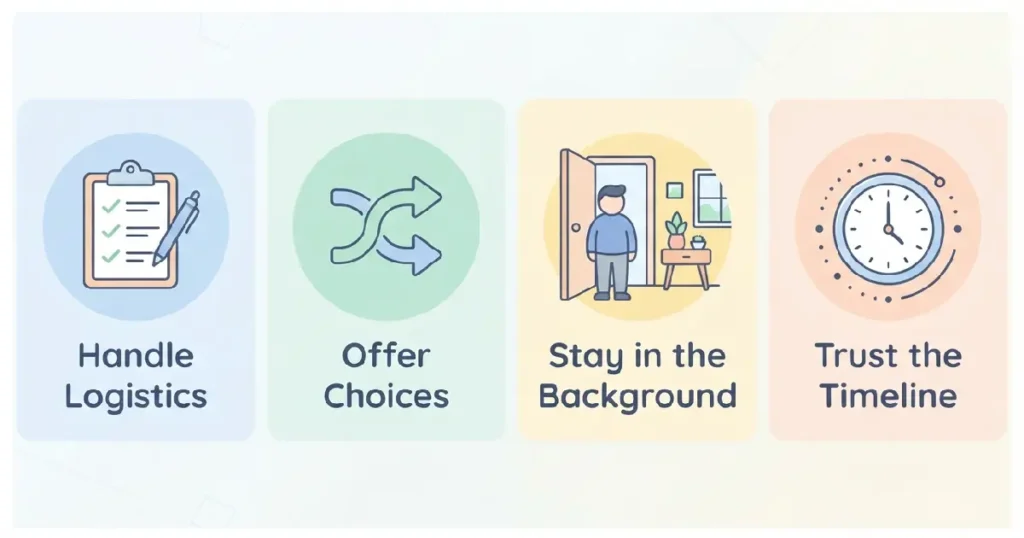
A simple way to remember it is the H.O.S.T. framework:
Handle logistics. Restock snacks, manage the driveway, keep drinks cold. Do this without commentary.
Offer choices, don’t dictate them. Present two or three venue or menu options and let your teen pick the direction.
Stay visible, not central. Be in the kitchen or on the porch, reachable in thirty seconds, but not in the room.
Trust the timeline. Resist the urge to schedule every hour. Unstructured time is where the actual bonding happens.
Left unexamined, over-hosting doesn’t just create one awkward afternoon. It quietly signals to your teenager that you don’t yet trust them with their own social world, and that message tends to outlast the party itself.
Designing a Birthday Your Teenager Will Actually Remember
A useful question to ask yourself the week before: what would this day look like if I only handled the parts nobody sees? Consider handing over the playlist entirely, no edits. Consider asking your teen to pick three options you’ve pre-approved on cost, rather than presenting one plan for approval.
The next time you feel the pull to add “just one more activity” or hover near the group a little longer than necessary, pause and ask what that impulse is really protecting. Often it’s your own anxiety, not your teenager’s actual need.
Go back to that party that tried too hard, the one from the beginning of this piece. It didn’t fail because the parents didn’t care. It failed because caring got expressed as control instead of trust. You now know the difference, and that difference is the whole thing.
The best birthday you’ll ever throw for your teenager might be the one where nobody notices you threw it at all.
My Closing Remarks
Here’s the honest part. Most parents I’ve worked with don’t fear the party itself, they fear becoming irrelevant to their kid’s happiness. I want to say this plainly: stepping back from the spotlight isn’t losing your place in their life. It’s proof you’ve raised someone ready to stand in their own. That’s not a smaller role. It’s the whole point.
More Related Stories for You
- If you’re curious about the personality patterns that quietly shape family dynamics, and how control can sometimes masquerade as care, this piece on narcissistic personality traits breaks down the warning signs worth understanding.
About The Author