
 Sara Carmen
Why the calmest relationships aren’t always the safest ones, and how to tell real alignment from a well-worn routine.
Key Points
- Asking “is she the one you should marry” is really asking whether your relationship still grows you, or whether it just holds you in place.
- Real partnership shows up in how two people repair after conflict, not in how quiet the house stays.
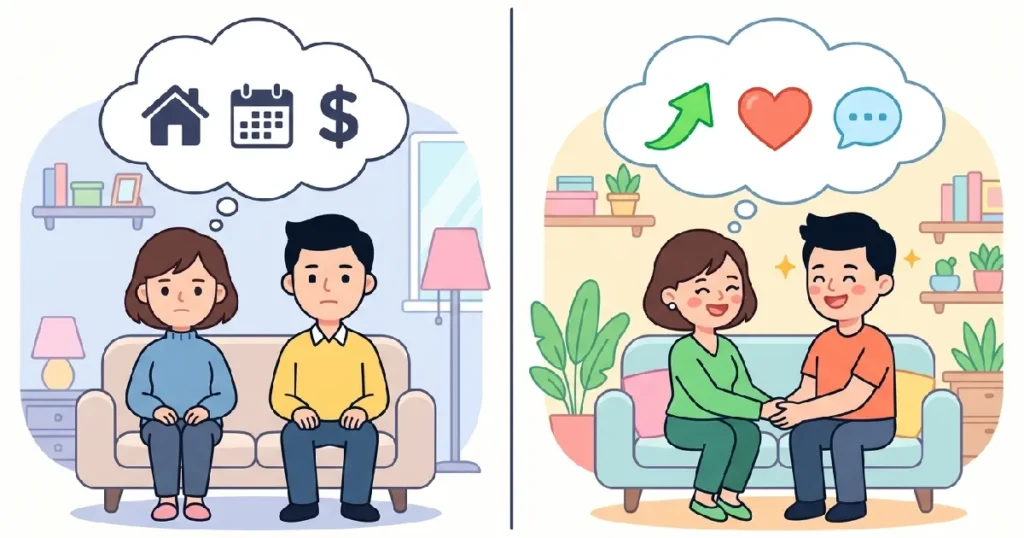
- Comfort keeps you anchored to what’s familiar. Alignment keeps pulling you both toward what comes next.
Contents
Table of Contents
We like to believe that peace is proof of love. When the arguing stops and the days start running smoothly, we assume we’ve finally found our person. But comfort and connection are not the same nervous system state, and mixing up the two might be the quietest way a good relationship slides into neutral.
You know the feeling. The routines run themselves. The rent gets split evenly. The schedules mesh without friction. And still, somewhere underneath the ease, a part of you wonders if “easy” and “right” have quietly become two different things.
That question doesn’t make you a bad partner. It makes you an honest one.
The Difference Between Secure Boredom and Stagnant Silence
Here’s something most couples never get told in plain language: not all calm is created equal.
There’s a kind of calm that comes from what researchers call coregulation, which is the way two nervous systems settle each other down just by being near one another. You can sit in silence next to her, folding laundry or watching nothing in particular, and feel completely at ease. No performance. No monitoring her mood. Your body simply trusts hers.
Then there’s a different kind of quiet. It looks identical from the outside. But underneath it, something has gone flat. Conversations have shrunk to logistics. You’re together, yet you feel strangely alone in the room. Therapists sometimes call this stagnant loneliness, and it’s one of the most under-discussed signs that a relationship has stopped growing even though nothing looks wrong on the surface.
The difference isn’t visible from a photograph of your Tuesday night. It’s felt in your body.
In my practice, I’ve sat across from more than one couple who described their relationship as “great, really, no complaints,” and then, within the same session, admitted they hadn’t shared an unscripted thought with each other in months. That contradiction is the whole article in one sentence.
According to the self-expansion model developed by psychologist Arthur Aron, people are drawn to relationships that help them grow their sense of identity, skills, and perspective. Couples who keep expanding together report higher satisfaction over time. Couples who stop tend to describe their partnership using words like “fine,” “stable,” or “easy,” which sound positive until you notice that none of them mean “alive.”
That distinction matters more than most people realize when they’re trying to answer the question underneath this whole article.
Is She the One You Should Marry? 5 Honest Signs She Is
1. She Makes Room for You to Change, Even When It’s Inconvenient for Her
The claim is simple. A partner who’s right for marriage doesn’t just tolerate your growth, she actively clears space for it, even when your growth complicates her plans.
Picture Daniel, a composite of several clients who’ve sat in my office over the years. He wanted to leave a stable but soul-draining job to retrain in a new field. His partner, Priya, didn’t pretend this was easy. Money got tighter. Their five-year plan shifted. But she leaned in instead of pulling back, asking questions about his new direction instead of quietly resenting the disruption.
That’s the marker. If your evolution destabilizes her a little and she still moves toward you instead of away, you’re looking at someone who sees your growth as shared territory, not a threat to the routine.
2. Conflict Leads Somewhere, Instead of Nowhere
The claim: healthy long-term partners treat disagreement as information to grow from, not a fire to put out as fast as possible.
Longitudinal research from psychologist John Gottman’s decades of couples studies found that the couples who stayed together weren’t the ones who fought less. They were the ones who repaired faster, taking accountability without needing to be dragged into it. The fight itself mattered less than what happened in the ten minutes after.
If your arguments end in “us versus the problem” instead of “me versus you,” and you both walk away slightly more understood than before, that’s not friction. That’s teamwork with better information now than it had an hour ago.
3. You’d Still Choose Her With Nothing Structural Holding You There
Here’s a blunt but useful exercise. Strip away the shared apartment, the split bills, the mutual friend group, and the mortgage you’re both terrified to unwind. Would you still choose her as a person?
Call it the perks test. Structural comfort, meaning the practical scaffolding of shared life, is not the same as choosing someone. Plenty of people stay married to their living situation long after they’ve stopped choosing the person in it.
If the answer is an immediate, uncomplicated yes even in the hypothetical, that tells you something real. If you hesitate, that hesitation is data too, and it’s worth taking seriously instead of explaining away.
4. Your Ordinary Tuesdays Still Get Shared

Intimacy researchers describe something called micro-disclosure, the small, low-stakes stream of thoughts partners pass back and forth all day. The weird thing your coworker said. The dumb thought you had in traffic. None of it matters individually. All of it matters together.
If you’re still narrating your ordinary day to her, unprompted, because you genuinely want her reaction, that stream is alive. It’s one of the most reliable signals of ongoing emotional attunement, according to relationship researchers cited by the American Psychological Association’s work on marital communication.
5. You Talk in “We” About Years You Haven’t Lived Yet
The final sign is the one couples most often overlook, because it doesn’t show up in a single dramatic moment. It shows up in whether the future gets discussed at all.
Couples heading toward a healthy marriage tend to naturally drift into “we” language about things years away, where to live, whether to have kids, how to handle aging parents. Not because they’ve solved it all, but because thinking ahead together doesn’t feel threatening.
If mapping out year three or year five together feels natural rather than loaded, that’s forward-momentum, and it’s one of the clearest markers separating a partnership from a placeholder.
3 Warning Signs You’re Just Comfortable, Not in Love

Most people in this exact situation don’t realize how much of their relationship is being held together by logistics rather than emotion. Here’s what that usually looks like.
1. Your Fights Have Been Replaced by Silence, Not Peace
A relationship that’s stopped fighting isn’t automatically a healthy one. Sometimes it’s a relationship where both people have quietly agreed the routine matters more than the truth.
This is radical conflict avoidance, and it doesn’t feel dramatic from the inside. It feels responsible. Mature, even. But differences that never get voiced don’t disappear. They calcify into a low hum of resentment that neither of you names out loud.
2. Your Conversations Have Shrunk to Headlines and Chores
When the micro-disclosures dry up, what’s left is scheduling. Who’s picking up groceries. Whether the car needs an oil change. Whose parents are visiting when.
That’s not connection. That’s project management with a shared last name attached to it.
3. Dating Apps Terrify You More Than Staying Ever Could
Here’s what no one tells you.
The fear of re-entering the dating market is one of the most powerful, least examined reasons people stay in relationships that have gone flat. It’s not romantic. It’s exhausting. And exhaustion is a completely understandable reason to avoid something, but it’s a terrible reason to marry someone.
A relationship built only on comfort is like a car with heated seats and no engine. It’s warm. It’s pleasant to sit in. But you are not going anywhere.
Left unexamined, this pattern doesn’t just quietly limit a relationship, it can eventually become the reason it ends, usually years later than it should have, and usually with far more damage than an honest conversation now would have caused.
What to Do With This Right Now
One place to start is the Tuesday Text Audit. Scroll back through your last week of messages to her. Count how many were logistics versus how many were an unprompted thought you shared just because you wanted her reaction. The ratio tells you more than any long conversation will.
Consider running the Five-Year Forecast together. Not a formal talk, just a casual “where do you picture us in five years” over dinner. Watch whether the conversation flows or whether one of you quietly changes the subject. Avoidance here is information.
A useful question to ask yourself is this: if every practical reason to stay disappeared tonight, would you still be dating her from scratch. Not the apartment, not the shared friends, not the fear of starting over. Just her.
The next time you find yourselves in conflict, try naming the pattern out loud. Something as simple as “I think we’re avoiding this instead of working through it” can interrupt years of quiet accumulation in a single sentence.
The Question Was Never About Her
That Tuesday night question you keep pushing down isn’t really asking whether she’s right for you. It’s asking whether the relationship is still alive, still moving, still capable of surprising you both.
Comfort tells you to stay exactly where you are. Alignment asks you to keep growing, together, even when that’s harder than staying still.
You now know the difference between a relationship that’s resting and one that’s stalled. That’s not a small thing to walk away with.
Comfort keeps you parked. Real love keeps the engine running.
My Closing Remarks
Here’s what I’ll say plainly, from years of sitting with couples on both sides of this question. Comfort isn’t the villain. It’s actually a beautiful thing when it’s built on top of real connection. But when comfort is the entire foundation, it becomes a very convincing disguise for a relationship that quietly ended a while ago. You’ll know the difference the moment you stop being afraid to ask the question honestly.
More Related Stories for You
- If you’re wondering where this relationship might actually be heading, you might also want to read signs he is going to propose for a look at the other side of this same question.
About The Author