
 Sara Carmen
Novelty isn’t a luxury for your marriage. It’s a nutrient your brain craves.
Key Points
- One of the most powerful things to try with your spouse once a month is anything that feels new, slightly risky, and done together.
- Novelty activates the same reward chemistry that defined the early, electric days of your relationship.
- You don’t need a bigger budget or more time. You need one bold, intentional choice each month.
Contents
Table of Contents
You’re folding the same laundry. Sitting in the same chair. Asking the same question you ask every night: “So, what do you want for dinner?”
And your partner gives the same shrug.
It’s not that anything is wrong. The bills are paid. The kids are fed. Nobody is yelling. But somewhere under all that smooth functioning, you feel it. A flatness. A quiet hum of “is this it?”
You’re not broken. Your marriage isn’t failing. You’re simply running on autopilot, and autopilot was never designed to feel exciting.
That low-grade boredom you’re noticing? It has a name, and it has a fix.
Why Comfortable Marriages Slowly Go Numb
Here’s the part most couples never learn. Your brain treats predictability as efficiency, not romance.
When you do the same things in the same order, your nervous system stops paying close attention. Psychologists call this habituation, which simply means your brain tunes out anything familiar to save energy. It’s the reason you stop smelling your own home and stop noticing the partner sitting right next to you.
The early days felt thrilling for a biological reason. Everything was new. Every date released dopamine, the brain chemical tied to reward and anticipation. New experiences lit you up.
Then life got organized. And organized life is dopamine’s enemy.
Researcher Arthur Aron spent decades studying this. His work, often described through the self-expansion model, found that couples who regularly did novel and arousing activities together reported significantly more relationship satisfaction than couples who did pleasant but familiar ones. Not more expensive. Not more romantic. Just new.
Relationship scientist John Gottman, whose research at the Gottman Institute has tracked thousands of couples, found something similar. Couples who keep building shared adventure and curiosity stay connected. Couples who let routine swallow them slowly drift.
Left unexamined, that drift doesn’t stay harmless. It’s often the quiet reason couples wake up one day feeling like roommates.
So here is the one idea this entire article rests on.
Scheduled novelty is not silly. It is medicine for a marriage running on routine.
You don’t need fifteen changes. You need one bold thing each month.
15 Bold Things to Try With Your Spouse Once a Month
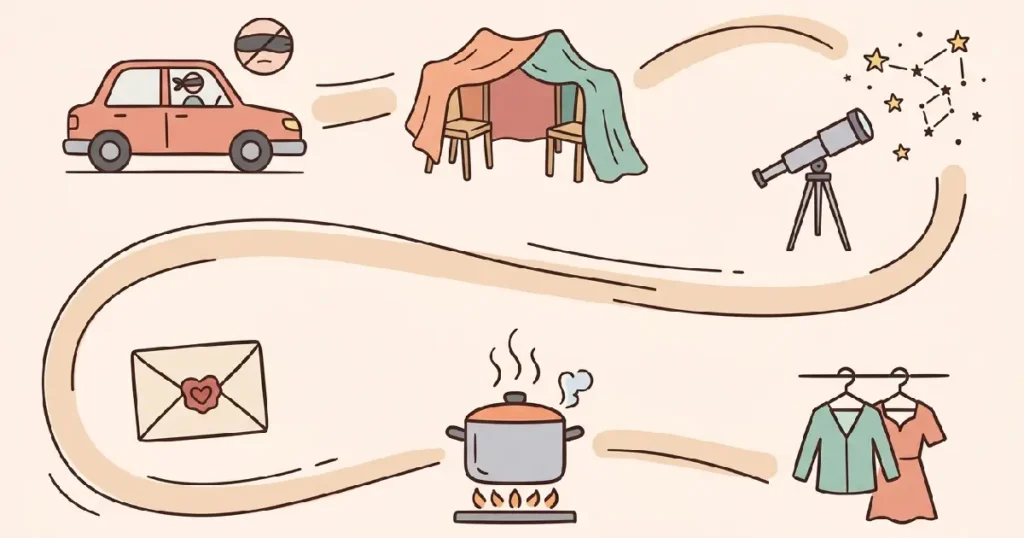
Think of each of these as a small jolt to a sleepy nervous system. Pick one a month. Watch what wakes up.
1. The “Yes Day” Trade-Off
Hand one partner full control for twelve hours. The other says “yes” to every reasonable request, within agreed money and safety limits.
This forces you into your spouse’s world. You taste their cravings, their pace, their idea of fun. You learn who they are when they aren’t compromising for you.
The next time you assume you “already know” your partner, a Yes Day will surprise you.
2. The Vision and Audit Night
Once a month, pour a favorite drink and have a defenseless, honest check-in. Ask three brave questions.
What made you feel most loved this month? Where did you feel lonely? What dream or fear haven’t you told me yet?
Vulnerability is the fastest road to closeness, but only when it’s safe. This ritual builds a container where honesty doesn’t trigger a fight.
3. The No-Phone Disconnection Challenge
Pick a Saturday. Power both phones off from 9 a.m. to 9 p.m. and drop them in a drawer.
Then navigate your own city using nothing but instinct and each other. No GPS. No reviews. No texting.
Solving real problems as a two-person team creates a rush that scrolling never could.
4. The Financial Goal Sprint
Turn money into a game instead of a fight. Choose one reward, like a weekend away, then cut all non-essential spending for exactly one week to fund it.
Most couples argue about money because it feels like restriction. This flips it into teamwork with a finish line. You’re not sacrificing. You’re sprinting toward something together.
5. The “Adrenaline First” Class
Sign up for something that genuinely scares you both. Trapeze. Indoor rock climbing. An intense martial arts seminar.
This is Aron’s research in action. Shared, slightly frightening challenges trigger the same dopamine release that defined your first months together. Your brain can mistake that pounding heart for attraction, and that’s exactly the point.
But here’s what no one tells you.
The fear is the feature, not the flaw.
6. The Mystery Location Blindfold Drive
One partner plans a secret destination within an hour. The other wears a blindfold from the passenger seat until arrival.
A speakeasy. A scenic overlook. A weird roadside attraction. The not-knowing turns an ordinary drive into genuine suspense.
Anticipation, remember, is dopamine’s favorite food.
7. The Living Room Blanket Fort
Leave your maturity at the door. Spend an hour building a giant fort from every blanket and sheet you own. Then sleep in it.
Changing where you sleep, even inside your own home, instantly shatters domestic autopilot. Your brain wakes up because the room is suddenly wrong in the most delightful way.
8. The Improv “Crash Test”
Attend a live improv show, or better, take a beginner workshop together.
Improv runs on one rule: “Yes, and.” You accept whatever your partner offers and build on it. You also look ridiculous in front of each other and laugh until your face hurts.
Laughing at your own awkwardness melts the stiff walls that routine builds.
9. The Kitchen “Chopped” Competition
One partner buys four bizarre, clashing ingredients. Goat cheese. Passionfruit. Instant ramen. Dark chocolate.
Together, you have one hour to make something edible. Maybe even good.
You’ll fail, panic, improvise, and collaborate. That’s a marriage in miniature, with snacks.
The Insight Differentiator: Most articles tell you novelty “spices things up.” Here’s the deeper truth they miss. The point of these experiments is not the activity. It’s the witnessing. Your partner stops being a fixed object in your mental furniture and becomes a person you’re discovering again. Boredom isn’t a lack of fun. It’s a lack of fresh attention. Every bold thing on this list is really just a tool to make you look at each other again.
10. The 24-Hour Local Tourist Swap
Book a cheap room inside your own city. The single rule: you cannot enter your own home for 24 hours.
Eat where you’ve never eaten. Walk streets you only ever drive. See your familiar town through a traveler’s eyes.
Sometimes adventure isn’t a new place. It’s new attention paid to an old one.
11. The “Amateur Hour” Massage Night
Skip the half-distracted shoulder rub in front of the TV. Lay down towels, buy real warming oil, and watch a proper instructional video on massage technique together.
Then spend 45 focused minutes practicing on each other. Touch without an agenda lowers cortisol, the body’s stress hormone, and rebuilds physical closeness that routine quietly erodes.
12. The “In Case of Emergency” Love Letters
In separate rooms, write your partner a detailed letter. But not a sweet one. Write the letter you want them to read during your next bitter argument.
Seal it. Save it in a drawer.
When tension spikes, that envelope becomes a circuit-breaker, your calm self reaching across the fight to your angry self.
13. The Thrift Store Character Dinner
Twenty dollars each. Pick a complete, ridiculous outfit for your partner. They pick yours.
Wear them straight to a sit-down dinner. Bonus points for inventing fake names and backstories, and holding the characters with the waiter.
Playing pretend together is something we lose after childhood. Reclaiming it is wildly bonding.
14. Midnight Stargazing and Legacy Talk
Drive past the city lights at midnight. Lie on the car hood. Look up.
Then skip the small talk. Ask the big questions. If our story ended tomorrow, what would be our proudest shared achievement? What family patterns are we breaking on purpose?
These conversations remind you that you’re not just managing a household. You’re building a legacy.
15. The Reverse Bucket List
Everyone celebrates what’s still ahead. Flip it.
Once a month, map a timeline of everything hard you’ve already survived together. Job losses. Health scares. Moves. Sleepless newborn years.
Seeing your survival history laid out is proof. You are not fragile. You are a unit that has already weathered storms.
How to Actually Start Without Overwhelming Yourselves

Fifteen ideas can feel like fifteen obligations. Don’t let it. The goal is one bold thing a month, not all of them at once.
Here are three ways to make it stick.
The Jar Method. Write each idea on a slip of paper. Drop them in a jar. On the first weekend of every month, draw one. Letting chance decide removes the “what should we do” paralysis that kills most plans.
The 10-Minute Pitch. Once a month, each of you pitches one bold idea in ten minutes or less. The other can’t say “no” outright. They can only ask, “How could we make that work?” This keeps both partners in the driver’s seat.
The Reflection Ritual. After each experiment, ask one question together: “What did I see in you tonight that I forgot was there?” That single question is where the real intimacy lives, long after the activity ends.
A useful question to sit with this week: when was the last time your partner genuinely surprised you, and when did you last surprise them?
If the answer is “I can’t remember,” that isn’t a verdict. It’s an invitation.
Meet Daniel and Priya “Things to Try With Your Spouse Once in a Month”
In my years working with couples, I watched a pattern repeat so often it stopped surprising me. Daniel and Priya came in describing “nothing wrong” and “no spark.” Married nine years. Two kids. A clean, quiet, slowly suffocating routine.
I gave them one assignment. One bold thing a month. Nothing fancy.
Their first attempt was the blindfold drive. Priya took Daniel to a tiny rooftop taco stand twenty minutes away that he never knew existed. He laughed in the passenger seat like a kid.
She told me later it wasn’t the tacos. It was watching him delighted again. She’d forgotten that version of him existed under the dishwasher loading and the work emails.
They didn’t need a new marriage. They needed new attention.
That’s almost always the truth.
Your Marriage Isn’t Tired. It’s Just Under-Stimulated.
Go back to that kitchen. The same chair. The “what do you want for dinner” shrug.
Nothing about that scene means your love is gone. It means your routine got too good at its job.
You now know something you didn’t an hour ago. Boredom is not a sign of a dying relationship. It’s a signal that your brain is begging for something new, and you have fifteen ways to answer it.
Pick one. This month. Watch your partner become a person you’re curious about again.
Because the spark was never something you lost. It’s something you stopped lighting.
My Closing Remarks
Let me be blunt with you, friend. I have watched couples spend thousands on counseling when what they actually needed was a blanket fort and a reason to laugh. I’ve seen a single ridiculous thrift-store dinner do more than months of careful talking. Stop waiting to “feel” like it. Feelings follow action, not the other way around. Do the bold thing first, and let your heart catch up. Your marriage isn’t asking for perfection. It’s asking for you to show up and play.
More Related Stories for You
About The Author