
 Elena Garcia
The right clothes don’t just impress your relatives. They regulate your nervous system.
Key Points
- Your cute outfit for thanksgiving acts as psychological armor against holiday stress and social anxiety.
- Research in enclothed cognition shows that what you wear directly affects your attention, confidence, and emotional regulation.
- The five outfit formulas ahead blend current fall trends with sensory comfort so you feel grounded, not performative.
Contents
Table of Contents
The Hook
You’re standing in front of your closet three hours before Thanksgiving dinner. The house smells of sage and stress. Your mother has already texted twice asking if you’re bringing the green bean casserole. And somewhere between the third outfit change and the fourth self-critical glance in the mirror, you realize you’re not getting dressed. You’re bracing yourself.
You feel the familiar tightness in your chest. The question isn’t really “What looks cute?” It’s “What will help me survive the evening?”
And yet, most style advice treats Thanksgiving like a runway. It ignores the reality that holiday gatherings are emotional minefields disguised as dinner parties. The good news? Psychology has something to say about what you should wear.
Context and Problem Definition
This is where enclothed cognition enters the conversation. Coined by researchers Hajo Adam and Adam Galinsky at Northwestern University, enclothed cognition refers to the systematic influence that clothes have on the wearer’s psychological processes. In their landmark study, participants who wore a white lab coat showed significantly higher selective attention than those in street clothes. But the effect only worked when participants believed the coat belonged to a doctor, not a painter. The symbolic meaning of the clothing combined with the physical act of wearing it created a measurable cognitive shift.
Translation for your Thanksgiving prep: your outfit isn’t fabric. It’s a signal to your brain about who you’re about to be.
Combine this with self-presentation theory, which explains why we care so deeply about what others think during social gatherings. According to theorists Mark Leary and Barry Schlenker, social anxiety spikes when we’re highly motivated to create a good impression but doubt our ability to do so. Holiday dinners amplify this tension. You’re simultaneously expected to be warm, successful, grateful, and put-together. No wonder your closet feels like a threat.
According to the American Psychiatric Association, nearly one in three Americans expects to be more stressed this holiday season than last year. Left unexamined, this pattern doesn’t just strain your mood. It can quietly become the reason you dread the holidays entirely.
But there’s a reframe coming. And it starts with understanding that dressing well for Thanksgiving isn’t vanity. It’s emotional preparation.
The Core Content: Five Outfit Formulas
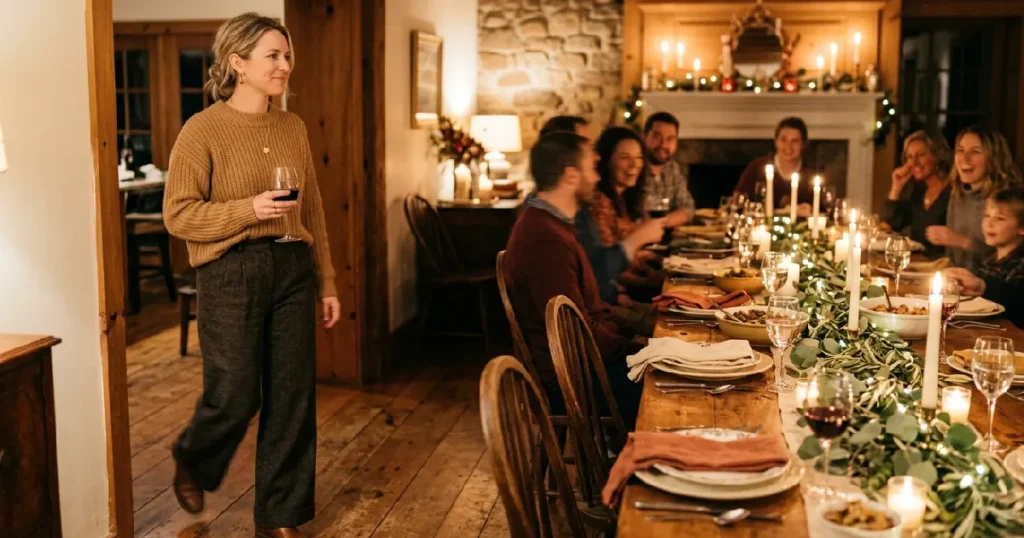
- The Structured Softness: Tailored Trousers and a Chunky Knit
This outfit pairs the psychological authority of structured bottoms with the sensory comfort of an oversized sweater. You get the enclothed cognition benefits of tailored clothing, associated with competence and control, without sacrificing the cozy factor Thanksgiving demands.
In Adam and Galinsky’s research, the symbolic meaning of clothing mattered as much as the wearing of it. A doctor’s coat boosted attention; a painter’s coat did not. When you choose pieces that symbolize “put-together” while feeling like a blanket, you hack your own nervous system. Maya, a composite client I worked with last fall, used to wear stiff, overly formal blouses to family dinners to prove she had her life together. She always felt like an imposter. Switching to wide-leg wool trousers and a soft camel knit changed her entire evening. She said, “I felt like I was managing the room instead of hiding in it.”
One place to start is your bottom half. Choose trousers with a defined waist and clean line, then pair them with a sweater you could nap in. The contrast tells your brain: I am both capable and comfortable. That is the exact combination holiday anxiety tries to convince you that you lack.
- The Elevated Knit Dress: One Piece, Zero Decision Fatigue
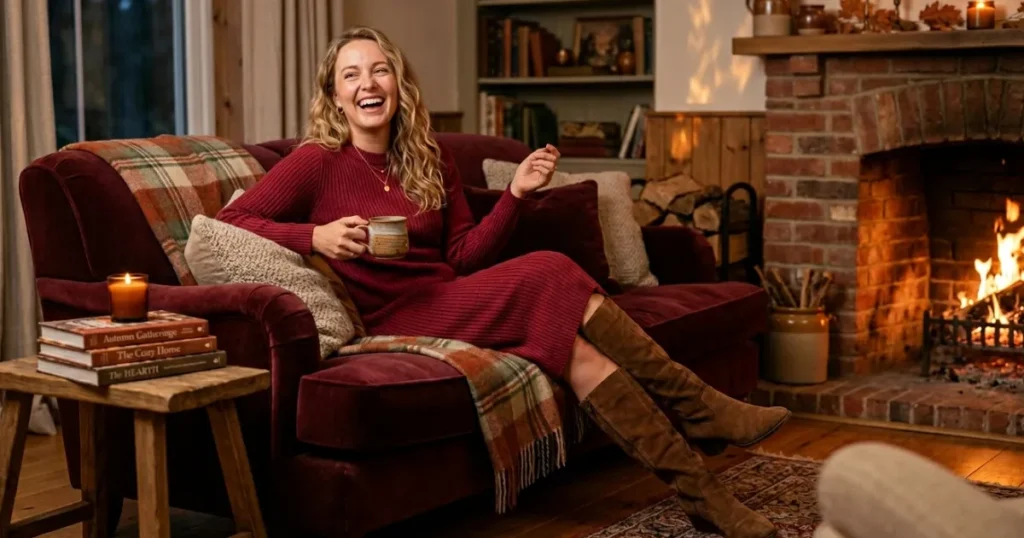
A midi-length sweater dress in a rich burgundy or deep chocolate eliminates the mental load of coordination while providing the sensory ease of a single, flowing garment.
Decision fatigue is real, and the holidays are full of micro-decisions. What time should the turkey come out? Should you engage with your uncle’s political commentary? When you remove the clothing decision entirely, you conserve cognitive resources for what actually matters. Research on embodied self-expression shows that comfortable clothes linked to ease and freedom help people feel more authentic in social situations.
Look for a dress with a defined shoulder or subtle shoulder pad, even in knit form. The structure around your upper body signals confidence, while the stretch everywhere else allows you to breathe after pie. Add knee-high boots with a low block heel. You want to feel grounded, not wobbly.
Most people in this situation don’t realize that simplicity is a secret weapon. Wearing one elegant piece reduces self-consciousness because you’re not performing a new identity. You’re simply reinforcing your existing one.
- The Rich Neutral Layer: Camel, Cream, and Dark Denim
This palette works because earth tones are psychologically grounding. They signal stability, warmth, and accessibility. The layering aspect gives you literal control over your body temperature and metaphorical control over your comfort level.
Color psychology research consistently associates warm neutrals with safety and reliability. When you’re walking into a room where old family dynamics might reactivate, wearing colors that feel like a deep breath matters. Think of a cream cashmere turtleneck under a camel wool coat, paired with dark wash straight-leg jeans. The jeans keep you relatable. The coat makes you feel like someone who has boundaries.
Consider this your “soft armor” look. It says: I am warm, I am steady, and I am not trying to outperform anyone. That confidence is magnetic.
Psychology Today notes that monitoring negative self-talk is critical during the holidays because it directly impacts anxiety levels. Wearing grounding colors can act as a visual reminder to speak kindly to yourself.
- The Texture Contrast: Satin Slip Skirt and Oversized Cashmere
Mixing textures, silky against fuzzy, structured against fluid, creates visual interest without trying too hard. Psychologically, it signals creativity and self-possession.
This is the outfit for the Thanksgiving where you want to feel quietly remarkable. A midi satin skirt in forest green or espresso brown paired with an oversized cashmere crewneck and loafers. The skirt catches candlelight. The sweater says you don’t need to try. That paradox is exactly what makes it work.
If you’re hosting, this combination moves beautifully from kitchen to table. If you’re a guest, it transitions from polite appetizer conversation to the couch without looking disheveled. The sensory variety of textures also keeps you present in your body, which is a known anxiety management technique.
But here’s what no one tells you.
The satin isn’t about being fancy. It’s about being intentional. When you choose fabric that feels deliberate, you signal to yourself that your presence matters.
- The Power Casual: Dark Jeans, Silk Blouse, and Structured Blazer
This is the outfit for the woman who wants to feel like herself, just slightly more fortified. It takes your everyday uniform and adds one layer of intention.
Add a structured blazer in tweed or heavy cotton over a silk blouse and your best dark jeans. The blazer is the architecture. Everything else is you. A useful question to ask yourself: “Would I wear a version of this on a good day at work?” If yes, you’ve found your formula. The blazer should feel like a hug with shoulders. The jeans should fit perfectly. The blouse should move when you do.
Research suggests that focusing on gratitude and meaningful traditions creates greater intimacy than overspending on appearances. This outfit honors that research. It says you showed up for the people, not the performance.
Practical Application: The “Now What?”
Now that you have the formulas, here’s how to make them work for your specific holiday scenario.
Strategy 1: The 48-Hour Rule Try on your complete outfit two days before Thanksgiving. Not the morning of. Not an hour before. Two days gives you time to adjust, replace, or simply get used to seeing yourself in the look. Anxiety thrives on last-minute uncertainty. Eliminate it early.
Strategy 2: The Sensory Check Before you commit, do a full sensory scan. Sit down in the outfit. Reach for an imaginary top shelf. Hug yourself. If anything pinches, rides up, or requires readjustment, it will become your entire focus during dinner. Comfortable clothes are linked to feelings of ease and freedom, which directly supports social confidence.
Strategy 3: The One-Anchor Piece Choose one item in your outfit that makes you feel most like yourself. Maybe it’s a vintage bracelet. Maybe it’s a scarf. When social anxiety spikes, touch that piece as a grounding reminder that you chose to be here, and you chose to come as yourself.
Strategy 4: The Exit Strategy Pack a loose cardigan or oversized scarf in your bag if you’re visiting. Knowing you have an escape layer reduces anticipatory anxiety. It sounds small. It works.
The Close: Emotional Landing
You’re standing in front of your closet three hours before Thanksgiving dinner. But this time, you reach for the trousers that hold their shape and the sweater that feels like safety. You look in the mirror and see someone who is prepared. Not performative. Prepared.
Your outfit is the architecture you wear into the room. It doesn’t change who you are. It simply holds you upright while you do the real work of being present.
The house still smells of sage and stress. Aunt Linda still asks about your love life. But you? You are dressed for the reality of the evening, not the fantasy of perfection.
And that is shockingly good.
My Closing Remarks
I have sat across from too many women in my practice who believe the lie that caring about their holiday outfit makes them shallow. It doesn’t. It makes them human. Your clothes are the first boundary you set between your inner world and the chaos of the dinner table. Choose them with the same intention you’d choose your words. That is not vanity. That is self-respect. And honestly? The right pair of wide-leg trousers can change your entire life. I have seen it happen.
More Related Stories for You
- If you’re wondering how to carry this confidence into other holiday events, read about whether jeans work for a Valentine’s date and how to style them with the same psychological intention.
About The Author