Sara Carmen

A perfect weekend, then silence by Tuesday. The pullback has a logic, and once you see it, you can stop guessing.
Key Takeaways
- Most fear of commitment signs flare right after closeness, which is why a great weekend can trigger a cold Tuesday.
- The retreat runs on relief: distance quiets an old alarm, and that quiet becomes habit-forming.
- Readiness shows up in repair speed and kept plans, so you can measure change in 30 days instead of waiting on promises.
Quick answer: Fear of commitment signs are repeating behaviors that create distance right after closeness: vanishing after great dates, vague future plans, sudden fault-finding, and exits when things get serious. They usually point to an intimacy alarm rather than missing love, and the pattern can change once it’s named and tested.
Contents
Table of Contents
Sunday you made pancakes together and laughed until your face hurt. Tuesday, their replies shrink to one word. You replay every sentence, hunting for what you did wrong.
You didn’t break anything. Closeness itself tripped an old alarm, and distance is how their nervous system switches it off. That trade happens below awareness, which is why the mixed signals feel so personal and make so little sense.
I coach people on both sides of this loop. Below, you’ll get the seven signs, what each one protects, a way to tell fear of intimacy from fading interest, and four tools you can try this week.
Why You Push Love Away: The Relief Loop Behind the Signs
Most signs of fear of commitment share one engine: relief. Closeness raises an old alarm, distance lowers it, and the brain takes notes. Behaviorists call this negative reinforcement: whatever removes discomfort fast gets repeated.
The retreat works, so it sticks. A partner with anxious attachment reads that relief as rejection and chases, which raises the alarm again. That’s the push-pull cycle, two nervous systems doing their best.
Hazan and Shaver’s 1987 study, the first large survey of adult attachment styles, found roughly one in four people described this exact reflex: wanting love, then getting uncomfortable when it arrived. The alarm usually formed early, in homes where needing people led to disappointment.
People expect fear of commitment symptoms to look dramatic. The real list is quiet, almost polite. One edge case matters before you label anyone: grief, burnout, and job stress can mimic the whole pattern.
Ask what the retreat follows. If it tracks closeness, suspect fear; if it tracks life stress, offer support.
7 Fear of Commitment Signs and What Each One Protects

Each sign below doubles as a reason. The behavior is the armor; the fear underneath explains why you push love away. Client names here are composites with details changed.
1. The Sunday-to-Tuesday vanish
A genuinely great weekend, then flat texts by Tuesday. In my practice, this 24-to-72-hour lag after peak closeness is the most reliable tell on the list. Intimacy triggered the alarm; the quiet is the recovery. Low interest drifts on its own schedule, while fear retreats on cue.
2. The flaw finder
The moment someone qualifies, the magnifying glass appears: their laugh, their shoes, their job. Mikulincer and Shaver (2016) call these deactivating strategies, mental moves that dial down attachment needs so the alarm quiets. Watch the timing: the flaw list spikes after a close moment, then fades once distance returns.
3. The someday plan
Ask about a trip three months out and you get “let’s see how things go.” A concrete date feels like a cell door; a maybe keeps the exit open. Run a simple count for one month: plans with dates versus plans with shrugs. The ratio tells you more than any “I really like you.”
4. The thermostat holder
The relationship warms and cools on one dial, and one person holds it. Maya, a composite client, paused things three times in eight months, and each restart came within two weeks, always on her schedule. Control stands in for trust: if I set every term, nothing can ambush me.
5. The over-functioner
Never asks for help, splits every bill to the cent, answers “how are you” with “fine” while clearly unwell. Needing someone once cost too much, so self-sufficiency became armor. Offer concrete help and watch closely: the flinch is small, fast, and real.
6. Great in a crisis, restless in peace
They shine when your car breaks down and itch when nothing is wrong. Chaos has a script; calm feels like the held breath before bad news. One client picked fights on quiet Sundays because peace felt like a trap he hadn’t found yet.
7. The preemptive exit
When things get real (a key, a drawer, a label), they pick a fight or ask for space. Leaving first turns a possible ambush into a planned departure. This is where self-sabotage hides inside logic: the exit always arrives dressed as a reasonable concern.
Female Commitment Issues: What Gets Missed
Fear of commitment in women often wears a socially approved costume: high standards, ambition, a full calendar. Independence gets applause, so the loop can hide for years. The commitment phobic woman traits I see most: a schedule so packed a partner needs a booking slot, and a checklist that grows the moment a man meets it.
One edge case fools everyone: she commits fast, but only to unavailable people. Married men, overseas jobs, partners who travel eleven months a year. A relationship with a built-in ceiling can’t swallow her whole, which is the quiet math behind the fear of engulfment. Serial situationships where she sets every term do the same job.
Here’s the comparison I sketch for clients, because female commitment issues get misdiagnosed in both directions:
| Signal | Fear of commitment | Low interest | Healthy pacing |
|---|---|---|---|
| After a great weekend | Goes quiet within days | Warmth stays flat either way | Warmth holds steady |
| Future plans | Vague, dates get dodged | No plans offered at all | Specific, just slower |
| Conflict | Escalates near milestones | Shrugs, walks, no repair | Names it, repairs it |
| The retreat sounds like | “I’m scared of losing myself” | “I’m just not feeling it” | “I want this, slowly” |
Weight the last row heaviest. Fear negotiates terms; low interest negotiates exits.
Signs an Avoidant Is Ready to Commit (Watch the Calendar)
Here’s the part most lists skip: avoidant attachment loosens under safety, and people move along the spectrum all the time. Mikulincer and Shaver’s research shows defenses ease when someone feels genuinely secure, and you can watch that shift in ordinary behavior. Emotional unavailability shrinks in measurable ways.
Four signals I trust more than declarations:
| Signal | What you’ll see | Why it counts |
|---|---|---|
| Repair attempts speed up | Silence after conflict drops from days to hours | The alarm now recovers with you present |
| Plans survive friction | They drive 40 minutes in rain instead of rescheduling | You outrank their comfort |
| Your absence registers | They name the empty chair and adjust their week | Attachment needs switch back on |
| Unglamorous access | You see the sick day, the money worry, the mess | The armor comes off and stays off |
Words are cheap; calendar entries cost something. Weight anything that spends their time, money, or comfort. If the shift has you wondering whether a ring is next, here are the surprisingly odd signs he’s about to propose.
One honest limit: you can be someone’s secure base and still need reciprocity. Their capacity grows in small doses, and your needs don’t shrink to fit the wait.
What to Do Next: 4 Tools That Turn Anxiety Into Data
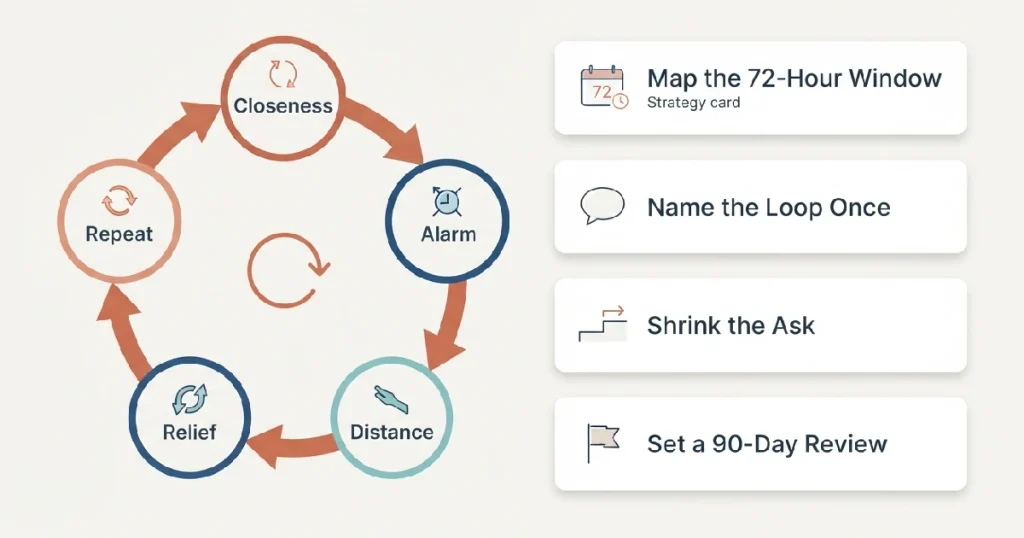
These four tools convert relationship anxiety into something you can actually read. Try them in order.
Tool 1: Map the 72-hour window
For three weeks, log peak moments of closeness and the contact that follows over the next three days. One question drives the log: what happened right before the quiet? If distance keeps trailing intimacy, you’re watching a loop. Cap it at three weeks; tracking past that turns you into a detective instead of a partner.
Tool 2: Name the loop once
Say it plainly, one time, without a verdict:
“I’ve noticed we have an amazing night, then you go quiet for a few days. I’m curious what those days feel like on your side.”
Then listen. Curiosity in return is data. So is being punished for noticing.
Tool 3: Shrink the ask
Trade the big talk for one small, concrete commitment each week: “Can we lock Saturday in by Wednesday?” Small kept promises build tolerance the way graded exposure does, one survivable step at a time. Notice what shifts when the ask is tiny and specific.
Tool 4: Set a 90-day review
Pick a date and write down two criteria: repair speed and kept plans. If the loop is still running, this script keeps the exit kind:
“I care about you, and I need a relationship that moves toward something. If we’re still here in March, I’m going to step back.”
A deadline turns waiting into a decision you own.
Frequently Asked Questions
How do I tell fear of commitment signs from low interest?
Check the timing. Fear retreats right after closeness and usually circles back; low interest drifts evenly, through good weeks and bad, and stays gone.
Can a commitment-phobic person actually change?
Yes. Avoidance softens with felt safety and deliberate practice, and therapy speeds it up; psychologists call the result earned security. Trust sixty days of changed behavior over any promise.
How long should I wait for an avoidant partner?
Give it a defined window, like 90 days, with two criteria: faster repairs and kept plans. If neither moves, treat that as your answer.
Back to the pancakes and the one-word Tuesday. The next time it happens, you hold better cards: a timing test, a table that separates fear from a fading spark, one script, and a calendar date when you’ll decide with evidence instead of hope.
You can feel the fear, check the map, and stay anyway.
My Closing Remarks
I’ve sat with people on both sides of this loop for years, and the ones who find steady love share a habit: they get curious about the pullback instead of ashamed of it. The client stories here are composites with details changed, and the patterns are real. If Tuesday’s silence has you spiraling, start with the map. Small data beats big guesses.
More Related Stories for You
When the label talk finally happens, walk in prepared: these questions to ask your partner before marriage surface the answers that matter most.
About The Author