
 Nicole Adkins

Stop second-guessing your gut. Learn the quiet signs of emotional manipulation, spot hidden control, and protect your peace today.
Key Takeaways Box:
- Real toxic people traits rarely look loud or explosive; they show up as subtle shifts in accountability that leave you constantly doubting yourself.
- Your physical reactions like sudden exhaustion or tension around someone are useful diagnostic data when tracking repeated behavioral patterns.
- Setting healthy personal boundaries does not require winning an argument or diagnosing anyone; it only requires deciding what you will no longer tolerate.
Quick Answer Block:
Toxic people traits are repeated interpersonal patterns marked by chronic manipulation, boundary violations, subtle deflection, and emotional exploitation. Rather than an official psychiatric diagnosis, these behaviors represent relationship habits that quietly drain your energy, distort shared reality, and avoid mutual accountability while expecting endless empathy and flexibility from you.
Contents
Table of Contents
Have you ever left a normal dinner with someone feeling completely wiped out? Nothing dramatic happened on paper. Nobody yelled. Yet you get in your car, your shoulders are up by your ears, and your head hurts.
You find yourself replaying simple sentences over and over. You wonder if you said something rude, or if you were just being way to sensitive.
We tend to think toxic behavior looks like a soap opera villain screaming across a room. In real everyday life, it is much quieter than that. It feels more like a slow, steady leak in your car tire.
You do not notice anything is off until you are suddenly stuck on the side of the road wondering how you got there. When someone consistently leaves you questioning your own sanity, the issue usually isn’t your sensitivity. It is their pattern.
The Nervous System Tax: How Your Body Spots Bad Patterns
Clinical research on relational stress shows that our physiology often recognizes subtle hostility long before our thinking brain catches up. John Gottman’s decades of marriage research show that prolonged interpersonal tension triggers physical fight-or-flight reactions that shut down clear thinking.
When you spend time around high-conflict relationship patterns, your nervous system ends up paying a heavy toll. You might notice shallow breathing, a tight knot in your stomach, or an urge to explain yourself constantly.
Take Sarah and Mark. Whenever Mark came home from work, Sarah found herself tiptoeing around their kitchen. She was cleaning counters that were already clean, trying to guess his mood before he even spoke a word.
Mark never hit anything, and he rarely raised his voice. But his heavy sighs, cold stares, and sudden silent treatments kept Sarah on edge every evening. She was living in a constant state of low-grade alert.
The big difference people miss is between someone having a bad day and someone having an enduring trait. Everyone has bad days where they snap, shut down, or say something clumsy.
The difference is what happens next. A healthy person notices their impact, feels bad, and offers a real repair. A person with toxic people traits acts like their bad behavior was your fault for making them upset in the first place.
8 Covert Toxic People Traits You Might Be Brushing Off

1. Weaponized Vulnerability and the Upside-Down Apology
This trait shows up when someone uses their own emotional struggles, past hurts, or current mental health battles to dodge simple responsibility. The moment you bring up a legitimate hurt, they flip the script and become the victim.
Consider Elena and her brother David. Elena finally told David that it hurt her feelings when he canceled their plans at the last minute for the third time in a month.
Instead of saying he was sorry, David slumped in his chair and said he was just a terrible brother who ruins everything, so maybe he should just stop coming around altogether. Suddenly, Elena was the one soothing him, telling him he wasn’t awful, and apologizing for speaking up.
This is a covert manipulation tactic that changes the focus from your valid hurt to their delicate feelings. The original issue disappears completely. You end up comforting the person who hurt you, while your own boundary gets swept under the rug.
2. Transactional Kindness and Hidden Ledgers
Some people offer gifts, favors, or help that feel wonderful at first, but those gifts come with an invisible price tag. Their generosity is not an act of love; it is an investment in future leverage.
Think of Marcus and his coworker Greg. Greg would frequently bring Marcus his favorite coffee, offer to cover short shifts, and send helpful project notes without Marcus even asking.
Three weeks later, Greg asked Marcus to cover for a major mistake on a client presentation. When Marcus hesitated because it violated company rules, Greg exploded. He listed every single coffee and favor he had done, calling Marcus ungrateful and disloyal.
Healthy generosity is freely given with no strings attached. Transactional kindness builds an emotional debt that the other person uses to force your compliance whenever they need something from you.
3. Intentional Provocation and Reactive Abuse
One of the most damaging signs of toxic behavior is when someone pushes your buttons behind closed doors until you finally snap, and then uses your reaction to make you look crazy.
Imagine Rachel and her partner Tom at a family gathering. On the drive there, Tom made subtle digs about Rachel’s outfit, dismissed her career promotion, and gave her dismissive smirks whenever she tried to talk.
By the time they walked into his parents’ house, Rachel was completely stressed. When Tom made one more sly comment by the buffet, Rachel yelled at him to back off. Tom calmly turned to his family with wide eyes and said he had no idea why she was always so angry.
This cycle leaves you feeling deeply ashamed of your own behavior. But your outburst was not random; it was provoked on purpose so the other person could keep the upper hand and play the innocent party.
4. DARVO and Shifting Goalposts
DARVO stands for Deny, Attack, and Reverse Victim and Offender, a term coined by psychologist Jennifer Freyd. It is a classic defense move used by people who cannot stand being held accountable.
When you bring up a specific issue, they deny it happened (“I never said that”). Then they attack your character (“You are always keeping score because you are insecure”). Finally, they reverse the roles (“You are actually attacking me right now”).
Alongside DARVO, you will often find shifting goalposts. You work hard to meet their stated demands, only to find out that the rules changed quietly overnight. Nothing you do is ever quite enough, because keeping you off balance keeps them in control.
5. Chronic Conversational Hijacking
In healthy interactions, conversations operate like a game of catch with natural back-and-forth rhythm. Someone with subtle toxic tendencies turns every exchange into an exhibition game where they own the ball.
Whenever you bring up a challenge you are facing, they immediately pivot to their own lives, either competing with your distress or outdoing your success. If you had a difficult week, theirs was catastrophic; if you hit an exciting milestone, they minimize it with a tale of their own larger achievement.
Notice how you feel after speaking with them. You consistently realize that they never asked a single follow-up question about your life, leaving you feeling emotionally erased.
6. The Subtle Sarcasm Shield (“Just Joking”)
Hostility does not always come dressed in an open insult. Often, it wears the mask of humor, teasing, and playful banter.
Someone will deliver a cutting remark about your weight, your intelligence, or your career choices in front of a group of friends. When your face drops or you calmly call them out on it, their defense is immediate: “Lighten up, can’t you take a joke?”
This maneuver lets them plant cruel seeds while denying any malicious intent. It forces you into a no-win spot where defending your dignity gets framed as being touchy or humorless.
7. Strategic Incompetence and Emotional Free-Riding
Weaponized helplessness is a quiet way people avoid adult responsibility in personal and shared spaces. They complete tasks so poorly or make such a theatrical mess of basic chores that you eventually throw your hands up and do it yourself.
In relationships, this also extends to emotional labor. They pretend they simply cannot grasp how to show up on time, manage basic household bills, or communicate without starting a fire.
By staying helpless, they preserve their comfort while placing the entire logistical and emotional burden squarely on your back.
8. Conditional Presence and the Hot-and-Cold Cycle
Few things destabilize the nervous system faster than intermittent reinforcement. One week, they are warm, texting you non-stop, and making you feel like the center of their world.
The next week, their energy turns icy for no apparent reason. They respond with one-word answers, act distantly, and leave you scrambling to guess what you did wrong to cause the shift.
This unpredictable warmth keeps you hooked on their approval. You spend your days walking on eggshells, constantly working to earn back the warmth they arbitrarily withhold.
Breaking the Gaslighting Cycle
Gaslighting is more than just telling a lie. It is a systematic erosion of your trust in your own memory, feelings, and sanity.
It starts with small dismissals like “you’re remembering that wrong” or “you take everything way too seriously.” Over time, you begin keeping notes on your phone, saving screenshots of basic texts, and asking friends if you are losing your mind.
The biggest trap is trying to convince the other person that they are gaslighting you. You cannot use logic to win an argument with someone who does not care about honesty.
When you spend your energy trying to make them see your perspective, you are playing their game on their home turf. Real clarity comes when you stop trying to convince them of the facts and simply trust what you already know happened.
3 Practical Tools for Dealing with Difficult Personalities
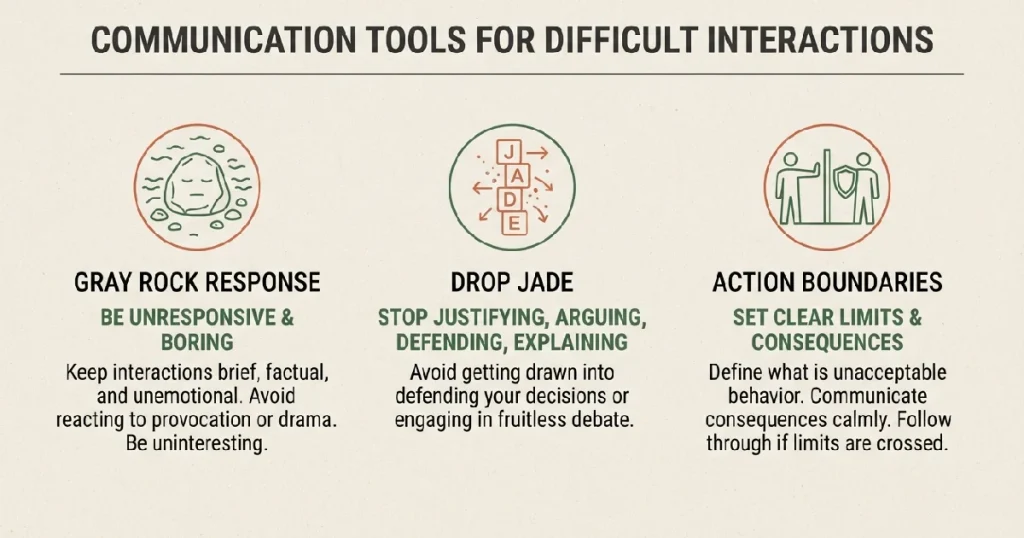
When you are dealing with difficult personalities in your family or at work, walking away completely is not always possible right away. Here are three grounded steps you can start using this week.
1. Use the Gray Rock Response
If you have to interact with someone who thrives on drama, make yourself as boring as an unpainted rock. High-conflict people look for emotional reactions to feed on; stop giving them a show.
- Keep your voice flat, calm, and neutral.
- Stick strictly to basic facts: “The report is on your desk,” or “I will pick up the kids at five.”
- Do not share personal news, goals, or worries that they could turn into ammunition later.
2. Drop the JADE Habit
When you decide to say no, stop explaining your reasons. JADE stands for Justify, Argue, Defend, and Explain. Every reason you give them is simply another handhold they can grab onto to pull you into an argument.
- Instead of: “I can’t come over Saturday because I have so much laundry, I didn’t sleep well, and I really need to rest…”
- Try this: “I’m not available this Saturday. Thanks for thinking of me.”
- If they push and ask why, use a calm broken-record line: “That day just does not work for me.”
3. Build Action-Based Boundaries
A boundary is not a rule you place on someone else; it is an action plan for what you will do to protect yourself. You cannot control what they say, but you can control what you stick around to listen to.
- Clear script: “If you continue to raise your voice during this conversation, I am going to hang up the phone, and we can try again tomorrow.”
- If they keep yelling, do not argue about why they yelled. Simply hang up the phone.
- Your boundary only exists when you follow through on your own action.
Frequently Asked Questions
Can a person have toxic traits without realizing it?
Yes, many people repeat unhealthy habits learned in childhood without conscious malice. However, a lack of bad intent does not mean their behavior causes less harm, and you are not required to tolerate mistreatment while they figure things out.
How do I know if I am the toxic one in the relationship?
The fact that you are honestly asking yourself this question is usually a clear sign that you are not chronically toxic. Truly manipulative people spend their energy blaming everyone else, whereas people who care about others actively reflect on their faults and try to change.
What should I do if the toxic person is a parent or close family member?
Focus on setting clear, practical boundaries rather than trying to change their core personality. Limiting the length of your visits, keeping conversations focused on neutral topics, and stepping away when lines are crossed will protect your energy while preserving necessary contact.
Finding Your Ground Again
Dealing with these patterns can leave you feeling drained, confused, and unsure of your own instincts. But now that you can see these maneuvers clearly, you do not need their permission to step off the emotional roller coaster.
You don’t need a formal label or an admission of guilt from someone else to decide you have had enough. Your comfort, your dignity, and your peace of mind are reason enough to step back.
Boundaries are simply the distance at which you can respect yourself and let others be who they choose to be.
My Closing Remarks
Sitting with clients over the years has taught me that the hardest part of letting go of bad relationships is giving up the wish that the other person will finally understand your pain. It hurts when someone you care about cannot offer basic safety. Give yourself credit for how hard you tried. You are allowed to stop working overtime to maintain relationships that only drain you.
More Related Stories for You
Explore our detailed guide on understanding core personality traits and emotional patterns to build healthier dynamics in your life.
About The Author