David Wall

Two people can stare at the same spreadsheet and want opposite retirement dates. What is the fight really about?
Key Takeaways
- The retirement planning couples checklist most people use skips the number that decides everything: the survivor’s monthly check.
- Retiring in the same month can backfire, since the risky stretch is a temporary mismatch window most couples never schedule.
- Two private allowances and one written spending rule prevent more late-night fights than any portfolio tweak.
Quick answer: Retirement planning for couples works when both partners settle three things: exit dates with a defined overlap, a Social Security claiming age chosen to protect the survivor, and private spending money nobody audits. Money fights usually start when one partner plans alone and presents the result as a decision.
Contents
Table of Contents
Renée had the spreadsheet open at 11 p.m. Tom was already in bed. She wanted 62. He wanted 67, and every version of her plan turned his number into a delay she resented. (Names and details are composites from my practice.)
Neither of them was stubborn about arithmetic. She was buying time, he was buying safety, and neither had said that part out loud.
Gottman’s research found 69% of relationship conflict is perpetual, rooted in personality rather than fixable facts (Gottman & Silver, 1999). A saver marries someone who spends to feel alive, then they try to settle it with a calculator.
Here are the seven decisions I walk couples through, with scripts and current numbers.
Two retirements, one plan: should married couples retire together?
Secret 1: Write an ordinary Tuesday before you pick a date
Couples argue about the year because a year is abstract. Describe a plain Tuesday in your first retired year: 10 a.m., 2 p.m., 8 p.m.
Renée’s Tuesday had a garden, a gym class, and lunch with her sister. Tom’s had her in every line. That page told them more than three months of budget talks: she wanted room, he wanted company.
Aim for two shared anchors a day (coffee, dinner) with separate blocks between. Write that alone-together ratio down and negotiate it like any other number.
Secret 2: Give the mismatch window an end date
Retiring together sounds romantic and often works poorly. Most couples retirement plans assume one finish line, yet two people rarely hit their number in the same month.
Moen, Kim, and Hofmeister (2001) found the transition itself dented marital quality for both spouses, with the highest conflict among people who retired while their partner still worked. Being retired more than two years improved marital quality.
The risky stretch is the gap, and a gap can be scheduled. Twelve to twenty-four months with a review date beats “I’ll know when I know.”
| Exit pattern | Where it shines | Where it strains | Guardrail to set first |
|---|---|---|---|
| Same-month exit | Shared rhythm, one celebration | Two work identities vanish at once, no paycheck for either | Stagger claiming dates even if the last workday matches |
| Relay, 12 to 24 months apart | One paycheck and one health policy stay live | The working spouse feels like the only adult | Name tasks the retiree owns outright, not “helps with” |
| Open-ended gap | Room to adapt if health or work changes | No end date breeds quiet scorekeeping | Put a dated review on the shared calendar |
One wrinkle: a spouse who claims at 62 while working part-time hits the earnings test. For 2026, Social Security withholds $1 for every $2 earned above $24,480 if you stay under full retirement age all year.
The money decisions that outlive both of you

Secret 3: Price Social Security as survivor insurance
Retirement planning for married couples turns on one asymmetry: a claiming age looks like a bet on your own lifespan, while it sets the survivor’s floor.
At a full retirement age of 67, claiming at 62 pays 70% of your full benefit; waiting to 70 pays 124%. On a $3,000 benefit, that is $2,100 versus $3,720 monthly.
The survivor keeps the larger of the two checks, delayed credits included. The higher earner’s delay therefore protects whoever lives longer, usually the wife.
Social Security’s January 2026 averages show the drop: $3,208 for an aged couple both receiving benefits, $1,919 for an aged widow or widower alone. Roughly 40% less income, same property tax bill.
Secret 4: Give each other money nobody audits
Retirement strips out the last private dollar. Every purchase lands on one shared statement, and a 68-year-old ends up explaining a $40 hobby part.
Split the annual withdrawal three ways: ours, his, hers. Fund the two private pockets equally even if the old paychecks were unequal, since the income is joint now.
Five percent each is a workable start on a $60,000 withdrawal: $3,000 apiece, no receipts, no commentary.
Stress-test the plan against three endings nobody schedules
Most plans assume one future: both of you alive, healthy, and married. Three others deserve a page each.
| Shock | What changes on paper | Decide while you are both fine |
|---|---|---|
| One of you dies first | One Social Security check, single brackets, Medicare income thresholds halved | Which pension survivor option you elect, which account the survivor taps first |
| One of you needs long care | Medicare pays for skilled rehab, not years of custodial help | Buy coverage, ring-fence one account, or write down the family plan |
| One of you leaves | Two households, one set of old bills | Both names on accounts, both logins working, both able to read statements |
Secret 5: Run the survivor’s tax math now
The survivor projection is the step retirement planning couples postpone the longest. When a spouse dies, the survivor keeps the bigger check and files as single.
The 2026 Medicare surcharge (IRMAA) threshold drops from $218,000 on a joint return to $109,000 for a single filer, with standard Part B at $202.90 a month before surcharges. Medicare reads income from two years back, so a Roth conversion you both approved at 63 can raise a widowed spouse’s premium at 65.
Run one projection with one of you gone. If it breaks, the repairs are cheap today: more Roth dollars, a survivor-friendly pension election, or a mortgage cleared before the second exit.
Care needs deserve a trigger line too. Many long-term-care policies pay once someone needs help with two of six daily activities, so name the account you would drain first.
Secret 6: Write the spending rule before the bad year
Guardrails are the part of retirement planning couples skip, because trimming feels like failure. Decide the trim while markets are calm.
One workable version: hold two years of essential bills in cash and short bonds. If the portfolio finishes a year 20% below plan, discretionary spending drops 10% until it recovers; 20% above plan, add 10%.
Name who calls the meeting. The partner tracking balances spots trouble first, so give the other one veto power over which line item gets cut.
The retirement planning equipment for couples that earns its keep
Software cannot settle a timing disagreement.
Secret 7: The retirement planning couples checklist, with the trap in each tool
| Tool | What it does | Failure mode to avoid |
|---|---|---|
| Two my Social Security accounts | Earnings history plus estimates at 62, 67, and 70 | Estimates assume today’s salary continues until you claim, flattering an early exit |
| One shared balance sheet | Every account, debt, and premium on one page | One owner. If only one of you can open the file, the plan has one point of failure |
| A tax and withdrawal projector (Boldin, ProjectionLab, or planner software) | Tests withdrawal order, Roth conversions, survivor cases | One success score with no spending flexibility built in |
| Free simulators (FIRECalc, cFIREsim) | Runs your plan through past crashes | Short horizons. An eight-year age gap means planning to the younger spouse’s 95th birthday |
| A beneficiary and access audit | Beneficiaries, power of attorney, health proxy, password-manager emergency access | Forms override a will. An ex-spouse still listed on an IRA usually wins |
Here is the collision almost nobody maps. The years between your last paycheck and Medicare are your cheapest Roth conversion years, and a health insurance subsidy can vanish in those years if reported income rises. Required distributions start at 73, or 75 for anyone born in 1960 or later.
Sketch that timeline on one page with both birth years, since spouses rarely share the same windows.
Retirement planning equipment for newlyweds: the 45-minute starter kit
Newlyweds need four things finished before the honeymoon photos get framed:
- Beneficiary forms on both retirement accounts, primary and contingent.
- Both Social Security statements pulled, so each of you sees the survivor math while it is cheap to change.
- One automatic contribution with an escalation rule: take the full match, then add one percentage point per raise. The 2026 limits are $24,500 for a 401(k) and $7,500 for an IRA, and a non-earning spouse can fund a spousal IRA from the other’s income.
- A standing money date plus a check-first dollar amount you both chose.
Practical next steps: four moves for this week
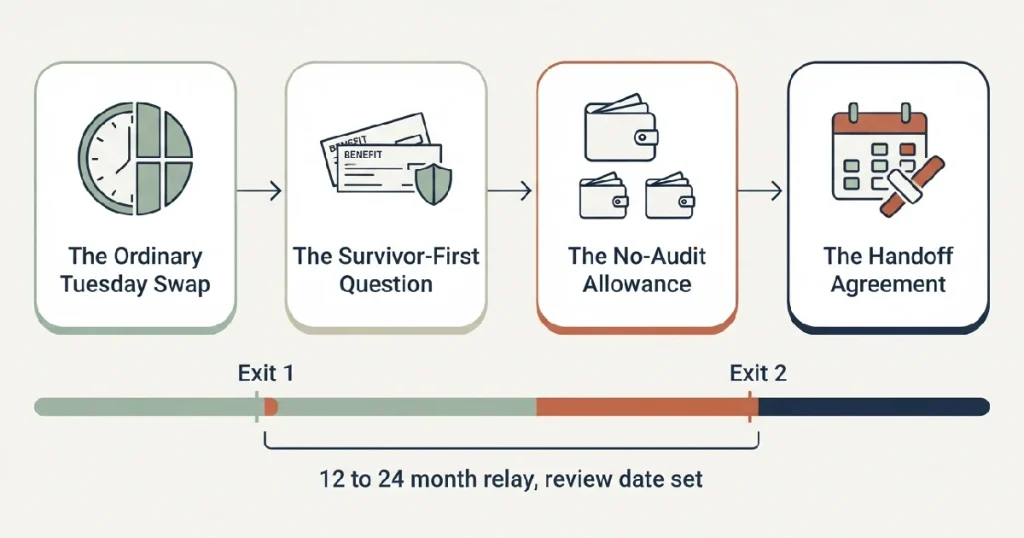
1. The Ordinary Tuesday Swap. Trade pages before you debate a year: “Can I read you my plain Tuesday? Ten in the morning, two in the afternoon, eight at night. Then you read me yours.” Circle overlaps and collisions.
2. The Survivor-First Question. Ask the higher earner: “If I go first, what does your monthly check look like? I want to price my claiming age as insurance for you.” Pull both estimates at 62, 67, and 70, then write the survivor’s number on the page.
3. The No-Audit Allowance. Try: “I want each of us to have money the other never questions. What number makes you feel like an adult and still keeps us safe?” Start equal, revisit in 90 days.
4. The Handoff Agreement. For the partner leaving first: “While I’m home and you’re still working, I’ll own dinners, the pharmacy runs, and the insurance calls. Let’s pick a date to review how it feels.” That date belongs in the shared calendar.
Frequently Asked Questions
Should married couples retire together?
Not necessarily. Friction shows up in an open-ended gap where one spouse is retired and the other still works, so give that window a set length and a review date. Two shared anchors a day protect closeness without erasing independence.
My spouse says “two more years” every year. What now?
Ask which number or condition would make stopping feel safe, then plan toward it. Open-ended delays usually point at an unnamed fear, often health coverage or identity, and naming it moves things.
How much do we need to retire as a couple?
Start from last year’s real spending, subtract work costs, then add health premiums and the travel you actually want. Plan a flexible first withdrawal near 3.5% to 4% with a written trim rule.
Renée and Tom never agreed on one retirement year. They agreed on a Tuesday: her garden mornings, his solo bike rides, coffee and dinner together, plus a 20-month relay with a review date on the calendar.
He delayed claiming to 70 after they ran the survivor’s number out loud. She stopped reading his 67 as a rejection.
You can hold a shared future without matching dates. What you need is a plan that survives one of you being wrong, one of you being sick, and one of you being alone.
The strongest retirement plan is the one you can each explain without the other in the room.
My Closing Remarks
My lane is the relationship side, and I still ask for the numbers, because that is where the feelings hide. Take the survivor math to a fee-only fiduciary or a tax pro before you act on it. Then have the Tuesday talk yourselves. No professional can tell you what a good ordinary day looks like, and that day is what you are buying.
More Related Stories for You
If private allowances sound great on paper and impossible in practice, start with the mechanics: our guide to a budget for couples that retires the money-warden dynamic covers proportional contributions and guilt-free spending.
About The Author