Sara Carmen

Why does silence from someone you barely knew hurt more than a breakup, and how do you heal without their explanation?
Key Takeaways
- Ghosting in dating hurts most because your brain treats an unexplained exit as an open file, and self-blame is its favorite way to close it.
- In a January 2025 survey, half of singles admitted they had ghosted someone too, mostly over lost interest rather than any fatal flaw.
- You can build closure yourself with a 20-minute evidence audit, one dignified message, and a filter that reads calendars instead of chemistry.
Quick answer: Ghosting in dating is when a romantic connection ends through sudden, unexplained silence instead of a conversation. It usually signals the ghoster’s conflict avoidance or fading interest, not a defect in you. Healing starts when you stop waiting for their explanation and close the loop yourself.
Contents
Table of Contents
The last message in the thread is yours. Sent Tuesday at 9:14 p.m., something warm and easy. Delivered, read, then three days of nothing. By Friday you have reread the conversation eleven times, hunting for the exact sentence where you supposedly ruined everything.
Most of us have been there, staring at a read receipt like it owes us money. The unspoken tension underneath sounds like this: “If I can figure out what I did wrong, I can make sure this never happens again.”
Psychologists call the first half rumination and the second half a control bargain. Both run on the same fuel: ambiguity. Your mind snags on unfinished business, a quirk called the Zeigarnik effect. An unanswered goodbye is the most unfinished business dating can make.
The seven tips below treat ghosting in dating as a solvable ambiguity problem: three reframes that change what the silence means, and four tools that close the loop without a single reply from them.
Why Ghosting In Dating Hurts More Than a Clean “No”
A straight rejection stings, then scabs over. Silence never gets to scab. The ghosting psychology behind that gap starts in the brain’s alarm wiring.
In a landmark 2003 fMRI study, Eisenberger, Lieberman, and Williams found that ostracism lit up the anterior cingulate cortex. That region also processes the distress of physical pain. Being dropped genuinely hurts, so retire the shame about how much it hurts.
A clean “no” at least hands you a story with an ending. Ghosting hands you a missing person. Researcher Pauline Boss named this ambiguous loss: a loss without proof or closure. Her work shows these losses are harder to process than clear endings, because the mind keeps trying to solve them.
Here is the part most advice skips. Self-blame is a control strategy in disguise. “I talked too much on date two” is agonizing, yet it offers a fix: talk less. “They are avoidant with conflict” offers nothing to fix, so your brain keeps shopping for a version where you hold the steering wheel.
The trade-off is brutal: you buy a feeling of control with your self-respect, and the receipt never stops printing.
Tip 1: Name the loop before it names you

One place to begin is a two-line interrupt for when the replay starts. Say it quietly or in your head: “This is ambiguity pain, not a character verdict. My brain is trying to finish a file they abandoned.”
Naming a feeling engages the brain’s calming circuits instead of its alarm system. Researchers call this affect labeling.
What Dating App Ghosting Says About the Ghoster
Start with the numbers. A January 2025 NumberBarn survey polled 1,510 adults in the 30 largest U.S. metro areas. Among singles, 75% said they had been ghosted by someone they were dating or talking to on an app.
The same survey found 50% of singles admitted ghosting someone themselves. The person who vanished on you has likely been vanished on, too.
Ask ghosters why they did it and the verdict on your worth gets even quieter. The top dating reason, cited by 54%, was simply losing interest. Another 28% named a dealbreaker, and 9% cited personal stress or feeling overwhelmed.
Read that middle number closely. A dealbreaker is a verdict about fit between two specific people. Think of a job rejection from a company that wanted a different profile. It convicts nobody of being unlovable.
Dating app ghosting also carries almost no social cost. You share no friends, no coworker, no cousin who would hear about it, and the unmatch button deletes the evidence. Weak ties plus zero accountability form a design recipe for disappearing. Getting ghosted on Tinder mid-conversation says more about the medium than your message.
The hardest zone is being ghosted after 3 dates. One unanswered opener is a shrug. Three good dates build real attachment. Attachment theory, rooted in Bowlby’s work, predicts protest behavior when a bond figure goes silent.
Anyone with an anxious attachment streak knows the symptoms: checking, drafting, bargaining. You had enough history to bond and no defined commitment to point to. That mismatch explains the intensity. Neediness has nothing to do with it.
Use this decoder before you decide what the silence means:
| What happened | What it most likely signals | Your best move |
|---|---|---|
| Match vanishes mid-chat | App fatigue, low investment, or a deleted profile | Nothing to send; the unmatch already spoke |
| Quiet fade after 1-2 dates | An early mismatch they lacked the nerve to name | One optional check-in, then let it rest |
| Ghosted after 3 dates or more | Enough history that you deserve one direct ask | Send the one-message door (below), then stop |
| They resurface weeks later (breadcrumbing) | Boredom or option-keeping, rarely renewed intent | Judge any comeback by kept plans, never by 11 p.m. texts |
Tip 2: Run the two-list sort
Take five minutes and write two lists. List one: everything you actually observed about how this person handles discomfort (canceled plans, slow replies after tension, jokes instead of answers). List two: every accusation you have aimed at yourself this week.
Notice that list one is built from observations while list two is built from guesses. Consider testing a swap: for each self-accusation, ask what in list one could explain the same silence.
The Rumination Trap: Why Re-Reading the Chat Keeps You Stuck
Most advice about dating and ghosting says “stay busy.” It fails because replaying the thread does not feel like wallowing; it feels like investigating. The late psychologist Susan Nolen-Hoeksema spent decades studying rumination. Her finding: this kind of replay weakens problem-solving while posing as it.
That is rehearsal dressed up as insight.
There is a second trap underneath. If their texting ran hot and cold, you were on a variable reward schedule. That intermittent reinforcement is what makes slot machines the stickiest game in the casino. Unpredictable rewards train checking habits much faster than steady ones.
That is why the inconsistent person is harder to release than the consistently kind one, and why “they were so into me sometimes” keeps the hook set.
At 1 a.m. this turns into searches like “ghostsingles,” hoping a forum of the equally confused holds the missing answer. Reading other people’s ghosting stories gives a ten-minute relief bump, then the loop restarts with fresh material.
Tip 3: The 20-minute evidence audit
Set a timer for 20 minutes and draw two columns: Facts and Stories. Facts are things a neutral friend could verify (“He rescheduled once and came”). Stories are verdicts (“He was already pulling away that night”). Sort every memory that stings, and notice how thin the facts column runs.
Then archive the chat and mute the thread. A common pitfall: checking their Instagram reopens the file. If you catch yourself heading there, close the app and jot the urge down instead. The audit works once; running it nightly turns it into rumination with a spreadsheet.
What to Do Next: Four Tools That Build Closure Without a Reply
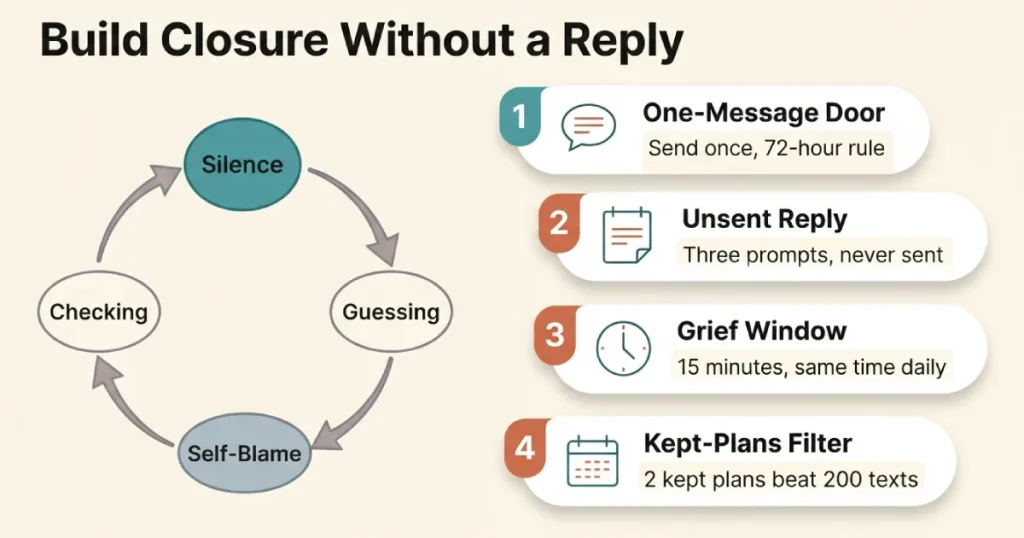
Reframes change the verdict. Tools change the nervous system. These four are small on purpose, because grief shrinks your available bandwidth.
Tip 4: The one-message door
If the uncertainty is costing you sleep, consider sending one clear, warm message, once:
“Hey, I’ve enjoyed getting to know you. If you’re not feeling it, no hard feelings, I’d just rather know than guess. Wishing you well either way.”
The rules make it work. Send it in daylight, when you would be calm reading any reply. Give it 72 hours, then treat silence as the answer and let no contact stand.
If they already unmatched or blocked you, skip the door entirely; that action was the message. If you catch yourself drafting a second one, the request has become a negotiation. You cannot negotiate someone into wanting you.
Tip 5: The unsent reply
Open a notes file and write the message you will never send, using three prompts: What I thought this was. What actually happened. What I am taking with me.
James Pennebaker pioneered expressive writing research decades ago. His findings suggest that turning a messy experience into structured language loosens its grip. Close the note when you finish.
If the urge to send it shows up later, reread the third prompt. That part is addressed to your future, and it was never theirs to read.
Tip 6: The 15-minute grief window
Pick a daily slot, say 6:30 p.m., and set a timer for 15 minutes. That is your appointment with the loss: replay, cry, reread the audit, whatever shows up.
When the thought ambushes you at 11 p.m., jot one line (“midnight, replaying date two”) and tell it, “You have an appointment tomorrow at 6:30.” This borrows worry postponement from cognitive behavioral therapy. The loop feeds on urgency, and scheduling strips it out.
Expect the strange part: chosen rumination gets boring fast, and windows often end early.
Tip 7: The kept-plans filter
For the next person, run a quiet three-week test: count kept plans against warm words. Two follow-throughs outweigh two hundred good-morning texts. Effort that costs calendar space is the honest currency of interest.
It is the same rhythm that makes low-key at-home date nights sustain long marriages: showing up, repeatedly, on purpose. If someone’s consistency only exists inside your phone, you have your answer before date four.
Frequently Asked Questions
How many days of silence counts as ghosting?
In the NumberBarn survey, respondents most often called it ghosting after about three unanswered attempts. A workable line: 72 hours of out-of-character silence after real dates, with one direct check-in left unanswered.
Should I text them one last time or let it go?
One kind, clear message is reasonable if the guessing is wrecking your sleep. Send it once, then treat any silence past three days as a full reply.
Why does it hit hardest at night?
Evenings remove distraction, and idle time is rumination’s favorite fuel. A scheduled daytime grief window gives the thoughts an appointment, so they stop ambushing you at midnight.
Back to Tuesday, 9:14 p.m.
The thread still ends with your message. That part never changes. What changes is who writes the ending. The silence is now data about their exit style, and your next move belongs to a calendar instead of a read receipt.
The file closes when you stop submitting evidence to a jury that left the building.
Closure was never theirs to give you; it is yours to build.
My Closing Remarks
If we were sharing a coffee table right now, I would skip the theories about why they left and hand you a napkin with one line on it: an explanation was never the price of your peace. Be patient with the nights that still sting. Keep the grief window honest, keep the audit closed, and let the next person earn you in daylight, one kept plan at a time.
More Related Stories for You
Curious what the opposite of a slow fade looks like? See the quiet signs he is getting ready to propose, where consistency, future plans, and follow-through replace the guessing game entirely.
About The Author