Sara Carmen

Feeling alone in your own home? Here is what is really happening behind closed doors and how to protect your peace.
Key Takeaways
- Being married to a narcissist often feels less like conflict and more like a slow, quiet erasure of who you used to be.
- The most damaging narcissistic traits rarely look like arrogance. They look like silence, sulking, and subtle sabotage.
- You can stop the spiral without a single argument, once you understand the four rules that protect your nervous system and your identity.
Quick Answer: Being married to a narcissist means living with a spouse who consistently prioritizes their own ego, comfort, and image over your emotional reality, often through manipulation, blame-shifting, or emotional withdrawal. The relationship typically leaves the non-narcissistic partner feeling confused, exhausted, and responsible for problems that were never theirs to fix.
Contents
Table of Contents
The Quiet Erosion Nobody Warns You About
We get married expecting a partner. Somewhere along the way, you started feeling like a roommate who’s also responsible for everyone’s emotional temperature. You’re technically not single, but you’re managing this marriage alone.
If you’ve typed “I am married to a narcissist” into a search bar at 2am, you already know the specific exhaustion this creates. It’s not dramatic fights you’re recovering from. It’s the slow fog of second-guessing your own memory, your own reactions, your own worth.
That fog has a name. Psychologists call it cognitive erosion, and it happens gradually, through thousands of small moments where your reality gets quietly overwritten.
This piece isn’t here to diagnose your spouse. It’s here to help you recognize the pattern, protect your mind, and make decisions from clarity instead of exhaustion.
Truth 1: It’s Rarely the Loud, Flashy Narcissist You Expect

Beyond the Stereotype
Most people picture a narcissist as someone who brags at parties and demands attention in every room. That version exists, but it’s not the one doing the most damage in quiet households.
The American Psychological Association notes that narcissistic traits exist on a spectrum, and the clinical indicators of personality pathology include not just grandiosity, but fragile self-esteem masked by withdrawal and defensiveness. Covert narcissism hides behind humility, martyrdom, and a constant undertone of being wronged.
You don’t get a villain monologue. You get silence at dinner because you forgot to mention their work project to a friend.
The Fragile Victim Play
Covert partners often use illness, fatigue, or emotional collapse as a control mechanism. The headache that appears right before a difficult conversation. The sudden exhaustion when it’s their turn to handle the kids.
The Gottman Institute has spent decades researching relationship breakdown, and their research on stonewalling and persistent emotional detachment shows how withdrawal functions as a form of control, not just avoidance. When one partner checks out emotionally during conflict, the other is left to manage the entire emotional atmosphere of the home alone.
Being married to a covert narcissist often means you’re the one who ends every disagreement apologizing, even when you walked in holding a legitimate concern.
What This Looks Like If You’re Married to a Narcissist Man
The pattern often shows up as weaponized incompetence. He “can’t” figure out the dishwasher, the pediatrician’s number, or the school pickup schedule, so it quietly becomes entirely your job.
Watch for subtle dismissals too. A promotion gets a flat “that’s good” instead of excitement, delivered just enough to avoid conflict while still draining the moment of joy.
Truth 2: Why You Feel Crazy (The Mechanics of Cognitive Erosion)
DARVO in Real Time
You bring up something that hurt you. Within two minutes, somehow you’re the one apologizing.
This has a mechanism behind it, and it’s called DARVO: Deny, Attack, Reverse Victim and Offender. You say, “It hurt when you ignored me in front of your family.” They respond, “I can’t believe you’d accuse me of that, after everything I do for this family, you’re always looking for something to complain about.”
Notice what happened. Your original concern disappeared, and now you’re managing their hurt feelings instead.
If you want to understand how this fits into a larger pattern, understanding the full cycle of narcissistic abuse shows how DARVO is rarely a one-time reaction. It’s a repeated loop that trains you to stop raising concerns at all.
Somatic Symptoms of Living on High Alert
This isn’t only psychological. Chronic conflict without resolution keeps your nervous system in a state researchers describe as fight-or-flight activation, and your body pays the bill.
Brain fog, digestive issues, tension headaches, and unexplained fatigue are common in people living in high-conflict households. Your body isn’t betraying you. It’s responding accurately to an environment that never fully feels safe.
The screenshots you take, the mental timeline you keep, the recordings you save, those aren’t signs of instability. They’re a nervous system trying to protect itself after its reality has been challenged one too many times.
Truth 3: Why Traditional Marriage Therapy Often Fails
Couples therapy assumes two people acting in good faith, both willing to be vulnerable and accountable. That assumption breaks down fast with a narcissistic spouse in the room.
A manipulative partner often treats the therapy session as a stage. They can be charming, self-aware, even tearful, performing insight they won’t carry home.
Weaponized Therapy Speak
Here’s where it gets disorienting. If you’ve been married to a narcissist husband who’s picked up therapy language, you may hear your own boundaries used against you.
“You’re the one being toxic right now.” “I think you’re projecting your narcissism onto me.” The very words meant to protect you get turned into new tools of confusion.
This is why many trauma specialists now recommend solo, trauma-informed therapy focused specifically on coercive control and narcissistic abuse recovery, rather than joint sessions that can become another arena for manipulation.
Truth 4: The 4 Non-Negotiable Daily Rules for Self-Preservation
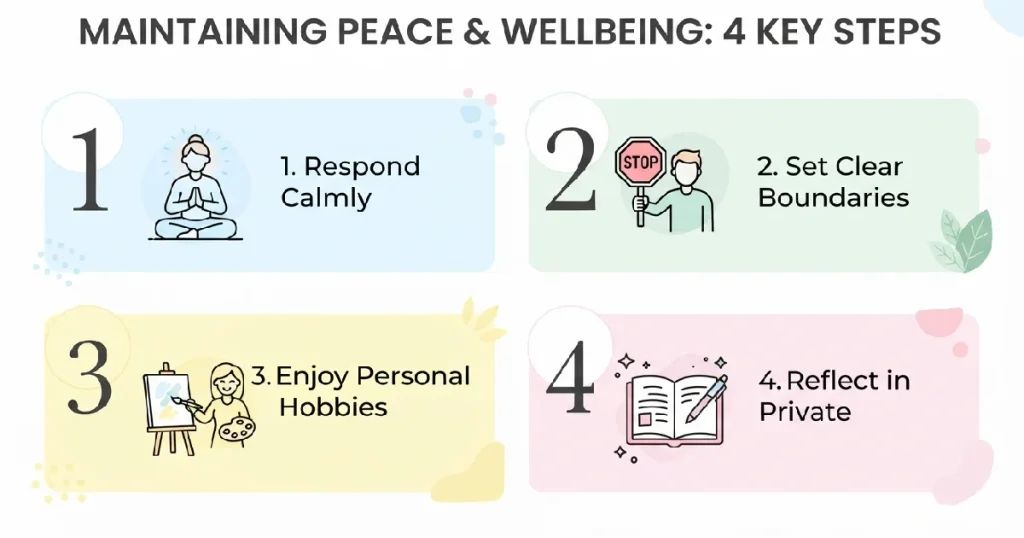
You can’t change your spouse’s patterns. You can change how much of your energy those patterns are allowed to consume.
Rule 1: Starve the Feedback Loop. Narcissistic behavior often escalates because big emotional reactions function as fuel. Try responding with flat, neutral statements like “Okay, noted” instead of defending yourself. Low supply, over time, reduces the payoff for provoking you.
Rule 2: Stop Explaining Your Boundaries. This is sometimes called the No-JADE approach: no Justifying, Arguing, Defending, or Explaining. A boundary is a statement about your own future action, not a request for permission. Try: “I won’t be continuing this conversation while voices are raised,” then simply leave the room.
Rule 3: Build a Parallel Identity. Keep one hobby, one friendship, one goal that exists entirely outside your spouse’s awareness or approval. This isn’t about hiding things. It’s about rebuilding the sense of self that erosion has been quietly chipping away.
Rule 4: Create a Reality Anchor. Keep a private, encrypted log of what actually happened after disputes, written while the memory is fresh. This single habit is one of the most effective tools for navigating marriage and narcissism dynamics without losing your grip on your own perception.
Truth 5: Choosing Between Parallel Coexistence and Departure
There is no universally correct choice here, only the one that fits your current reality.
If you’re staying: Success means releasing the expectation of emotional reciprocity. You separate finances where possible, document parenting agreements in writing, and build a support system outside the marriage.
If you’re leaving: Expect the post-separation phase to still be high-conflict. Secure bank statements, tax filings, and identification documents quietly, before any conversation about divorce begins.
The National Domestic Violence Hotline offers guidance on recognizing patterns of psychological and emotional coercion, which is worth reviewing even if your situation feels “not bad enough” to qualify. Emotional abuse rarely announces itself with that label.
Frequently Asked Questions
What does being married to a covert narcissist look like day-to-day?
Being married to a covert narcissist feels like living with a perpetual, resentful martyr. Instead of boasting, they manipulate through passive-aggressive digs, prolonged silent treatments, and subtle guilt trips, leaving you to carry most marital burdens while walking on eggshells.
Why does being married to a narcissist make you feel like you are losing your mind?
Systematic gaslighting dismantles your confidence in your own memory and perception. When a spouse denies your reality with total certainty, your brain experiences real cognitive dissonance, which over time produces chronic hypervigilance and self-doubt.
Can a marriage to a narcissist survive without therapy?
It can survive only if you let go of expecting emotional reciprocity, intimacy, or empathy as regular features of the relationship. Survival depends on firm personal boundaries and independent social and financial life, more than on joint counseling.
You Already Know More Than You Did an Hour Ago
Remember that 2am search, the one that led you here. You weren’t losing your mind. You were noticing patterns that have names, mechanisms, and solutions.
Being married to a narcissist doesn’t mean your intuition failed you. It means your intuition has been working overtime, quietly, for longer than you realized.
Your clarity was never the problem. It was the thing they needed you to doubt.
My Closing Remarks
I’ve sat across from so many people who apologized for “overreacting” before they even told me what happened. If that’s you, take a breath. You’re not fragile, you’re just finally paying attention.
Healing starts the moment you stop auditing your own reactions and start trusting them again. You get to have that back.
More Related Stories for You
If you want to go deeper into recognizing the full pattern, read Narcissistic Personality Traits: What They Look Like Up Close.
About The Author