Nicole Adkins

Not another “just think positive” post. This is the honest map nobody gave you.
Key Takeaways
- Building a genuine positive mind is not about smiling through pain but upgrading how your brain appraises daily stress.
- Your negative mind is simply a risk detector that needs a neutral referee rather than total suppression.
- Simple daily shifts in thoughts and mind habits will create lasting changes in sleep and emotional resilience.
Quick Answer Block
A positive mind is a cognitive appraisal system that evaluates life demands as manageable challenges rather than catastrophic threats. It does not ignore pain or force cheerfulness. Instead it pairs realistic risk detection with solutions so you can recover quickly from stress and make balanced everyday decisions without denial.
Contents
Table of Contents
We have all been there at 2 AM staring at the ceiling. Your brain is running through an awkward talk from three years ago or obsessing over an email you sent at 4 PM. Then that annoying voice whispers that you should just think positive.
It feels like a complete lie. In fact it usually makes you feel worse because now you are angry at yourself for being anxious in the first place.
Most advice about building a positive mind fails because it tells you to wipe out every bad thought. That is not how human biology works at all. Your brain was built to keep you alive in the woods not to sit on a cushion feeling blissful all day.
When you learn how your thoughts and mind actually process hard times everything changes. You stop fighting yourself. You get your energy back and you finally see practical ways to handle daily chaos without pretending everything is fine.
1. Understanding the Negative Mind Changes How You Process Fear
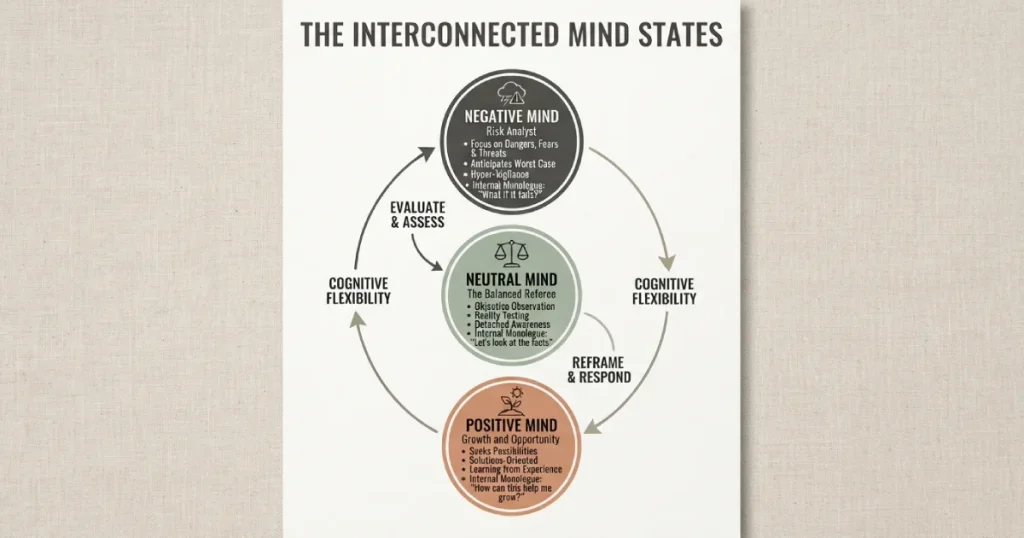
Your negative mind is not broken. It is basicly an internal risk analyst that never clocks out.
From an evolutionary standpoint the mind negative bias kept your ancestors from getting eaten by predators. If they thought the rustling bush was a rabbit and it was a tiger they died. If they guessed tiger and it was a rabbit they lived. So your brain is wired to assume the worst first.
Take Sarah for example. Sarah gets a calendar invite from her manager that simply says “Quick sync tomorrow.” Her brain instantly tells her she is getting fired. Her chest gets tight and she spends her evening feeling sick.
Sarah does not have a broken personality. Her negative mind is just doing its job too loudly. The goal is never to destroy the alarm system. The goal is recognizing that the alarm is just raw data not an absolute fact.
When a scary thought hits you do not try to run away from it. Say to yourself that your brain is just running a routine safety drill. That single shift stops the panic spiral in its tracks.
2. A Positive Mind Is an Appraisal Skill Not a Constant Mood
Real optimism is not walking around with a fake grin while your world falls apart. Clinicians look at how people appraise demands. A 2025 study in Psycho neuroendocrinology showed that positive states of mind and cardiovascular recovery from stress rely directly on challenge appraisal rather than hiding dark feelings.
Challenge appraisal means you look at a mess and say this is hard but I have tools to handle it. Threat appraisal says this will ruin me and I am totally helpless.
Look at Mark who just got passed over for a promotion he wanted badly. A forced positive reaction would be saying this is a blessing in disguise while feeling numb. That is fake and it causes alot of hidden resentment.
Mark using an actual positive mind admits the situation hurts and feels unfair. Then he asks what skills he needs to learn next so he can apply elsewhere. He evaluates the problem instead of letting the problem evaluate his self-worth.
You can train this specific skill by doing the Best Possible Self exercise. Sit down for ten minutes and write about your life five years from now assuming things went as well as realistically possible. Doing this teaches your brain to spot potential opportunities before a crisis hits.
3. How Mindfulness For Positive Thinking Cleans Up Daily Noise
Most people think mindfulness means sitting cross legged untill your thoughts vanish into thin air. That never happens and trying to do it just makes people quit.
True mindfulness creates a tiny pause between feeling a trigger and doing something stupid. A recent clinical study in the journal Emotion confirmed that mindfulness training fosters a positive outlook during acute stress by building acceptance instead of pushing bad thoughts down.
When Sarah gets that vague calendar invite she can use Mindfulness For Positive Thinking to pause. Instead of spiraling into resume updates she sits with the physical sensation in her stomach for ninety seconds. She notices the tight sensation without adding a story to it.
Emotions are chemical flushes that naturally peak and fade within ninety seconds if you stop feeding them stories. Once the body settles her mind and thinking clear up enough to see that her boss probably just needs a file status.
Mindfulness is simply watching your thoughts mind patterns without instantly believing everything they tell you. That tiny bit of breathing room gives you your power back.
4. A Positive Mind Dramatically Improves Sleep Through Realistic Optimism
People spend hundreds of dollars on weighted blankets and tart cherry juice trying to knock themselves out. Yet they still lay wide awake because their thoughts mind chatter refuses to shut off.
The issue is rarely physical tension alone. A 2024 study in Psychology & Health revealed that optimism predicts future sleep quality and quantity far better than generic relaxation habits.
When you go to bed convinced that tomorrow will be an uncontrollable disaster your nervous system stays on high alert. It keeps your cortisol elevated to protect you from imaginary threats. You can not sleep when your body thinks it is sleeping in a war zone.
Optimism settles the nervous system because it trusts your future self to solve future troubles. You do not need absolute certainty that tomorrow will be perfect. You just need to believe you are capable of handling whatever shows up.
Try spending five minutes before bed writing down three things that could go reasonably well tomorrow. It gives your mind negative scanner permission to clock out for the night.
5. Discovering the Neutral Mind Stops You From Polarized Thinking
In ancient yogic psychology and modern dialectical therapy there is a concept called the neutral mind. It is basicly the referee between your defensive fear and your wild hopes.
Your negative mind screams about all the ways you will fail. Your over-excited positive mind says you will definately be a millionaire by next Tuesday. Both of them are exaggerating.
The neutral mind steps right into the middle. It looks at the facts without emotional drama. It says yes this business venture is risky and you might loose some money but you also have savings and good skills so the risk is manageable.
This is the antidote to the toxic positivity culture spreading across the internet. When you force yourself into fake happiness you create a wierd split where your real emotions get shoved into the dark.
Practice holding both truths at the same time using a both-and sentence. Tell yourself it is true that you are terrified of this medical test and it is also true that you are strong enough to sit in the waiting room. That is the neutral mind doing its real work.
6. How Guided Meditation For Positive Thinking Protects You From Other People
Other peoples anxiety is intensely contagious. You can walk into an office or a family dinner feeling fine and leave thirty minutes later feeling like the world is ending just because someone dumped their dread on you.
Using a short Guided Meditation For Positive Thinking helps build an energetic buffer. It is not about imagining floating clouds. It is about practicing the mental boundary between what belongs to you and what belongs to someone else.
Imagine Mark dealing with an uncle at Thanksgiving who talks non-stop about impending economic doom. An untrained mind absorbs that panic like a dry sponge. Mark feels his heart rate jump and starts dreading his own mortgage.
With a grounded mental frame Mark listens and silently reminds himself that this is his uncles risk assessment and not his own reality. He can show basic empathy without adopting the fear as his own truth.
Taking five minutes in the morning to mentally ground yourself in your own values acts like emotional armor. You become far less reactive to whatever chaos walks through your front door.
7. Daily Integration Lasts Longer Than Cheap Affirmation Tricks
Repeating hollow affirmations in the mirror feels silly to most sensible adults because your subconscious knows you are lying. Saying you are rich when your checking account has twelve dollars in it just makes your brain rebel.
Long term cognitive rewiring happens through quiet daily choices not loud slogans. It comes from small habits where you train your mind and thinking to look at situations honestly.
When you drop something on the kitchen floor do you call yourself an idiot or do you just clean it up. How you talk to yourself during minor everyday accidents sets the blueprint for how you will handle massive life crisis later on.
A durable positive mind is built when you actively look for small pieces of progress every single afternoon. You do not need a parade. You just need to notice that you handled a rude cashier with patience or that you finally finished a chore you put off all week.
Those tiny micro-wins prove to your brain that you are reliable. Confidence is just the memory of having succeeded at small hard things over time.
5 Practical Mental Tools You Can Use Today

Rewiring your brain does not require hours of quiet journaling or moving to an ashram. You can test these simple five tools directly inside your busy daily routine.
The 90-Second Physical Pause
When unexpected bad news hits your screen step away immediately. Put your feet flat on the floor and feel your breath move in your belly. Do not send an email or make a phone call untill ninety seconds of pure physical grounding have passed.
The Both-And Script
Whenever you catch your thoughts spiraling into extreme doom stop and use this specific sentence structure out loud:
“It is completely true that this situation is scary and hard right now, and it is also true that I have survived difficult moments before and can take one small step forward.”
The Evening Best Possible Self Check
Keep an old notebook by your bed. Before turning off the lamp write down three realistic things that could go smoothly during your morning routine. This redirects your mind away from scanning for threats while you try to fall asleep.
The Fire Break Phrase
When a friend or coworker starts dumping intense anxiety onto your lap protect your energy by holding this silent phrase in your mind:
“This is their storm to ride, not my debt to pay.”
It lets you remain supportive without letting thier panic run your day.
The Midday Reality Audit
Set an alarm for 1 PM. When it rings ask yourself one honest question: What is the most practical helpful way I can look at my current problem right now. Pick the option that leads toward useful action rather than pure panic.
Frequently Asked Questions
Is having a positive mind just another way of ignoring real problems?
No. Ignoring problems is avoidance or denial which actually makes mental stress worse over time. A healthy positive mind acknowledges pain completely but chooses to focus attention on solutions and resilience rather than giving up.
What should I do when thinking positive feels completely fake?
Drop the positive thoughts entirely and move straight into the neutral mind. Focus strictly on plain observable facts without any emotional labels. That keeps you honest while preventing your negative mind from making up worst-case scenarios.
How many weeks does it take to notice a shift in my thinking habits?
Most people notice their physical stress reactions calming down within two weeks of doing daily appraisal pauses. Deeper changes in sleep quality and general outlook usually become second nature around four to six weeks of steady practice.
Moving Forward With a Clear Head
You do not need to wake up tomorrow as a bubbly motivational speaker who loves every minute of life. That is completely unrealistic and exhausting to maintain.
The real transformation happens when you stop viewing your dark moods as personal failures. Your negative mind is simply trying to keep you safe from harm. Thank it for its input like a cautious accountant and then let your neutral mind make the final executive decision.
When you change how you evaluate reality your whole life begins to feel lighter. You handle setbacks with dignity and you stop wasting precious hours arguing with your own head.
A resilient mind is not built by denying the dark but by trusting your own inner strength to turn on the light.
My Closing Remarks
I spent years thinking something was wrong with me because my mind would jump straight to the worst possible outcome whenever life got chaotic. Once I realized that my brain was just running an outdated survival script the pressure completely lifted. Be gentle with yourself this week. You are learning how to retrain decades of mental habits. Take it one honest breath at a time.
More Related Stories for You
If you want to look deeper into breaking free from old thought habits check out our detailed guide on mindfulness and negative thoughts to keep building your mental toolkit.
About The Author