
 Nicole Adkins

What staying married to someone who can’t really see you actually requires, and how to protect yourself either way.
Key Takeaways
- Narcissism and marriage can look completely normal from the outside while something real quietly dies on the inside.
- Ordinary compromise doesn’t work once narcissism and marriage collide, because every concession just becomes the new minimum.
- You can survive narcissism and marriage, whether you stay or leave, but only once you stop waiting for things to be fair.
Quick Answer: Narcissism and marriage creates an uneven union where one spouse demands constant validation, control, and special status while avoiding real accountability. Genuine give and take gets replaced by image management and repeated boundary violations, turning ordinary marital teamwork into a draining cycle of erosion, defense, and self-doubt for the other partner.
Contents
Table of Contents
Most of us walk into marriage thinking love and enough effort can fix almost anything. You say the vows, buy the house, have the kids, and figure the rest will work itself out over time.
Then one day you’re standing in your own kitchen wondering why eighteen years of trying harder changed absolutely nothing.
If you typed “narcissism and marriage” into a search bar late at night, you already know this feeling. You’re not confused about whether something is wrong anymore. You’re confused about why nothing you do makes it better, whether you’re secretly the problem, and what happens to the mortgage and the kids if you finally admit the truth out loud.
That’s a different kind of pain than ordinary marital friction. Regular couples fight about dishes and in-laws, then repair. Narcissism and marriage doesn’t follow that pattern, because repair requires two people capable of feeling genuinely sorry, and one of you isn’t built that way right now.
This article won’t tell you to communicate better or plan a date night. It’s going to lay out what’s actually happening in your house, then give you real options for staying or leaving with your mind and your money still intact.
The Anatomy of Narcissism in a Marriage: Why Vows Change Nothing
Clinically, narcissistic personality disorder involves a lasting pattern of grandiosity, a deep need for admiration, and a real shortage of empathy, according to standard diagnostic descriptions (Wikipedia, n.d.). That clinical reality is exactly why love, effort, or a wedding ring don’t change the underlying pattern.
The Public Image Contract vs. Private Reality
A lot of narcissism in a marriage lives entirely in public relations. The anniversary post. The perfect holiday card. The compliments at church on a Sunday morning.
Behind the front door, the temperature drops fast. The same person who hugs you at the office party might not speak to you for two days over a parking spot.
Take Rachel and Tom. Everyone at Tom’s job calls him the best husband they know and he brags about Rachel constantly at happy hour. At home, Rachel hasn’t heard a genuine compliment in six years and gets told she’s “too sensitive” the second she brings it up.
This split isn’t bad luck. Research on contempt and marital dissolution from the Gottman Institute shows contempt, not anger, is the single strongest predictor of divorce, and contempt thrives specifically where there’s no audience watching. The real damage isn’t just the coldness, it’s that friends keep telling Rachel how lucky she is, which makes her own eyes and ears start to feel unreliable.
The Marital Double-Bind: Why Compromise Fails
Healthy compromise needs two people capable of empathy. That part gets skipped in most standard marriage advice.
In a normal marriage, agreeing to split laundry fifty-fifty becomes the new normal most weeks. In narcissism and marriage, that same agreement dissolves in two days, and somehow you end up looking unreasonable for mentioning it again.
Say Mark agrees to handle bedtime three nights a week so his wife can get back to her yoga class. By day three he’s “too tired.” By day five he’s reminding her how much he sacrifices for the family, like the deal never happened.
Every concession doesn’t become a stable baseline here, it becomes the new minimum, and the next request starts even lower. That’s why setting a reasonable boundary often triggers more rage than the original problem ever did.
Everyday Destabilizers: How Narcissism Relationships Marriage Dynamics Play Out

Covert Financial Control and Asset Entrapment
Money is where this control gets most practical, and most dangerous.
One spouse might question every twelve dollar grocery run while quietly keeping a separate account stuffed with bonus checks. Joint mortgages, shared pensions, and tax filings become tools of control instead of shared goals.
Linda found out after fourteen years that her husband had been diverting part of his commission into an account she never knew existed. When she asked about retirement savings, he called her “paranoid” and “ungrateful” for everything he’d provided.
This isn’t thriftiness, it’s a tether. Learning how to identify financial coercive control can help you name what’s happening instead of doubting yourself, and the National Domestic Violence Hotline offers detailed guidance on recognizing coercive control and financial abuse in marriage before it gets worse.
Parental Triangulation: Weaponizing the Children
Kids get pulled into this faster than most parents realize. One parent becomes the fun one who never says no, the other becomes the strict one who ruins everything.
Jen’s ten year old started telling her “Dad says you’re always mad,” right after Jen asked him to do his homework. Meanwhile her teenager had quietly become her ex’s emotional confidant, hearing things no kid should carry.
This is the golden child and scapegoat pattern, and it’s rarely accidental.
The common advice to “present a united front” doesn’t work here, because a narcissistic co-parent will use that exact agreement to control every decision later. What actually helps kids is a parent who stays calm, consistent, and honest, becoming their one steady reference point for what’s actually true.
The Couples Therapy Trap
Marriage counseling assumes both people want the same repair. That assumption falls apart fast with narcissism relationships marriage dynamics.
A skilled narcissistic spouse can walk into a therapist’s office, turn on charm like a light switch, and leave forty minutes later having the counselor half convinced you’re the rigid one.
One woman described finally opening up about feeling dismissed for years, only to hear her husband casually call her “the gaslighter” in the very next session, using the exact word she’d brought in to protect herself.
Whatever gets said in that room can get used as ammunition on the car ride home. Individual trauma-informed therapy, focused on your own clarity rather than fixing the marriage, tends to do far less damage and a lot more good.
The Staying vs. Leaving Calculus: Assessing Your Marital Threshold
Radical Acceptance: The Rules of the “Parallel Marriage”
Some people stay. For the kids, the health insurance, the faith, the finances, or honestly because they’re just tired. That’s a real decision, not a weakness.
But staying only works long term if you drop the expectation of real warmth coming back. The parallel marriage means running the household like a business partnership instead of a romance.
Diane, married twenty-two years, decided to stay until her youngest finished high school. She stopped waiting for her husband to notice her efforts and started treating requests like logistics. “Can you pick up the kids Tuesday” instead of “I wish you cared more.”
When coldness hits, the internal script shifts too. Something like, my spouse can’t provide emotional warmth right now, so I’ll handle this as an administrative task, not a personal wound. Diane rebuilt her real emotional life through a weekly hiking group and nightly calls with her sister, using some basic strategies for emotional detachment in marriage to protect her own mind without pretending everything was fine.
The High-Conflict Departure: Exit Audits and Safe Dissolution
For people choosing to leave, timing and discretion matter more than most divorce articles admit.
Before anyone announces anything, it helps to quietly gather five years of tax returns, mortgage documents, bank statements, and account logins. Open a private email your spouse doesn’t know about. Photograph valuables and property records.
Expect one of two reactions once the exit becomes real: a sudden wave of love bombing and promises to change, or a scorched earth campaign to turn friends and family against you. Sometimes both, back to back, in the same week.
A lawyer who specifically understands high-conflict personalities will plan for this instead of getting blindsided by it. The rule worth repeating is simple: never announce an intent to divorce before the legal, financial, and logistical pieces are already quietly in place.
Operational Rules for Daily Survival in a Narcissistic Marriage
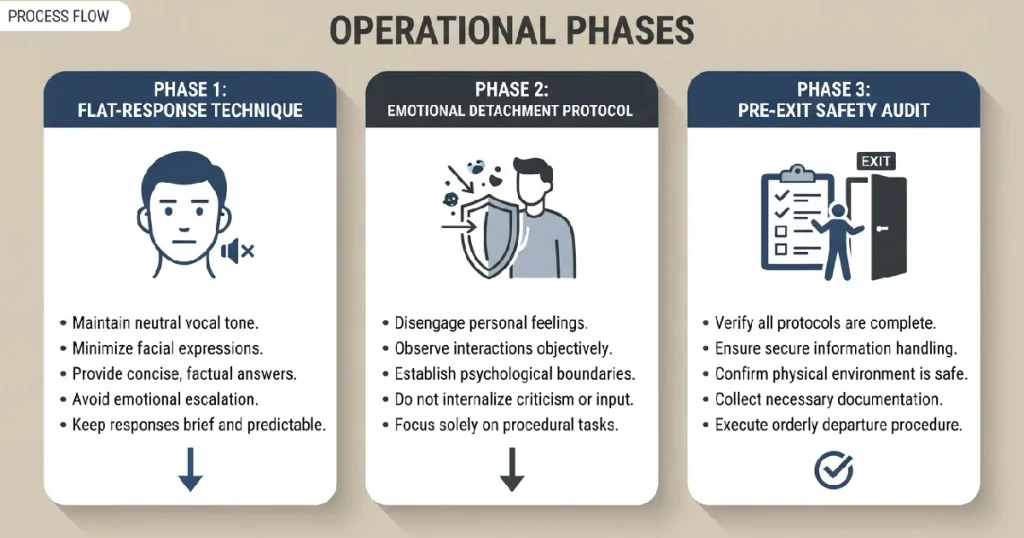
One place to begin is the Flat Response Technique. When a fight gets manufactured out of nothing, skip the defense and try something short and neutral. “You’re entitled to see it that way.” “I hear what you’re saying.” Then walk into another room.
This isn’t about winning, it’s about refusing to hand over the reaction that keeps the cycle going. Expect some pushback at first. When old provocations stop working, the intensity often spikes for a while before it settles, something therapists sometimes call an extinction burst.
Another thing worth testing is building a financial and emotional life that doesn’t run entirely through your spouse. A personal bank account in your own name. One friend group that has nothing to do with the marriage. A hobby that’s entirely yours. None of that is dishonest, it’s basic self-preservation.
A third tool worth trying is a private, timestamped journal kept somewhere your spouse can’t access. Just a few lines after confusing incidents: what was said, what actually happened, how you felt. Gaslighting works by making you doubt your own memory over time, so a written record anchors you to what’s real, independent of whatever story gets told later.
Consider starting small, maybe one flat response a day for a week, before using it in bigger moments. Confidence with this builds slower than people expect, and that’s normal.
Frequently Asked Questions
Can a narcissistic husband actually change for the marriage?
Real change needs sustained insight and accountability, which is rare without years of specialized individual therapy. Most “changes” are short-lived efforts to stop you from leaving. Watch actions over months, not promises made right after a fight.
Is divorcing a narcissist worse than staying?
Divorce can trigger intense, drawn-out conflict because a narcissistic spouse often treats separation as a loss of control, not a loss of love. With real legal and financial preparation beforehand, the short-term difficulty is usually survivable, and long-term wellbeing tends to improve a lot.
How do you co-parent with a narcissist without losing your mind?
Keep communication brief, factual, and documented, often through a parenting app instead of long emotional conversations. Focus on being your children’s steady, honest reference point rather than trying to control the other parent’s behavior.
Reclaiming Autonomy Beyond the Legal Paperwork
Back at the start of this you were standing in that kitchen wondering why years of effort changed nothing. Now you have language for what’s actually been happening, and a map for both staying and leaving with your eyes open.
A marriage license is a legal contract. It was never a clause requiring you to accept ongoing psychological harm in exchange for a shared address.
Staying with clear boundaries and leaving with a plan are both legitimate, adult decisions. What matters most is that you’re the one making it, with full information, instead of just reacting to whatever happens next.
Your mind, your peace, and your sense of self belong to you. That was true before the marriage, and it stays true no matter what your spouse is capable of recognizing.
My Closing Remarks
I’ve sat across from a lot of people working through exactly this, and I want to say it plainly. Noticing this pattern in your own marriage doesn’t make you dramatic or disloyal, it makes you honest. That honesty is hard won and it matters. Whether you stay a while longer or start building your exit, you deserve a plan built on clarity, not guilt. You’re allowed to protect your own mind.
— Nicole
More Related Stories For You
If you’re still untangling what you’re actually dealing with, this breakdown of narcissist meaning in a relationship explains the core traits in plain, practical language.
About The Author