
 David Wall
The real science behind starting a conversation with confidence, minus the rehearsed lines and rejection fear.
Key Points
- Learning how to approach a woman starts with reading the room, not memorizing a pickup line.
- Specific “green light” body language cues can tell you when someone is genuinely open, often before a single word is spoken.
- These 8 real-world strategies work because they lower perceived threat, not because they make you more charming.
Contents
Table of Contents
You’ve seen her from across the room. Your palms get damp. You rehearse an opening line, throw it out, build another one, throw that out too. By the time you’ve gathered the nerve, she’s gone, either out the door or deep in conversation with someone else. You tell yourself you’ll do better next time. You usually don’t.
If that sounds familiar, you’re not broken, awkward, or doomed to swipe forever. You’re experiencing something with a name, a clear mechanism in your brain, and a real fix.
Approaching a woman well has almost nothing to do with confidence or charisma. It’s a skill built on reading social cues correctly, lowering perceived threat, and timing your words right. This piece hands you eight field-tested ways to do exactly that.
Why Approaching a Woman Feels So Much Harder Than It Should
There’s a reason so many men now say they’d rather meet someone in person than face another round of dating app fatigue. Endless swiping without real connection has left a lot of people craving something more organic. Yet the moment an actual opportunity shows up, old fears resurface fast.
In my practice, I hear a version of the same sentence constantly: “I freeze up and the moment just disappears.” That freeze has a name, and it’s called approach anxiety, a spike of social fear tied to initiating contact with someone you’re attracted to.
It’s not a personality flaw. It’s a documented, cross-demographic pattern. A 2022 study on dating anxiety in emerging adults found that fear of rejection and heightened self-consciousness about how one appears to others, sometimes called social physique anxiety, were strong predictors of avoidance in dating situations.
Here’s a useful way to think about it. Approach anxiety works like a hypersensitive smoke detector. It goes off just as loudly for a lit candle as it does for a burning house. Your brain can’t always tell the difference between mild social risk and real danger, so it sounds the same alarm either way.
That alarm doesn’t need to be silenced completely. It needs recalibrating.
Deciphering the Psychology of “Green Light” Signals
Before you say a single word, pay attention to her comfort level in the space around her. Situational awareness, meaning your ability to read the full context of a moment before acting on it, protects both her boundaries and your own ego.
Here are the clearest, research-supported signs someone is open to being approached:
- Sustained or repeated eye contact. A glance that returns more than once is different from a single accidental glance.
- Open posture. Uncrossed arms, a body angled toward the room rather than away from it, relaxed shoulders.
- Smiling at her surroundings. Positive mood signals openness to interaction.
- Removing a barrier. Taking out headphones, closing a laptop, setting down a phone.
These aren’t guesses. A speed-dating study examining nonverbal social cues found that mutual eye contact significantly increased the odds that two strangers rated each other as desirable partners for further conversation. Reading female body language accurately isn’t a mind-reading trick. It’s pattern recognition, and it’s learnable.
Reading these signs of attraction before you approach doesn’t just protect you from rejection. It protects her from an unwanted interruption. That’s not a minor detail. That’s the whole foundation of a respectful approach.
8 Real Strategies for How to Approach a Woman
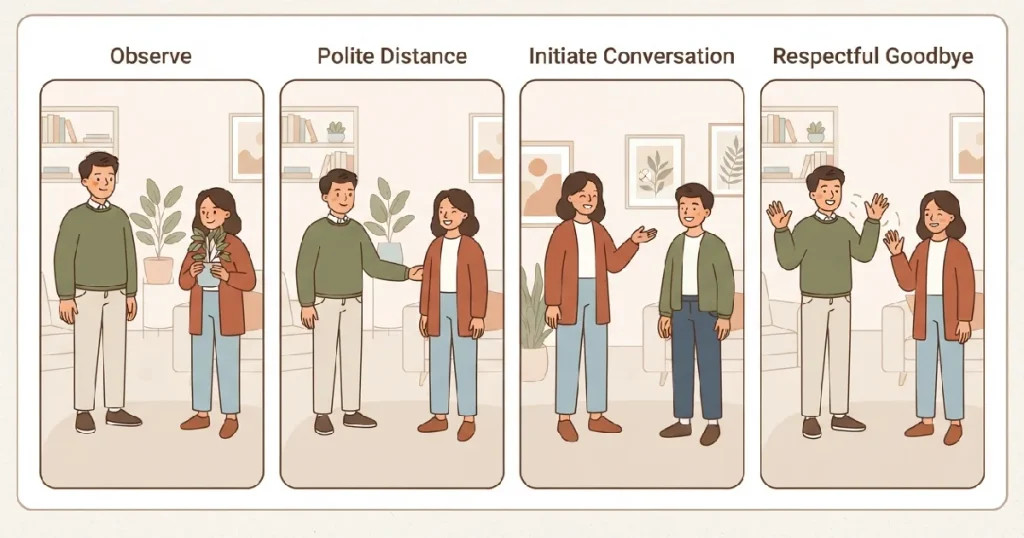
Each of these works because it lowers the emotional stakes of the first ten seconds. None of them depend on being the most confident person in the room.
1. The Contextual Comment
The Move: Skip her appearance entirely. Comment on something you’re both experiencing right now, the noise, the crowd, the chaos of the moment.
Green Light: She’s glancing around, smiling at her surroundings, arms uncrossed.
Try This: “This place is packed today. Is there ever a quiet hour here?” or “I always pick the worst mango in the pile. Any tips?”
Why It Works: It reads as observation, not evaluation. Low pressure means low rejection risk for both of you.
2. The Direct and Polite Compliment
The Move: State your intention honestly, but keep it focused on her style or energy, never her body.
Green Light: Eye contact that lasts more than two seconds, a warm smile, her body turning toward you.
Try This: “I know you’re busy, but I thought your style was really cool. I had to come say hello. I’m Mark.”
Why It Works: Honesty paired with an easy exit (“no worries if not”) removes the ambush feeling many approaches create.
3. The Low-Stakes Favor
The Move: Ask for a small, easily granted piece of help.
Green Light: Relaxed face, open posture, quick willingness to help.
Try This: “Could you keep an eye on my laptop for two minutes while I grab my order?”
Why It Works: This leans on a documented psychological pattern often called the Benjamin Franklin effect, where doing someone a small favor tends to make people feel warmer toward that person, not less.
4. The Shared Activity Ingress
The Move: Approach inside an activity you’re both already doing, a run club, a climbing gym, a cooking class.
Green Light: She mirrors your pace, glances toward your area, or removes one headphone as you pass.
Try This: “Nice send on that route. Did you use the side-pull hold to get past the middle section?”
Why It Works: The activity gives you built-in common ground before either of you has said a word.
5. The Playful Debate
The Move: Start a lighthearted, low-stakes disagreement about something happening right now.
Green Light: Laughing with friends, expressive hand gestures, a quick spark in her eyes when you speak to her.
Try This: “Settle a debate for me. Iced coffee in freezing weather, brilliant or completely chaotic?”
Here’s the part most men never consider: playful teasing works because of something researchers call Benign Violation Theory, the idea that we find things amusing, not threatening, when a social norm is broken in a way that feels safe. A playful debate violates the “polite stranger script” just enough to feel fun instead of intrusive. That’s the differentiator between charm and creepiness, and it has nothing to do with looks.
6. The Observation of Passion
The Move: Notice an item she chose to bring, a book, a band shirt, a sticker, and ask a genuine question about it.
Green Light: She places the item visibly rather than hiding it, tilts her head, answers with real enthusiasm.
Try This: “That author is one of my favorites. Have you gotten to the twist yet?”
Why It Works: You’re not commenting on her. You’re commenting on something she chose to share with the world, which feels far less exposing.
7. The New in Town Recommendation
The Move: Position yourself as someone discovering the area, which puts her in the comfortable role of local expert.
Green Light: A welcoming expression, nodding along, giving extended answers instead of one word.
Try This: “I just moved to the neighborhood. Is this the best coffee around, or is there a hidden gem I’m missing?”
Why It Works: Asking for guidance rather than offering a line shifts the power dynamic in a way most people find disarming.
8. The Clean Break Two-Step
The Move: State your interest briefly, hand over your number, and leave immediately.
Green Light: Polite attentiveness, a gentle smile, a comfortable stance during the brief exchange.
Try This: “I have to run, but I think you’re great and wanted to leave you my number. No pressure at all, have a good one.”
Why It Works: Removing yourself removes the pressure of an on-the-spot answer. The entire decision stays in her hands.
Turning Insight Into Action This Week

Try the R.S.V.P. Method. Read her body language first. Say a low-stakes, contextual opener. Value her actual response, whatever it is. Proceed into conversation or part ways with grace. This four-step rhythm keeps you from skipping straight to a line without checking the room first.
Practice the 3-Second Scan. Before approaching anyone, give yourself three full seconds to notice posture, eye contact, and mood. It sounds small, but this habit alone builds building social confidence faster than any script.
Prepare your graceful exit in advance. Decide right now what you’ll say if she’s not interested. Something like, “No worries, have a great day,” said with a genuine smile, keeps your dignity intact and hers too.
A useful question to ask yourself afterward: did I read the room accurately, regardless of the outcome? That question, not the answer she gave you, is the real measure of growth.
Handling Romantic Rejection Without Losing Yourself
But here’s the part nobody tells you.
Handling romantic rejection gracefully is not a consolation skill. It’s the actual goal. A polite “thanks, but I’m not interested” followed by you smiling, wishing her well, and walking away unbothered is a complete success, not a failure. That single moment of composure does more for your long-term confidence than a hundred lucky yeses ever could.
Most people in this situation don’t realize that the people who get the best at meeting women organically are usually the ones who stopped treating rejection as information about their worth. It was never that. It was just one person’s answer on one particular day.
You Already Have What You Need
Go back to that moment from the start of this piece, the one where your palms get damp and the window closes before you move. You still get that smoke alarm. Everyone does. The difference now is you know it’s reacting to a candle, not a fire, and you have eight different ways to walk toward it instead of away.
The goal was never to stop feeling the fear. It was to learn you could feel it and move anyway.
My Closing Remarks
I’ve watched plenty of men in session talk themselves out of a two-second hello, convinced the stakes were enormous. They almost never were. What actually changes someone’s dating life isn’t a perfect line, it’s the willingness to risk one small, honest sentence. That’s the whole skill. You already have more courage than you’re giving yourself credit for, use it on something small today.
More Related Stories for You
- Once you’ve gotten the conversation started, knowing how to keep that warmth going matters just as much, including small gestures like thoughtful goodnight text messages that build connection long after the first hello.
About The Author