Sara Carmen

You text back, you show up, you care. So why does real closeness feel like a room you keep slipping out of?
Key Takeaways
- Asking “am I emotionally unavailable” already tells you something: people who are fully checked out almost never wonder.
- Emotional distance is usually a protection strategy your nervous system learned early, and learned strategies can be retrained.
- The most revealing moment is the ten seconds right after someone shares something vulnerable with you.
Quick answer: You may be emotionally unavailable if you consistently pull away when conversations turn vulnerable, keep partners at arm’s length, and feel numb, restless, or irritated during closeness. It is usually a learned protection pattern linked to avoidant attachment, and it can change with deliberate practice.
Contents
Table of Contents
Your partner says some version of it on an ordinary Tuesday, maybe on the couch after dinner: “You’re here, but I can’t reach you.” And you sit there genuinely confused, because you did everything right. You planned the trip, fixed the sink, answered every text.
We tend to measure love by what we do. Our partners measure it by what we let them see.
That gap between showing up and letting someone in is where emotional unavailability lives. From the inside, it rarely feels like coldness. It feels like efficiency, independence, or just wanting some peace. Attachment researchers call the underlying move a deactivating strategy: your system turns down the volume on closeness whenever it starts to feel like too much.
If “am I emotionally unavailable” is the search that brought you here, the question itself is a good sign. Below you’ll find seven observable signs, a quick scored quiz, the roots of the pattern, and four ways to start closing the gap this week.
The 7 Signs of Emotional Unavailability (With a Quick Self-Check Quiz)

Skip the vague labels. Each sign below is a behavior you can catch yourself doing. As you read, score yourself: 0 if it rarely happens, 1 if sometimes, 2 if often. Score your last two relationships, since a current honeymoon phase can hide a lot.
1. You answer feelings with fixes
Your partner says, “I’ve felt lonely lately.” You hear a problem to solve: more date nights, a shared calendar, a weekend away. Those are kind responses, and they also sidestep the actual request, which was to be heard. Watch the reflex: advice, jokes, or logistics arriving before any acknowledgment of the feeling.
2. Closeness gives you a hangover
A genuinely intimate weekend, a real conversation at 1 a.m., then three quiet days. You pick a small fight, cancel plans, or vanish into work: a vulnerability hangover. Attachment research describes this as dialing down closeness right after it spikes. The timing is the tell: withdrawal follows connection like clockwork.
3. Normal needs feel like demands
A partner asks for one goodnight call and something in you bristles. Reasonable requests register as pressure, and the word “needy” starts appearing in your head. The irritation is doing a job: it creates distance without requiring you to say, “I’m scared of how much this matters.”
4. The future tense goes blurry
Notice how you talk about next summer. If plans beyond the next few weeks dissolve into “we’ll see” and “let’s not overthink it,” ambiguity may be keeping you safe. Vagueness preserves an exit, and exits are comforting when closeness feels risky.
5. You go blank or silent in conflict
Mid-argument, the words stop. You stare at the wall, scroll your phone, or leave without saying when you’ll return.
The Gottman Institute calls this stonewalling, and it tracks real physiological flooding. Heart rate climbs past roughly 100 beats per minute during conflict, so the shutdown feels involuntary (Wilde, 2025). Silence with no return time lands on your partner as abandonment.
6. You find flaws when things get serious
Their laugh was charming in month two and grating by month six. Fault-finding often escalates exactly when commitment deepens, because a flaw gives your mind permission to step back. If the reasons sound small even to you, consider that fault-finding can be fear of intimacy wearing a respectable outfit.
7. Every relationship hits the same ceiling
Look at your history sideways. Different people, same ending: things stall around month five, or right after someone says “I love you,” or the moment they need more of you. A repeating depth limit points to your own pattern more than to bad luck in partners.
Reading your score:
- 0 to 4: Your distance is probably situational. Stress, grief, or a rough patch can mute anyone for a while.
- 5 to 9: A mixed pattern. Notice which situations trigger the pullback; the sections below will feel familiar.
- 10 to 14: A consistent avoidance pattern, worth addressing directly and ideally with support.
One honest caveat: this quiz is a mirror. It cannot diagnose anything. Score yourself on a calm week. Grief, burnout, and the first months after a breakup can mimic every sign on this list.
Why Am I Emotionally Unavailable? The Roots of the Pattern
Most emotional distance starts as intelligence. A child whose feelings were met with eye-rolls, lectures, or silence learns a smart workaround: need less, share less, handle it alone. Attachment theory, pioneered by John Bowlby, frames this as adaptation. Hazan and Shaver’s classic study found secure, anxious, and avoidant patterns showing up in adult romantic love (Hazan & Shaver, 1987).
Here is the part most checklists skip: the pattern is often selective. You may be warm with friends, generous at work, the one everyone calls in a crisis. Then a romantic partner asks for reassurance and the drawbridge goes up. Romantic emotional intimacy activates the attachment system in a way friendships usually don’t, so “I’m great with my friends” can be true and still miss the point.
Before you label yourself, rule out the lookalikes:
- Depression and burnout flatten feeling everywhere, including hobbies and food you used to love.
- Grief and fresh heartbreak build temporary walls that usually soften with time.
- Introversion is a wiring preference: solitude recharges you and you come back warm.
- Avoidance is specific: closeness itself triggers the retreat, and you come back guarded.
One more distinction matters. Avoidant people usually care privately and feel guilt about the distance; the wall protects a soft interior.
A steady pattern of exploitation, contempt, and zero accountability is a different problem. Our guide to the characteristics of a narcissistic man can help you tell them apart. Avoidance responds to safety and practice, while mistreatment calls for boundaries first.
What Emotional Availability Looks Like in Daily Life
Emotional availability is a set of small, observable behaviors. It looks like turning toward a partner’s bid for connection instead of scrolling past it. It looks like naming your own state (“I’m anxious about tomorrow”) without waiting to be interrogated. And it looks like returning after conflict with a repair instead of pretending nothing happened.
Space itself is healthy. The difference shows up in four places:
| Marker | Protective withdrawal | Healthy solitude |
|---|---|---|
| Trigger | Closeness or a feelings conversation | Tiredness or overstimulation |
| How it’s communicated | Silence, vague excuses, irritation | “I need an hour to recharge” |
| What happens during | Numbing, scrolling, rehearsing their flaws | Actual rest, hobbies, calm |
| The return | Guarded, topic stays buried | Warm, picks the thread back up |
Two honest trade-offs. First, the volume knob is shared: as closeness gets louder, so do the grief and anger you have been muting. Expect a few messy weeks.
Second, early openness can overshoot. A measured disclosure (“I get scared when we fight”) builds trust. Handing a new partner your entire wound inventory on date three can scare people off.
There is also one situation where opening up is the wrong move: a partner who mocks your feelings or stores them as ammunition. Availability needs a safe receiver. If your vulnerability keeps getting weaponized, the work is boundaries and an honest look at the relationship. No amount of self-improvement fixes an unsafe audience.
Four Practical Ways to Rebuild Emotional Availability
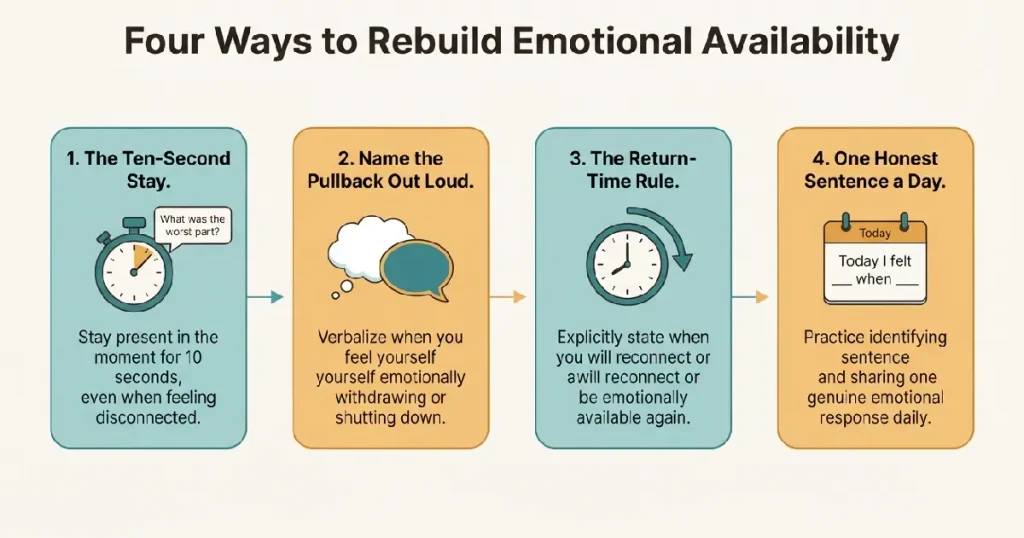
Pick one strategy and run it for two weeks. All four at once tends to collapse by day three.
1. The Ten-Second Stay
When someone shares something vulnerable, count ten slow seconds before offering anything. One question before any solution. Try: “That sounds heavy. What was the worst part of it?” Notice what shifts when your only job is to understand before you fix.
2. Name the Pullback Out Loud
The moment you catch the urge to joke, deflect, or vanish, describe the urge instead of obeying it. Script: “I notice I want to change the subject right now. Give me a second, I want to stay with this.” Said aloud, a reflex becomes a conversation, and partners read that honesty as closeness.
3. The Return-Time Rule
Flooding is real, and pushing through it rarely works. Take the break, always with a timestamp: “I’m flooded. I need 30 minutes, then I’ll come back to this at 8:30.”
Gottman’s guidance is at least 20 minutes for the body to settle. The promised return separates a pause from abandonment. Keep the appointment, even if you only manage two sentences.
4. One Honest Sentence a Day
Once a day, tell a safe person one true feeling in plain words: “Today I felt ___ when ___.” Keep it small and specific. When the hangover shows up the next morning, treat it as weather and send the next sentence anyway. Tolerance grows through repetition, the same way it would at the gym.
When therapy for emotional unavailability makes sense
Consider professional support if the same ceiling has appeared in two or more relationships, if a partner keeps raising the distance, or if numbness is spreading beyond romance. Two options fit well. Emotionally focused therapy (EFT) has a strong research base for couples distress. Attachment-based individual therapy suits patterns that predate your current relationship.
A simple opener for a first session: “I shut down when people get close to me. I want to learn to stay.”
Frequently Asked Questions
Am I emotionally unavailable or just an introvert?
Introversion is about energy: solitude recharges you and you return warm. Avoidance is about threat: closeness itself triggers retreat. You can be both, so watch what happens after you rest.
Can an emotionally unavailable person actually change?
Yes. Attachment researchers describe “earned security”: adults who move from insecure patterns toward secure ones through therapy or consistently safe relationships. Measure progress in behavior: shorter withdrawals, faster repairs, more honest sentences.
Why do I pull away from partners who treat me well?
Safe closeness still trips the old alarm, and distance is what your system trusts. Kind treatment can feel unfamiliar enough to register as boring. Give that flat feeling a few weeks before you believe it.
Picture that couch again. Your partner says, “I can’t reach you,” and this time you have a map. You know which sign just fired and roughly where it came from.
You have ten seconds and one honest sentence to work with. You can ask for thirty minutes and actually come back at 8:30. None of that requires becoming a different person overnight.
Reachability is a practice, and practices are built one small, kept promise at a time.
My Closing Remarks
I’ll be straight with you: the person who worries about being emotionally unavailable is usually the one who cares the most about getting it right. That worry is worth something. Use it.
Pick the smallest rep on this page, keep it for two weeks, and let the evidence change your story about yourself. Walls that took years to build deserve patience coming down.
More Related Stories for You
Want to see the other side of this equation? Our piece on what being a genuinely good partner looks like in practice breaks down the everyday behaviors that make someone feel safe to open up to.
About The Author