David Wall

Why do skeptics often improve fastest? A practitioner’s look at the mechanism most meditation apps skip.
Key Takeaways
- Mindfulness Coaching trains the moment you notice your mind wandering, which is why people who feel “bad at meditating” often improve fastest.
- The acceptance skill, far more than the breathing, is what keeps practice from turning into stressful self-monitoring.
- Progress shows up first as shorter recovery time after tension, measurable in minutes, long before any lasting sense of calm.
Quick answer: Mindfulness coaching is one-on-one training where a coach teaches present-moment awareness and acceptance skills, then fits short practices into your real schedule. It works by training you to notice thoughts and urges early and let them pass. That lowers stress reactivity and sharpens focus.
Contents
Table of Contents
That conclusion is common, and it’s usually wrong. Here’s the tension nobody names: when you first slow down, you feel more of the chaos, because you’re finally close enough to notice it. Attention without acceptance can turn practice into self-surveillance.
Mindfulness coaching is built around that exact problem. Here are seven reasons it works, what the research honestly shows, and a two-week test you can run without believing anything.
What Is Mindfulness Coaching? The Plain Answer
Mindfulness coaching pairs you with a trained coach who teaches attention and acceptance skills. The coach then adjusts the dose around your calendar, your triggers, and your tolerance for sitting still. The pairing of coaching and mindfulness matters because awareness is easy to learn and hard to apply at 4 p.m. on a deadline day. A coach watches how you practice and changes what isn’t working.
Here’s how the main options compare in daily use:
| Option | What it trains | Best fit | Where it stalls |
|---|---|---|---|
| Meditation app | Guided meditation basics | Cheap daily reps | Generic pacing; easy to quit when stress spikes |
| MBSR course | A set 8-week curriculum | Structured group learning | Fixed schedule; roughly 20 to 27 hours of class time |
| Mindfulness coaching | Awareness plus acceptance, tailored to you | Applying skills under real pressure | Unregulated field; quality varies widely |
| Licensed therapy | Assessment and treatment | Anxiety disorders, trauma, depression | Not designed as a focus or performance tool |
One honest note before the reasons: coaching has no licensing board. The questions in Strategy 3 below matter more than any certificate on a website.
Why Coaching Mindfulness Works When Solo Practice Stalls
A busy skeptic often gets more from six sessions of mindfulness coaching than from six months of broken app streaks. The first three reasons explain why.
Reason 1: The return is the rep, so restless minds train fastest
Most people grade meditation by how calm they felt. Coaches grade it by how many times you noticed your mind wander and brought it back to the breath anchor. Each return is one repetition for meta-awareness, the part of attention that tracks where your attention is.
In our session logs, a fidgety six-minute sit with 25 returns builds more usable skill than a blissful twenty-minute sit with two. The wandering is the equipment.
Reason 2: A coach closes the acceptance gap
Monitoring your thoughts without accepting them can make practice feel like watching yourself struggle and grading yourself for struggling. Lindsay and Creswell’s Monitor and Acceptance Theory (2017) explains the split. Attention monitoring sharpens thinking but can raise emotional reactivity; acceptance is what lowers it.
Most apps rush past acceptance, and most quitters never hear the distinction. A good coach slows down right there, teaching you to let a thought sit without fixing it. Clients who say they’re “too anxious to meditate” have often learned monitoring without acceptance.
Reason 3: A person on your calendar beats a streak counter
Apps lean on motivation, which disappears on the exact days you need practice most. A booked session with a human creates a social commitment your brain treats differently than a phone notification.
Between sessions, coaches attach micro-practices to cues you already hit: kettle on, seatbelt clicked, laptop opened. Researchers call this an implementation intention: a specific when-then plan. It survives brutal weeks better than a vague goal to meditate more. The metric we track in mindfulness coaching is practices completed per week, never minutes meditated.
The Stress and Focus Payoff You Can Actually Measure
Reason 4: Your recovery time shrinks first
Stress is the spike, and then it’s the two hours of replay afterward. Rumination, the loop of rehearsing a conversation that already ended, turns a tense meeting into a ruined evening. Mindfulness training targets that loop through decentering: watching a thought as an event in the mind rather than an order to follow.
The evidence here is solid and modest at once. In a 2014 JAMA Internal Medicine review of 47 randomized trials, Goyal and colleagues found mindfulness meditation programs reduced anxiety and depression. The anxiety effect size was 0.38 at eight weeks, with no clear advantage over exercise or other active treatments.
That review excluded audio-only programs without a live teacher. The evidence base belongs to human-led training. Track one number for two weeks: minutes from a trigger until you stop rehearsing it. Watching that number fall from 90 to 20 persuades a skeptic faster than any promise of zen.
Reason 5: The dose fits your nervous system
Personal mindfulness coaching earns its fee in the edge cases. A client with a harsh inner critic can feel worse during long body scans. We shorten the dose and anchor attention outside the body, on sounds or the feel of feet on the floor.
Someone with a trauma history keeps eyes open and practices in daylight. If panic surfaces, the session stops and a referral conversation begins. Generic programs can’t make those calls. Ten minutes done daily beats forty minutes abandoned in week two.
Reason 6: The gap between trigger and reply gets wider
Focus at work is mostly about catching impulses early: the urge to check Slack, fire off a correction, or say yes to a meeting you’ll resent. Psychologists call the underlying brake response inhibition. It trains with live material: your actual inbox, your actual calendar. Teams that build a ten-second pause before decisions interrupt the react-and-escalate loop, a pattern we cover in how mindful workplaces handle pressure.
The measurable version: count heated messages you drafted, paused, and rewrote. Three per week is a working skill.
Reason 7: The Skill Travels to Loud Rooms
Quiet-room practice that never leaves the quiet room is a hobby. Coaches train in messy contexts on purpose: open offices, parked cars, the ninety seconds before a hard conversation. Skills generalize when practice conditions vary.
Mindfulness in classroom settings follows the same logic. Teachers who use a thirty-second arrival ritual before lessons report smoother transitions. The mechanism is plain: a repeated cue tells the attention system which job comes next.
You can borrow that ritual before your next meeting. One honest limit belongs here too: awareness won’t fix a 60-hour workload or untreated depression. Sometimes the mindful move is changing the load or booking a clinician. A good coach will say so out loud.
Practical What-To-Do-Next: Four Moves for Your First Two Weeks
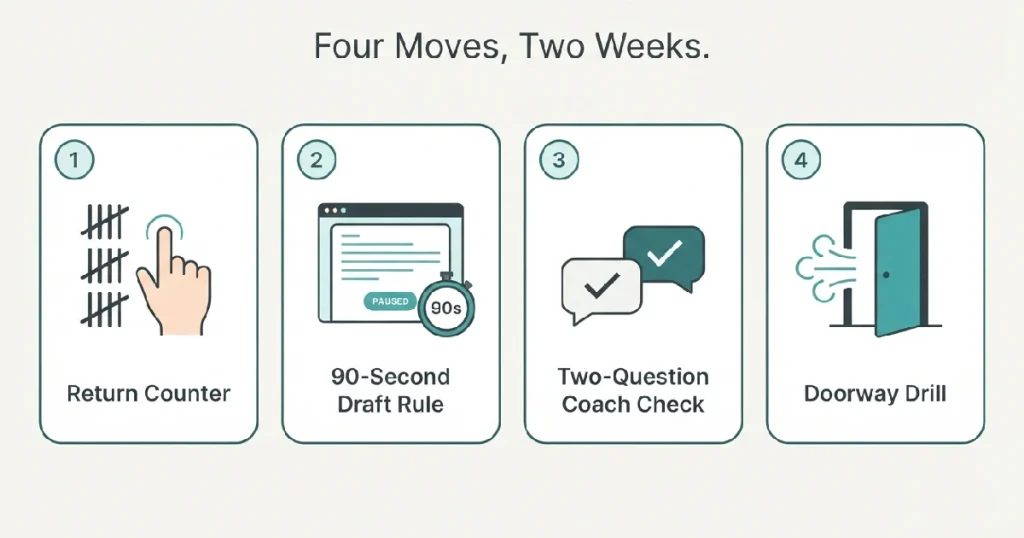
One place to begin is a two-week experiment small enough to survive a bad week. Consider testing these four moves in order.
1. The Return Counter
For one week, score returns instead of minutes: each time you notice wandering and come back to the breath, tap one finger. Say to yourself, word for word: “That noticing was the rep.” Try six minutes a day and watch the count climb. A rising count means the skill is growing even on chaotic days.
2. The 90-Second Draft Rule
When a message spikes your pulse, write the full reply. Then wait ninety seconds, both feet pressed into the floor, before rereading it. If it still reads hot, send this instead: “I want to give this a proper answer, so I’ll come back to you by 3.” Notice what shifts when the pause has a deadline; people accept delays far more easily when they end.
3. The Two-Question Coach Check
Before hiring a mindfulness coach, ask two questions word for word: “What do you do when a client feels worse during practice?” and “When would you refer me to a therapist?” Green flags: specific answers, screening questions, a referral network. Red flags: promises to cure anxiety, pressure to buy a big package, or “just observe it” as the answer to everything.
4. The Doorway Drill
Pick one doorway you cross every day and let it cue three slow breaths before you enter. For a team or a class, try the spoken version: “Let’s take ten seconds to land before we start.” Ten seconds, then business as usual; the brevity is what makes the habit stick.
Frequently Asked Questions
Is mindfulness coaching worth it if I already use a meditation app?
If your practice survives bad weeks, an app may be plenty. Coaching pays off when you quit under stress, feel worse while practicing, or can’t carry calm into hard conversations.
How many sessions before I notice anything?
Most clients notice a pause before reacting within three to six sessions, paired with six to ten minutes of daily practice. Recovery time after tension usually shifts before any lasting sense of calm arrives.
Can it replace therapy for anxiety?
No. Coaching builds attention skills; it doesn’t assess or treat anxiety disorders, trauma, or depression. A responsible coach works alongside clinical care and refers out when symptoms cross that line.
Back to That 3:47 p.m. Email
The inbox hasn’t shrunk, and your jaw still tightens some days. Now you catch the tightening at second five instead of hour two. You know the return is the rep, and you have a two-week experiment instead of a vague resolution to be calmer. That’s a mental map you can use on the worst afternoon of your quarter.
You can’t choose the thought that arrives, but you can own the ninety seconds after it.
My Closing Remarks
I came to this work as a skeptic who meditated badly for years before anyone corrected my form. The clients in this piece are composites, but the patterns are real. I see them weekly, including the people who felt worse before they felt better. If you take one thing, take this: struggling during practice means you’re practicing, not failing.
Count your returns. Serenity can wait.
More Related Stories for You
Curious why the calmest person in the room ends up steering it? Read the quiet mechanics of mindful leadership.
About The Author