
 Sara Carmen
The old relationship is gone. Here’s the honest, science-backed path to building something steadier in its place.
Key Points:
- Learning how to rebuild trust after cheating starts with accepting a timeline measured in years, not weeks.
- Couples who actually recover use structured disclosure and daily accountability, not just apologies and promises.
- Betrayal trauma rewires your brain’s alarm system, and understanding that mechanism explains your triggers better than anything else can.
Contents
Table of Contents
Something breaks the moment you find out. Not just your heart, your sense of reality. We tend to assume betrayal announces itself in advance, that we would somehow feel it coming. But most people who discover an affair describe the exact same free-fall: one minute your life makes sense, the next you’re re-reading old text messages searching for a version of events that isn’t true anymore.
You are not overreacting. What you’re feeling has a clinical name, and more importantly, it has a path forward.
If your chest tightens every time your partner’s phone buzzes, you’re not broken and you’re not “too sensitive.” Clinical psychologist Dennis Ortman coined the term Post-Infidelity Stress Disorder to describe exactly this: hypervigilance, intrusive images, and emotional flooding that closely mirror classic trauma responses. Research on betrayed spouses estimates that somewhere between 30 and 60 percent develop symptoms severe enough to meet clinical thresholds for trauma.
That statistic matters because it reframes what’s happening to you. This isn’t a character flaw. This is a nervous system doing exactly what it was built to do: scan for danger after a real threat got past its defenses once.
Here’s the part almost nobody tells couples in crisis. Recovery isn’t a lucky exception. According to data compiled on 60% to 75% of couples who complete structured, therapeutic work, most go on to rebuild a functioning, often stronger, relationship. That number should give you room to breathe. Healing from infidelity is a skill set, and skill sets can be learned.
The Infidelity Recovery Timeline: Why Rushing Repair Backfires
Most couples want a deadline. Something like: give me six weeks and I’ll be over it. That deadline doesn’t exist, and chasing it usually makes everything worse.
Genuine repair, the kind where you stop flinching at unexpected phone calls, typically takes 12 to 24 months of consistent, deliberate work. For many couples, meaningful pieces of that healing stretch across two to five years. That’s not failure on your part. That’s the real shape of an infidelity recovery timeline.
One factor decides more of that timeline than anything else.
It’s whether the full truth comes out at once or in pieces. Therapists call the second pattern trickle-truth, when a partner reveals details of the affair gradually over weeks or months instead of disclosing everything up front. Every new fragment resets the trauma clock, and the betrayed partner has to re-process the betrayal from scratch each time.
The numbers back this up starkly. Couples who receive full, honest disclosure early face roughly a 43 percent divorce rate over five years. Couples where the affair stays wrapped in secrecy or minimized detail see that number climb to nearly 80 percent. Full disclosure is painful. It is also, statistically, the more merciful path.
How to Rebuild Trust After Cheating: 5 Concrete Steps
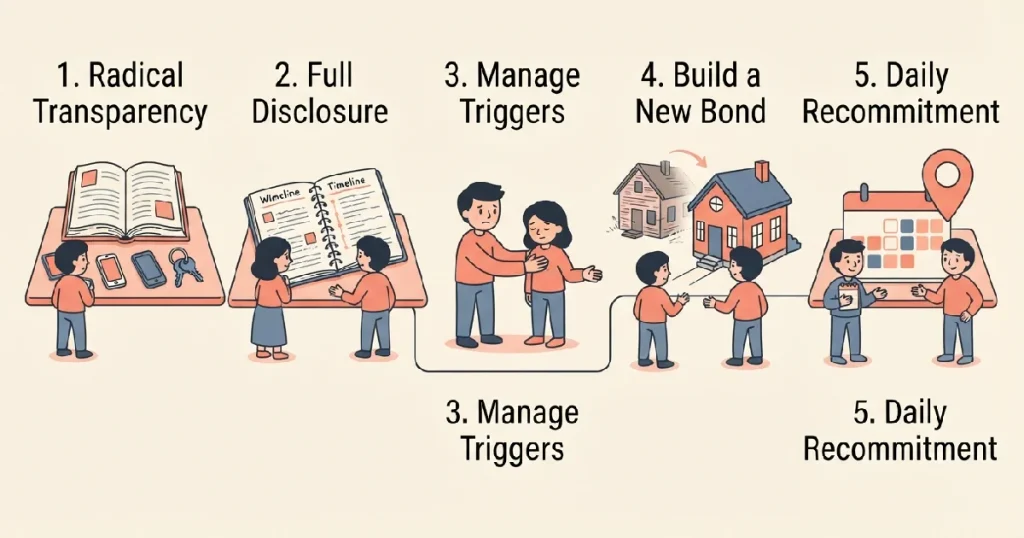
There is no single conversation that fixes this. Repairing a relationship after an affair happens through repeated, boring, unglamorous acts of consistency. Here are the five that actually move the needle.
1. Radical Transparency: The Open-Book Standard
The unfaithful partner ends all contact with the affair partner immediately, ideally deleting the accounts and blocking the contact in front of the betrayed partner. Full access to phones, location sharing, and passwords follows right after.
This isn’t a punishment, and it isn’t permanent. It functions as an external regulator for a nervous system that hasn’t relearned how to self-soothe yet. Think of it as training wheels for trust, not a life sentence.
The betrayed partner gets to ask hard, specific questions without facing defensiveness or a clock running out on the conversation. Over time, as verification becomes routine, the anxious checking naturally starts to fade on its own.
2. Full Disclosure: One Timeline, No Trickle-Truth
The unfaithful partner writes out a full, chronological account of the affair: dates, logistics, how it started, how it ended. Both partners then schedule dedicated sessions to go through it, so raw questions get answered safely instead of leaking out in painful drips over months.
Accountability means owning the choice fully, without pointing back at a stale marriage or a distracted partner as the real cause. Blame-shifting here doesn’t just fail to help, it actively re-injures.
Once the facts are all on the table, let that baseline settle before jumping into conversations about the relationship’s long-term future.
Why “Just Trust Me” Never Works: The Smoke Detector Effect
Here’s something that rarely gets explained clearly, and it’s the piece that makes everything else in this article make sense.
A smoke detector that has just detected a real fire doesn’t calm down because someone tells it there’s no more smoke. It stays sensitive. It goes off at burnt toast, at steam from the shower, at things that pose zero actual danger.
Your brain’s threat-detection system works the same way after betrayal. The amygdala, the part of your brain responsible for flagging danger, got confirmation that your instincts were right once. Now it’s doing its job by staying loud, even at ordinary triggers like a late text or a closed laptop. This is why “just trust me” lands as meaningless. You aren’t being asked to believe a sentence. You’re being asked to recalibrate a system that worked correctly and can’t tell the difference between the original fire and burnt toast yet.
Most people in this situation don’t realize their reactions are neurological, not irrational. Once you see it that way, the goal shifts from forcing yourself to feel calm toward giving your nervous system enough repeated safe evidence that it can finally stand down.
3. Trigger Integration: Learning to Manage Betrayal Triggers Together
The unfaithful partner learns to respond to spirals with calm, active validation rather than frustration or defensiveness. The betrayed partner learns grounding tools, like journaling or stepping outside for five minutes, to metabolize the initial wave of panic before it turns into a fight.
Maria’s 2 A.M. Phone Check
Maria hadn’t slept through the night in three weeks. Every time her husband Daniel’s phone lit up on the nightstand, her stomach dropped and she found herself scrolling his messages before she’d even fully woken up. Daniel used to get defensive, saying “you promised you’d stop checking.” Their therapist reframed it differently: this wasn’t Maria breaking a promise, it was her alarm system doing exactly what alarm systems do after a real fire. Once Daniel started calmly narrating who texted and why, without sighing or rolling his eyes, Maria’s 2 a.m. checks dropped from nightly to twice a month within four months.
Setbacks like Maria’s aren’t proof the relationship is failing. They’re a common, expected pattern in how to manage betrayal triggers, not evidence of active new failure.
4. The Old Marriage Is Over: Building From New Ground
Both partners accept that the relationship dynamic that existed before the affair cannot be recovered, because the version of each of you that existed then no longer applies. The unfaithful partner commits to real personal work, often in individual therapy, to understand what allowed the betrayal to happen in the first place.
Couples counseling specifically trained in betrayal trauma, rather than general marriage counseling, tends to produce far better outcomes here. From there, both partners deliberately construct a new foundational dynamic instead of trying to patch the old one back together.
5. Structural Accountability: Small Proofs Over Time
The unfaithful partner might proactively offer something concrete, like a postnuptial agreement protecting shared finances, as a tangible gesture of commitment. Both partners agree on new daily boundaries that match the betrayed partner’s actual needs, not a generic template pulled from a book.
Volunteering schedule changes before being asked, consistently, over months and years, becomes the quiet proof that finally starts to outweigh the original violation. Trust rebuilds through thousands of small, boring, kept promises, not one grand gesture.
Affair Recovery Communication: 3 Conversation Rules That Prevent Blowups

Talking about the affair without a structure tends to spiral fast. These three rules keep conversations from turning into daily re-traumatization.
The Containment Window. Agree on a specific 20 to 30-minute daily window for affair-related conversations, rather than letting the topic hijack every hour of the day. Outside that window, both partners practice gently redirecting: “I want to talk about this. Let’s put it in tonight’s window.”
Objective Data-Gathering. The betrayed partner practices pausing accusations long enough to ask for facts first: “Walk me through what happened on that trip.” The unfaithful partner answers plainly, without folding into “well, you were distant too” style counter-attacks, which almost always reignite the fight.
The “I Feel” Trauma Mapping Technique. Ground the language in your own immediate experience rather than global character attacks. Instead of “you’re a liar and always will be,” try: “I feel unsafely exposed when you don’t answer texts quickly.” The second version invites repair. The first one invites a shutdown.
When to Seek Professional Support for Rebuilding Emotional Safety
In my practice, the couples who recover fastest are rarely the ones who love each other the most. They’re the ones who bring in structured, outside support early instead of trying to white-knuckle it alone.
The Gottman Trust Revival Method maps recovery into three sequential phases: Atonement, where the unfaithful partner takes full ownership without excuses; Attunement, where both partners rebuild the emotional connection that erosion damaged; and Attachment, where physical and emotional intimacy return.
Skipping ahead to intimacy before safety is established tends to backfire and re-traumatize rather than heal. A certified couples therapist trained in betrayal trauma acts as a referee your nervous system can actually trust, keeping both partners honest and paced correctly. Seeking that support isn’t a sign you’re failing. It’s a sign you’re serious.
Practical Tools for Managing Betrayal Triggers Tonight
One place to start is the Nightly Ten, a ten-minute check-in where the unfaithful partner shares one honest update about their day, unprompted. It sounds small. Over months, it becomes the evidence your alarm system needs to finally quiet down.
Consider the Pause-and-Name technique the next time a trigger hits. Silently name what’s happening: “This is my alarm system, not new evidence.” Then decide whether the current moment actually requires action or just five minutes to pass.
A useful question to ask yourself this week: what is one piece of transparency, however small, that would make tonight feel five percent safer? Bring that specific request to your partner instead of a vague demand for “more honesty.”
The Hard Road to a Stronger Bond
Rebuilding trust after cheating is not a straight line, and anyone who promises you a shortcut is selling something. It runs on radical honesty, structured transparency, and thousands of small, kept promises stacked over months and years.
The old relationship really is gone. But the smoke detector that once screamed at every shadow can, with enough real evidence, finally learn the difference between danger and burnt toast. That’s not settling. That’s the quiet, earned version of safety that outlasts the version you had before.
My Closing Remarks
I’ve watched couples walk into my office convinced their relationship was unsalvageable, and I’ve watched some of those same couples build something more honest than what they had before the affair. It doesn’t happen through big declarations. It happens through Tuesday nights where someone answers a hard question without flinching. If you’re in the thick of it right now, you’re doing harder work than most people ever attempt. Keep going.
More Related Stories for You
- If betrayal patterns keep repeating in your relationships, it’s worth understanding the deeper narcissist traits in male partners that often precede infidelity in the first place.
About The Author