
 Sara Carmen
Fear of Intimacy: Why Getting Close Feels Like Danger, Even When You Want It Most
Key Points
- Recognizing a fear of intimacy is the first real step toward breaking the cycle of pulling away right when a relationship starts to feel good.
- This fear rarely looks like fear. It usually disguises itself as pickiness, a packed schedule, or “just not finding the right person.”
- Three specific, research-informed habits can retrain your nervous system to tolerate closeness instead of fleeing from it.
Contents
Table of Contents
You’ve tried. You’ve really tried.
You meet someone good. Kind, steady, genuinely interested in you. For a few weeks, it feels like maybe this is finally it.
Then something shifts.
Small habits start to grate on you. You pick a fight over nothing. Or you quietly pull back just enough to feel like you can breathe again. Later, alone, you wonder what is wrong with you.
Nothing is wrong with you.
A fear of intimacy is a subconscious defense that protects you from being fully known and then rejected or swallowed whole. It shows up as self-sabotage, sudden shutdowns, and a strange pull toward people you can never fully have. It was learned somewhere along the way. That means it can be unlearned too.
Left unexamined, though, this pattern doesn’t just create friction. It can quietly become the reason relationship after relationship ends at the exact same stage.
What Is a Fear of Intimacy, Really?
A fear of intimacy is not shyness. It is not being “too independent.” It is a real, measurable form of anxiety around emotional or physical closeness.
Clinical researchers actually study this. Psychologists Descutner and Thelen developed the Fear of Intimacy Scale back in 1991 to measure how anxious someone feels about sharing their private thoughts and emotions with a person they care about. Their research found something important: people who score high on this scale don’t lack love. They lack a felt sense of safety around expressing it.
Here is the part most people miss.
Most people with this fear don’t know they have it. You might genuinely believe you just haven’t met the right person yet, while your own defenses are quietly filtering out anyone who gets too close. It operates underneath conscious thought, which is exactly why it feels so confusing from the inside.
Why You Push Love Away: The Root Causes
To understand why closeness can feel like danger, you have to look back before you even understood what danger was.
Your earliest relationships taught your nervous system what to expect from love. If a caregiver was inconsistent, dismissive, or emotionally unavailable, you likely adapted by relying less on connection and more on yourself. Cleveland Clinic’s research on avoidant attachment style shows that this pattern often forms in childhood as a protective response to emotional neglect, and it follows people directly into their adult relationships.
That’s not coldness. That’s wiring.
Two competing fears usually drive the behavior. One is abandonment: the terror that if you let someone in, they will eventually leave, so you leave first to control the pain. The other is engulfment: the suffocating worry that closeness will erase your identity, leaving you swallowed up in someone else’s needs.
Add in a betrayal, a sudden breakup, or a partner who checked out emotionally, and the lesson gets reinforced. Vulnerability starts to equal danger. Your body remembers that math even when your mind wants something different.
7 Signs You Have a Fear of Intimacy
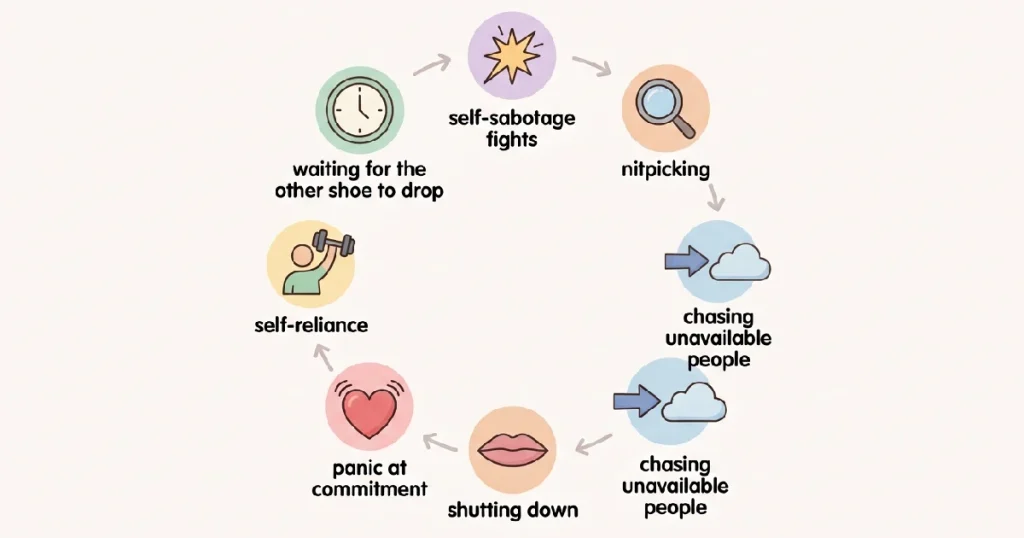
These signs rarely look dramatic from the outside. They look like normal relationship habits. From the inside, though, they follow a clear pattern.
1. You’re Always Waiting for the Other Shoe to Drop
Even when things are going well, part of you is scanning for the exit sign. You analyze a slightly short text message for hours. You brace for rejection during genuinely calm moments. This hypervigilance keeps you from ever fully relaxing into connection, because relaxing feels like letting your guard down right before you get hurt.
2. You Create Conflict Right When Things Get Good
This is classic relationship self-sabotage. A relationship reaches a new level of closeness, maybe after a great weekend or a vulnerable conversation, and suddenly you pick a fight about dishes or plans. The argument isn’t really about dishes. It’s a pressure valve that puts distance back between you and the intimacy that just started feeling too real.
3. You Turn Small Flaws Into Dealbreakers
You fixate on the way they chew, or a habit that used to be endearing, until it becomes proof they aren’t right for you. This nitpicking gives you a logical-sounding reason to withdraw, so you don’t have to admit the real reason is fear.
4. You Chase People You Can’t Actually Have
Long-distance partners. Emotionally unavailable exes. Someone already in another relationship. These situations offer the feeling of romance without the risk of daily emotional exposure, which is exactly why they feel safe to a nervous system that fears real closeness.
5. You Shut Down When Conversations Get Real
A partner asks how you’re really feeling, and you deflect with a joke or a one-word answer. This fear of vulnerability isn’t rudeness. It’s a wall going up faster than you can consciously stop it.
6. Commitment Talk Triggers Actual Panic
When a partner says “I love you” or brings up the future, you might feel a genuine wave of claustrophobia, a racing heart, or an urge to physically leave the room. This is fear of commitment expressing itself in your body before your mind even catches up.
7. You’d Rather Struggle Alone Than Ask for Help
Compulsive self-reliance looks admirable on the surface. Underneath, it often signals one of the clearest signs of emotional unavailability: the belief that needing anyone is a liability. Asking for support feels riskier than carrying the weight by yourself, even when the weight is heavy.
How Fear of Intimacy Shows Up in Daily Relationships

Beyond the big signs, this fear leaks into small, repeated moments that quietly regulate emotional distance.
Sudden ice-outs. After a weekend of real bonding, you go cold, stop replying as quickly, or restrict your availability to feel like yourself again.
Physical isolation as a shield. You retreat to another room, overbook your calendar with hobbies, or stay late at work specifically to avoid quiet, shared downtime.
The zero-investment defense. When your partner checks in emotionally, you give short, detached answers, just enough to satisfy them without revealing anything real.
Screens and substances as buffers. You reach for your phone or a drink right before a moment that calls for sober, genuine presence.
None of these moves are conscious sabotage. They are a nervous system trying to restore a distance that feels survivable.
3 Practical Strategies to Overcome a Fear of Intimacy
Understanding the pattern matters. Changing it requires practice, not just insight.
1. Practice the Critical Pause
The next time you feel the urge to pick a fight or vanish, wait two minutes before acting. Name the feeling out loud, even just to yourself: “I’m anxious because things feel close right now.” One place to start is simply narrating the emotion instead of obeying it. This small pause creates space between the trigger and the reflex.
2. Commit to Micro-Disclosures
Each day, share one small, slightly uncomfortable truth with your partner or a trusted friend. It could be a minor insecurity, a hard memory, or an honest reaction you’d normally hide. Consider treating this like strength training for vulnerability. Small reps build real tolerance over time, without demanding you overhaul your entire emotional world overnight.
3. Build an Independent Security Routine
Spend daily time on something that is entirely yours, whether that’s journaling, a solo walk, or a personal hobby. A useful question to ask yourself: does my sense of okay depend entirely on this relationship? Strengthening your relationship with yourself directly reduces the fear that losing a partner would be unsurvivable, which loosens the grip that fear has on your decisions.
The Bottom Line
Healing from a fear of intimacy is not about becoming a different person. It’s about slowly teaching your nervous system a new fact: closeness can be safe now, even if it wasn’t always safe before.
You don’t have to fix everything tonight. Choose one small, honest sentence to share with someone who matters, the same kind of sentence Marcus finally sent. That single act of staying, instead of disappearing, is often where real change actually begins.
The smoke detector doesn’t have to keep going off every time someone gets close. You can teach it, slowly, that this warmth isn’t fire.
My Closing Remarks
In my practice, the clients who make the fastest progress aren’t the ones who read the most about attachment theory. They’re the ones willing to send one honest, slightly scary text instead of going silent. I’ve watched that single choice rebuild trust faster than months of avoidance ever could. You are not broken. You are just finally paying attention.
More Related Stories for You
- Curious how these same patterns of emotional guardedness show up in narcissistic partners? Read Narcissist Traits in Men to understand the difference between fear-driven distance and manipulation.
About The Author