
 Sara Carmen
When love isn’t enough to calm your body, your nervous system needs a different kind of proof.
Key Points
- Learning how to build emotional safety starts in your nervous system, not your vocabulary.
- Three research-backed exercises can start interrupting the pursue-withdraw cycle in a single evening.
- Real security isn’t the absence of conflict. It’s knowing the relationship can hold one without breaking.
Contents
Table of Contents
We like to believe love should feel simple once we’ve found the right person. You’ve found someone who loves you, who says the right things, who shows up when it counts. And yet your body still tightens before certain conversations.
You still feel that old, familiar drop in your stomach when your partner’s voice shifts by half a tone. You scan their face for warning signs before you’ve even said what you needed to say. Something is off, and it isn’t the love. It’s the safety underneath it.
Here’s the short answer, before we go further: emotional safety is a physical state, not just a mental belief. It’s the felt sense that you can be fully yourself with someone, including your fears, your mess, and your needs, without your body bracing for punishment. When that state is missing, no amount of “I love you” fully lands.
This guide is going to walk you through five internal steps, three signs your relationship already has this quality, and three exercises you can do together tonight. No lectures. Just what actually works.
The Biology of Closeness: Why Emotional Safety Runs the Whole Relationship
Your nervous system doesn’t read love letters. It reads cues: tone, timing, facial expression, the speed of footsteps down the hallway. Psychiatrist and researcher Stephen Porges calls this constant, unconscious scanning neuroception, the automatic process your body uses to decide whether a person is safe or dangerous, often before your thinking brain catches up (Porges, 2011).
This is the core of polyvagal theory in relationships. When your body registers safety, it settles into what’s called the ventral vagal state: relaxed, curious, able to make eye contact and joke around. When it senses threat, it shifts into fight-or-flight, the sympathetic response that shows up as raised voices, defensiveness, or the urge to leave the room. And when threat feels inescapable, some people drop into a third state entirely: dorsal vagal shutdown, that flat, numb, checked-out feeling that looks like indifference but is actually a shutdown of the whole system.
This is exactly why the classic pursue-withdraw cycle develops in so many couples. One partner’s nervous system responds to disconnection by escalating, chasing reassurance, raising the volume. The other partner’s system responds to that same disconnection by retreating inward to self-protect. Neither person is choosing this consciously. Both are running an old survival program.
But here’s what no one tells you.
During an unsafe argument, blood measurably shifts away from your prefrontal cortex, the part of your brain responsible for logic, perspective-taking, and impulse control. That’s not a character flaw. That’s biology pulling resources toward pure defense. It explains why smart, loving people say things mid-conflict they’d never say with a clear head.
Emotional safety was never about eliminating conflict. Disagreements are inevitable in any real relationship. What safety actually changes is whether a disagreement gets processed by a calm brain or a threatened one.
5 Steps to Boost Relationship Confidence Before You Try to Fix Anything

You cannot build safety with another person while your own internal world is running on threat detection. These five steps are the groundwork for how to boost relationship confidence before the harder conversations even happen.
1. Identify your attachment style.
Anxious attachment tends to seek constant reassurance and interprets distance as danger. Avoidant attachment tends to pull away under emotional pressure and interprets closeness as suffocating. Knowing your default lets you catch the pattern instead of living inside it blindly.
2. Practice micro-boundaries daily.
Say no to the extra errand. Decline the invitation you don’t want. These small, low-stakes moments train your nervous system to tolerate the discomfort of disappointing someone, which prepares you for the bigger boundaries that matter later.
3. Audit your internal self-talk.
Before you assume your partner is annoyed, angry, or pulling away, ask what evidence actually supports that story versus what your anxiety invented overnight.
4. Use “I” statements to prevent defensiveness.
“I felt hurt when plans changed last minute” lands very differently than “you always cancel on me.” One is an invitation. The other is an accusation, and accusations trigger defense, not connection.
5. Ground yourself in reality over scenario-building.
Anxious minds are excellent storytellers. They can build an entire breakup narrative from one delayed text. Before reacting, ask yourself what your partner’s actual track record says, not what your worst-case imagination says.
Most people in this situation don’t realize how much of their relationship anxiety originates internally, long before their partner does anything at all. That’s not a criticism. It’s simply where the real leverage point lives.
3 Signs of Emotional Safety in a Relationship
Once the internal work starts, it becomes much easier to see whether the relationship itself is actually safe or just familiar. Here are three signs of emotional safety in a relationship worth checking against your own.
Vulnerability meets compassion, not criticism. In a safe relationship, sharing a childish fear or an embarrassing memory gets met with warmth. In an unsafe one, it eventually gets thrown back at you during a future fight. Instead of walking on eggshells around your own honesty, you feel lighter after sharing it.
Conflict acts as information, not a threat. Safe couples treat disagreements like a shared puzzle to solve together. Unsafe dynamics treat every disagreement like a countdown toward the relationship’s end. If a small argument regularly triggers panic about the whole relationship collapsing, that’s the nervous system talking, not the facts.
Boundaries get celebrated, not punished. When your partner says they need quiet time after work, does it register as healthy self-preservation, or does it feel like rejection? Emotionally safe couples experience space as something that protects the relationship, not something that threatens it.
3 Exercises to Build Emotional Safety Tonight
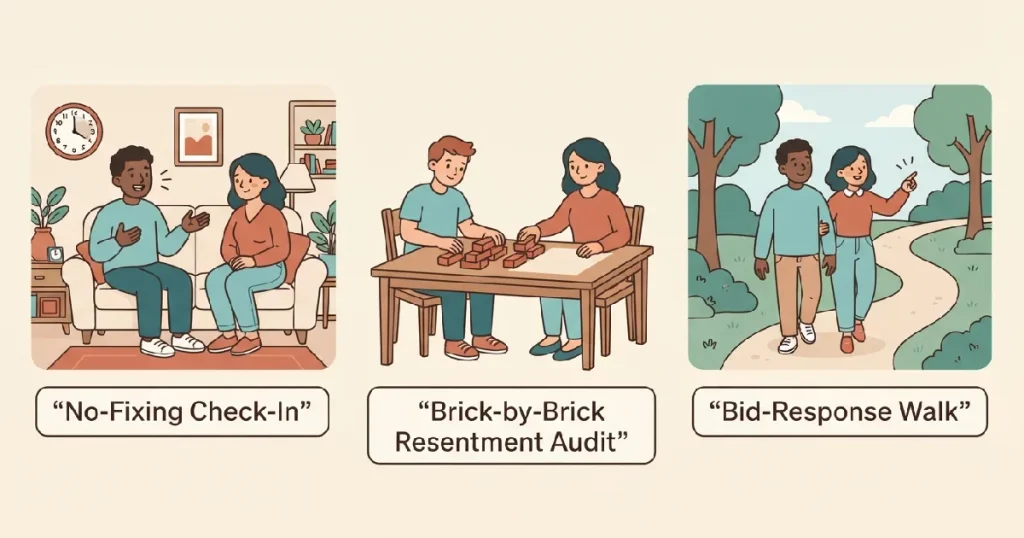
Insight only goes so far. These three relationship anxiety exercises turn what you now understand into something your body can actually practice and feel.
Exercise 1: The No-Fixing Check-In
Set aside ten uninterrupted, phone-free minutes. One partner talks for three to five minutes about anything on their mind. The other partner’s only job is to reflect and validate, using phrases like “that sounds really hard” or “I can see why you’d feel that way.” No advice. No fixing. No devil’s advocate. Switch roles the next night.
Exercise 2: The Brick-by-Brick Resentment Audit
Once a week, sit down for fifteen minutes and each share one small friction point from the past seven days, using the format: “When [specific event] happened, I felt [emotion].” The other partner responds only with “thank you for telling me” before any discussion begins. This keeps tiny resentments from stacking into a wall neither of you can see over.
Exercise 3: The Bid-Response Walk
Take a twenty-minute walk together with no destination and no phones. Notice the small bids for connection your partner makes, a comment about the sky, a joke, a sigh, and intentionally turn toward each one instead of past it. Walking side by side, rather than face to face, naturally lowers physical defensiveness and makes these small moments of connection easier to receive, echoing the research on small bids and secure attachment.
In my practice, the couples who repeat even one of these exercises consistently, not perfectly, are the ones who report feeling different within two to three weeks.
The Long Game: How to Build Emotional Safety That Lasts
Emotional safety was never going to be restored by one perfect conversation. It gets rebuilt the same way trust erodes: in small, repeated moments, most of which feel unremarkable in the instant they happen.
When a boundary does get crossed, and it will, the repair sequence matters more than the mistake itself. Try the three R’s: Repair quickly instead of letting silence fester, Reflect honestly on what triggered the misstep, and Reinforce the change with a visible, repeated adjustment in behavior over the following weeks.
Left unexamined, the pursue-withdraw cycle doesn’t just create tension in the moment. Over time, it quietly becomes the reason otherwise loving relationships wear down and end.
Pick just one exercise from this guide. Try it tonight.
Your Nervous System Was Never the Enemy
Remember that tightness in your chest before certain conversations, the one you felt at the start of this piece. That response was never proof something is wrong with you or your relationship. It was your body doing exactly what it’s designed to do: protecting you until it has enough evidence that it doesn’t need to.
Think of your nervous system like bare feet on a familiar floor. Step on broken glass once, and you’ll tiptoe across that same smooth floor for years afterward, even when there’s nothing left to fear. Emotional safety is the slow, patient process of teaching your feet, and your partner’s, that the floor really has changed.
You now know the difference between love and felt safety, and you have three ways to start closing that gap tonight.
That’s not weakness. That’s wiring, and wiring can be rewired.
My Closing Remarks
I’ve sat across from couples who love each other deeply but still flinch at raised voices from years ago, in different relationships entirely. What changes them isn’t a single breakthrough conversation. It’s the accumulation of small, unremarkable moments where one partner turns toward instead of away. Give yourself that same patience tonight. You’re not behind. You’re building something real, one small moment at a time.
More Related Stories for You
- If you’re trying to understand harmful relationship patterns beyond emotional safety, this guide on narcissist traits in men is worth your time.
About The Author