
 Sara Carmen
You didn’t fall out of love. You fell out of practice. Here’s how to find your way back to each other, one small drill at a time.
Key Points Box
- Learning how to improve emotional intimacy rarely requires big romantic gestures, just five focused minutes practiced on purpose.
- Emotional distance is a normal, well-documented phase in long-term relationships, and it is fully reversible with the right daily habits.
- These five drills use real psychological technique, from somatic regulation to structured eye contact, to rebuild connection faster than talking alone ever could.
Contents
Table of Contents
You still love each other. That was never really the question. But somewhere between the bills, the bedtime routines, and the exhausted collapse onto the couch each night, you started talking more like coworkers than partners. You update. You coordinate. You rarely actually meet.
Someone looking at your relationship from the outside might think everything is fine. You never fight. You split chores evenly. Your calendars sync perfectly.
But what they don’t see is the version of you that used to text your partner random thoughts during the day, and now only texts them the pediatrician’s phone number. What they don’t see is how long it’s been since either of you said something that felt even slightly risky to say out loud.
Here’s the short answer. Emotional intimacy is the felt sense of safety that lets you show your whole self, your worries, your mess, your unfinished thoughts, to your partner without flinching. It fades not because love disappears, but because couples quietly stop practicing it. The good news is that it responds fast to the right kind of repetition.
What Is Emotional Intimacy, and Why Does It Fade?
Emotional intimacy is not the same thing as a smoothly running household. You can have a partner who never forgets to pick up the kids and still feel completely alone with them at night.
Psychologists define emotional intimacy as mutual vulnerability paired with consistent responsiveness. That means you both take turns revealing something real, and you both take turns responding with care instead of judgment. Research backs up just how much this matters. A well-cited study found that emotional intimacy predicts long-term satisfaction more reliably than shared activities, financial stability, or even conflict frequency.
So why does it fade if it matters this much?
Life logistics eat it alive. Somewhere along the way, most couples swap emotional conversation for operational conversation, meaning you talk constantly about schedules, groceries, and logistics, but rarely about how you actually feel inside your own life. Your relationship starts running on executive function instead of attachment. It becomes efficient. It stops being close.
Think of emotional intimacy less like a light switch and more like a campfire. It doesn’t roar back to life after months of neglect, but it also doesn’t require a bonfire to survive. It just needs a few small logs added on purpose, every single day, so the embers never fully die out.
That reframe matters because most couples wait for a big gesture, a vacation, an anniversary, a long emotional talk, to fix what daily neglect actually caused. Small and frequent beats rare and dramatic every time.
5 Field-Tested Drills to Improve Emotional Intimacy
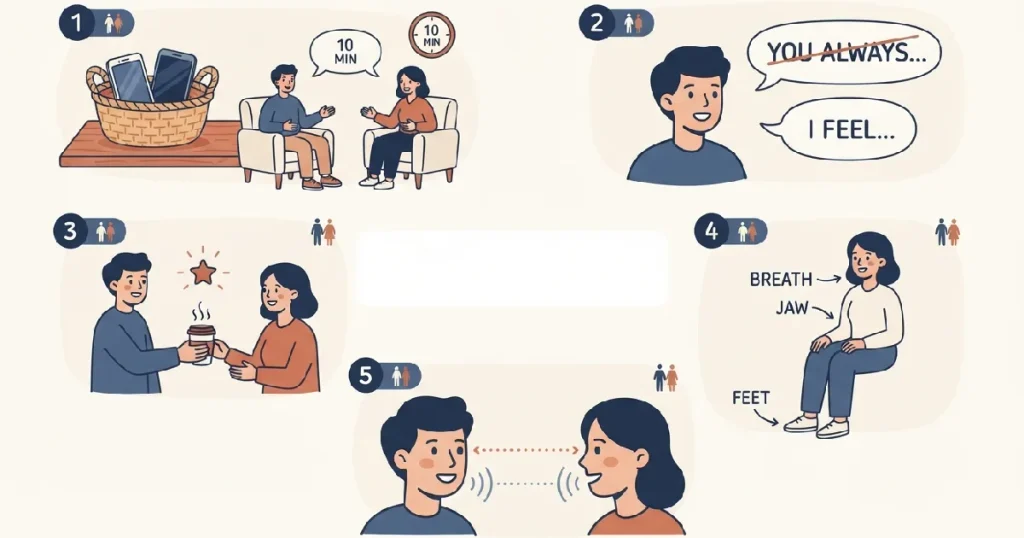
These emotional connection exercises work because they are short enough to actually do and specific enough to prevent you from defaulting back into logistics talk. Pick one tonight. You don’t need all five at once.
1. The 10-Minute Distraction-Free Daily Check-In
The claim: Set a fixed time every evening, phones away, screens off, and talk only about internal states, not tasks.
The evidence: In couples counseling, the single biggest barrier to reconnection isn’t lack of love. It’s lack of undivided attention. Even ten uninterrupted minutes activates a different kind of listening than the half-present kind most couples default to after 9 p.m.
So what: Ban household topics entirely during this window. If a chore or bill comes up, say “let’s hold that for later” and redirect to how the day actually felt.
2. The “I Feel” Game for Vulnerability
The claim: Replace blame-based language with feeling-based language, every single time, even when it’s tempting not to.
The evidence: “You never listen to me” invites defense. “I feel unheard when I’m talking and you’re on your phone” invites understanding. The words landing in your partner’s ear determine whether their nervous system opens up or shuts down.
Before: “You always ignore me when I get home.”
After: “I feel lonely when we sit in silence after work.”
So what: This one small language shift is one of the most effective relationship intimacy tips available, and it costs you nothing but a little practice.
3. Micro-Appreciation Verbal Rituals
The claim: Notice and say out loud the tiny things your partner does, specifically and often.
The evidence: John Gottman’s research on marital stability found that emotionally healthy couples maintain roughly five positive interactions for every negative one. That ratio isn’t built through grand romantic gestures. It’s built through small, repeated moments of noticing.
Here’s something most articles on this topic skip entirely. Appreciation doesn’t just make your partner feel good in the moment. It functions like a savings account for your relationship’s nervous system. Every specific “thank you for grabbing coffee, it made me feel thought of” makes both of your bodies associate each other with safety instead of stress. That buffer is what actually gets you through the next hard conversation without it turning into a fight.
So what: Say the specific thing, not the vague thing. “Thanks for handling that” barely registers. “Thank you for calling the insurance company today, I know you hate doing that, and it made me feel taken care of” absolutely does.
4. Somatic Boundary Regulating
The claim: Stay anchored to your own physical cues, your breathing, your jaw tension, your shoulders, during tense conversations, instead of absorbing your partner’s emotional state as your own.
The evidence: When conversations get tense, your body often reacts before your mind catches up. Heart rate spikes. Jaw clenches. This is the biological root of what feels like sudden defensiveness or shutdown.
Here’s a grounding technique your partner won’t even notice you using. It’s called the physiological sigh, two short inhales through the nose followed by one long, slow exhale through the mouth. Physiology researchers have shown this pattern calms the nervous system faster than a single deep breath. Use it mid-argument, before you respond, not instead of responding.
So what: You cannot build emotional safety with someone while your body is bracing for a fight. Regulate first. Talk second.
5. Structured Eye-Gazing and Synchronized Breathing
The claim: Sit facing each other in a quiet room, hold soft eye contact for three to five minutes, and let your breathing slowly fall into rhythm together.
The evidence: A now-classic study by psychologist Arthur Aron found that structured closeness exercises, including sustained eye contact, generate measurable feelings of connection between near-strangers in under an hour. Between two people who already love each other, the effect runs even deeper.
So what: This one will feel awkward at first. That’s normal. Laugh through it if you need to. The awkwardness usually fades by minute two, right around when something real starts to happen instead.
3 Signs of Real Emotional Intimacy in a Relationship

Once you start practicing these drills, how do you know it’s actually working? These are the signs of emotional intimacy that show up in daily behavior, not in how a relationship looks on paper.
Disagreeing Without Fear of Retaliation
You can tell your partner that something they said hurt you, and you get a listening ear back instead of a defensive one. Compare that to a couple where raising a concern triggers stonewalling or sudden cruelty. The first is safety. The second is management.
Unconditional Acceptance and Emotional Safety
You can admit something embarrassing, a wave of imposter syndrome before a big presentation, a fear you’ll never say out loud to anyone else, and your partner responds with warmth instead of judgment. Learning how to build emotional safety starts exactly here, in the moments when you’re most exposed and least attacked for it.
Balanced Autonomy and Shared Interdependence
You can genuinely encourage your partner’s separate hobby or friend group without a flicker of jealousy. Healthy interdependence looks like two whole people choosing closeness. Codependency looks like two incomplete people afraid of distance. The difference matters more than most couples realize.
Your Next 24 Hours: Building Emotional Intimacy
Rebuilding relationship trust and closeness doesn’t require a retreat or a twelve-week program. It requires one small, repeatable act done on purpose tonight.
One place to start is choosing a single drill and naming it out loud to your partner. Call it your “nightly ten,” your “I feel” rule, or your eye-contact minute. Giving it a name makes it a habit instead of an occasional idea.
A useful question to ask yourself tonight: when was the last time I told my partner something true that I hadn’t planned to say? If the answer feels uncomfortably far back, that’s not a diagnosis. That’s just information you can act on right now.
Conclusion: Taking the First Step Together
In my practice, I’ve watched couples rebuild years of quiet distance with nothing more dramatic than ten honest minutes a night, repeated without fail. Consistency beats intensity every single time.
You don’t need all five drills tonight. Pick one. Try it once. For more ways to keep the conversation going, The Gottman Institute’s open-ended questions are a solid next step once you’re ready to go deeper.
You still love each other. That was never the question. The real question is whether you’re willing to add one small log to the fire tonight.
That’s it. That’s the whole first step.
My Closing Remarks:
I’ve sat with couples who were terrified they’d drifted too far to come back. They hadn’t. What I’ve learned, again and again, is that closeness doesn’t return through one big conversation. It returns through small, unglamorous repetition, the kind nobody posts about. Start tonight, even if it feels clumsy. Clumsy still counts.
More Related Stories for You:
- Curious what it actually means when your partner still notices you after all these years? Here’s what it means when a guy calls you beautiful and why that small moment matters more than you think.
About The Author