
 Sara Carmen
Feeling unheard isn’t a communication failure. It’s a fixable pattern, and here’s the science-backed fix your relationship needs.
Key Points
- Active listening skills aren’t about staying quiet. They’re specific, learnable moves that calm your partner’s nervous system before you even respond.
- A 2018 study found that how you listen during your partner’s stress directly predicts how satisfied you’ll feel in the relationship down the road.
- Small shifts, like pausing three seconds or asking one open question, can turn a defensive fight into real connection tonight.
Contents
Table of Contents
We’ve all sat across from someone we love and felt completely alone in the room. Words move back and forth. Nothing actually lands. You talk, your partner nods, and somehow you still walk away feeling invisible.
That gap between hearing and truly listening is where most relationship pain lives. It’s not that couples stop caring about each other. It’s that they stop knowing how to listen in a way that actually reaches each other.
Here’s the part that should feel like relief: listening is a skill, not a personality trait. Five specific active listening skills can change how safe your partner feels with you starting tonight.
Why Couples “Hear” Each Other But Stop Truly Listening
Hearing is a biological event. Sound waves hit your eardrum whether you want them to or not. Listening is different. It’s a deliberate act of attention, and your brain doesn’t always want to spend the effort it requires.
Here’s what actually happens during a hard conversation. Your partner starts talking about something that hurt them. Instead of absorbing it, part of your brain quietly starts building a rebuttal. You’re not being cruel. You’re protecting yourself. Psychologists sometimes call this defensive listening, and it kicks in automatically the moment your nervous system senses criticism.
Add a phone buzzing on the counter or a mental to-do list running in the background, and full attention becomes nearly impossible. Most people don’t realize how often they’re only half-listening until their partner says, “You’re not even listening to me,” and they genuinely believe they were.
This isn’t a minor annoyance. A 2018 study published in the Journal of Family Psychology found that how attentively partners listened during moments of stress directly predicted how satisfied they felt in their relationship overall. Listening well wasn’t just polite. It was protective.
Learning how to listen without getting defensive starts with recognizing defensive listening as a nervous system response, not a character flaw. Once you see it that way, it stops feeling like something is wrong with you or your relationship.
When listening breaks down, small disagreements stop feeling like disagreements. They start feeling like proof that you don’t matter to the person you love most.
The 5 Active Listening Skills for Deep Intimacy
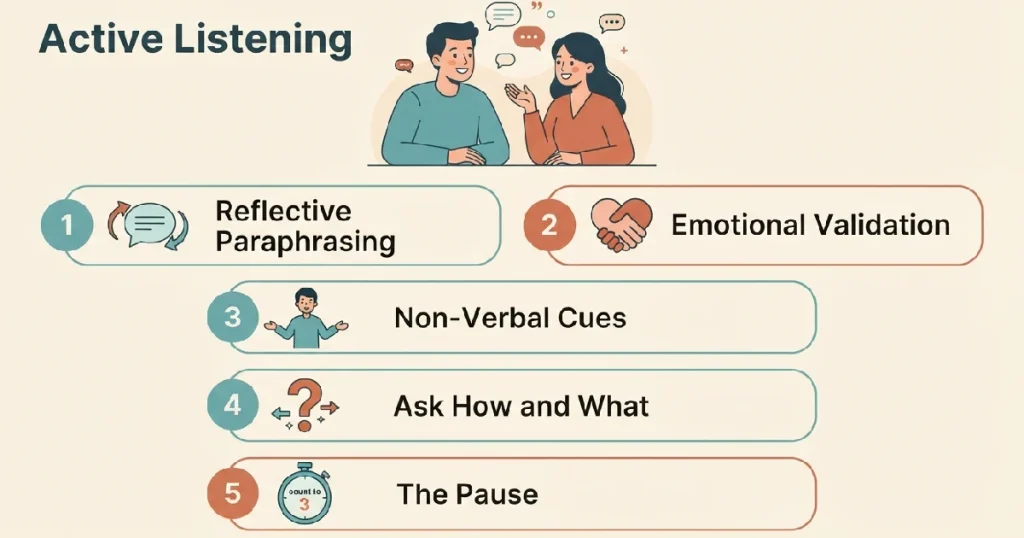
These aren’t abstract ideas. They’re relationship communication skills anyone can learn, regardless of how long you’ve been stuck repeating the same argument.
1. Reflective Paraphrasing: The Echo Effect
Reflective paraphrasing means summarizing your partner’s point in your own words, not word for word, but close enough that they know you actually processed it. Something like, “So what you’re saying is the silence after I left felt like I didn’t care.”
This forces your brain to actually encode what your partner said instead of skimming past it while you plan your response. It also gives your partner a chance to correct a misread before it snowballs into a bigger fight.
Therapists who teach the speaker-listener technique, a structured communication method used in couples therapy, rely almost entirely on this one move because it slows conversations down enough for both people to feel tracked.
Try this the next time your partner brings up something that stung them. Reflect their point back before adding your own. Watch how quickly the tension in the room drops.
2. Emotional Validation: Choosing Reality Over Winning
Validation means treating your partner’s feelings as legitimate, even when you don’t agree with the story behind them. It sounds like, “I can see why that made you feel dismissed,” instead of, “That’s not what I meant, so you shouldn’t feel that way.”
This is one of the central emotional validation techniques taught in the Gottman Method, a well-researched approach to couples therapy built on decades of observing real relationships. The idea is simple but not easy: your partner’s emotional experience can be true for them even if the facts are debatable.
Validation doesn’t mean surrender. You can validate a feeling and still disagree with a conclusion. “I get why you felt scared when I didn’t text back” is completely separate from agreeing you did something wrong.
What changes when you validate first is the entire emotional temperature of the room. Your partner stops needing to fight to be believed.
How Daniel Learned to Listen Without a Rebuttal Ready
Daniel used to pride himself on being a good problem-solver. Whenever his wife Priya brought up something bothering her, his mind immediately jumped to fixing it or defending himself, usually both at once.
One night, Priya said quietly, “I don’t need you to solve this. I need you to hear it.” Daniel sat with that sentence for days.
In their next hard conversation, he tried something different. He stayed silent until she finished, then repeated back what he heard before saying a word about his own side. Priya later told him it was the first time in years she felt like she was talking to him instead of at him.
Nothing about their disagreement changed that night. Everything about how safe it felt to have it did.
3. Attuned Non-Verbal Cues: The Silent Safety Net
Words are only part of the conversation. Your uncrossed arms, relaxed shoulders, and steady eye contact tell your partner’s nervous system something words can’t: you are not a threat right now.
When you’re anxious or defensive, your body tightens automatically, and your partner picks up on it before you’ve said a single word. Researchers who study nonverbal communication estimate that a large share of emotional meaning gets carried through tone, posture, and expression rather than the actual words spoken.
Here’s the part that rarely gets said out loud.
Listening isn’t only a mental skill. It’s a physical signal. Your calm body does half the work of making your partner feel safe enough to keep talking, long before your words even catch up. This is really the hidden mechanism behind active listening for couples: your nervous system is speaking whether you mean it to or not, and your partner’s nervous system is always listening back.
The next time your partner starts sharing something hard, check your posture before you check your response. Uncross your arms. Turn your body toward them. Let your face soften.
4. Therapeutic Curiosity: Real Questions, Real Answers
Questions like “Why would you say that?” put your partner on trial. Questions like “What was the hardest part of that for you?” invite them to open up.
This shift from closed, accusatory questions to open, exploratory ones changes the entire shape of a conversation. Closed questions demand a defense. Open questions invite a story. One turns your partner into a witness being cross-examined. The other turns them into a collaborator helping you understand their inner world.
Try swapping your next “why” question for a “what” or “how” question. Instead of “Why didn’t you just tell me?” try “What made it hard to bring this up with me?” The second version almost always gets you a more honest, less guarded answer.
5. The Pause Principle: Why Three Seconds Matter
Most people start crafting a response before their partner has even finished speaking. This happens so fast it feels involuntary.
The fix is deceptively simple. After your partner stops talking, silently count to three before you say anything. That small gap interrupts the reflex to rebut, defend, or immediately offer a solution nobody asked for.
Three seconds doesn’t sound like much. But it’s enough time to notice whether you’re about to respond to what your partner actually said, or to the version of it your defensiveness built in your head.
Active Listening Skills at a Glance

| Skill | What It Sounds Like | Why It Works |
|---|---|---|
| Reflective Paraphrasing | “So what you’re saying is…” | Confirms understanding before misreads escalate |
| Emotional Validation | “I can see why that hurt.” | Removes the need to fight for legitimacy |
| Attuned Non-Verbal Cues | Open posture, steady eye contact | Signals physical safety, not threat |
| Therapeutic Curiosity | “What was hardest about that?” | Turns cross-examination into discovery |
| The Pause Principle | A silent three-second count | Interrupts the rebuttal reflex |
Where to Start Tonight: Build the Habit
You don’t need to master all five skills at once. Pick one and practice it deliberately for a week.
One place to start is what you might call the One-Minute Echo. At the end of dinner or before bed, ask your partner one open question about their day, then reflect back what you heard before adding your own thoughts. It takes sixty seconds and trains the reflective paraphrasing muscle without pressure.
Consider also the Phone-Down Rule during any conversation that feels even slightly loaded. Put the phone face down, out of reach, before your partner starts talking. This single environmental change protects your attuned non-verbal cues from the biggest thief in the room.
A useful question to ask yourself mid-conversation is simple: “Am I listening to understand, or listening to respond?” That one sentence, asked silently in your own head, can catch a defensive spiral before it starts.
If a conversation goes sideways anyway, that’s not failure. It’s an invitation to repair. In my practice, the couples who improve fastest aren’t the ones with perfect technique. They’re the ones willing to say, “Can we try that again? I don’t think I was really listening.” That single sentence rebuilds more trust than a flawless conversation ever could.
Shifting From Conflict to Real Connection
Intimacy was never going to be built in one grand gesture. It gets built in the sixty-second moments: the pause before you respond, the question you ask instead of the assumption you make, the arms you uncross instead of fold.
You will not do this perfectly. You’ll interrupt when you meant to pause. You’ll ask “why” when you meant to ask “what.” That’s not a failure of the relationship. That’s just being human under stress.
What matters is the repair, not the perfection. Every time you catch yourself and try again, your partner learns something important: being fully heard by you is still possible, even after years of missing each other.
Tonight, pick one skill. Just one. Notice what happens when your partner realizes, maybe for the first time in a while, that you’re not just hearing them. You’re finally listening.
My Closing Remarks
The couples I’ve worked with rarely fall apart because they stopped loving each other. They fall apart because they stopped feeling heard, one small conversation at a time. I still remind myself of the pause principle in my own relationships, and it still surprises me how three quiet seconds can soften an entire argument. You don’t need a perfect script. You need one honest attempt tonight, and then another tomorrow.
More Related Stories for You
- If your partner’s compliments ever leave you second-guessing what they really mean, this related read on what it means when a guy calls you beautiful can help you decode it, too.
About The Author