
 Sara Carmen
The fight isn’t about the dishes. It’s about whether you feel heard, and these five exercises can change that starting tonight.
Tired of the same fight on repeat? These seven at-home exercises help you feel heard again, starting tonight.
Key Points
- These communication exercises for couples target the biology of conflict, not just the words you choose.
- You don’t need a therapy degree to try these communication exercises for couples, just ten honest minutes and a little patience.
- Backed by research referenced by the Gottman Institute, these tools lower conflict intensity without one single heavy, exhausting talk.
Contents
Table of Contents
Most couples don’t fall apart in one dramatic moment. They drift there quietly, one repeated argument at a time, until dinner turns silent and the television does more talking than either partner does.
You know this feeling.
You’ve had the fight about the dishes, or the tone of voice, or something your mother-in-law said, so many times you could recite your partner’s next line before they say it.
Someone watching from the outside might think you two just don’t talk enough. But what they don’t see is the hundreds of small conversations happening every single day, most of them one-sided, most of them landing nowhere.
Someone else might assume the silence means you’ve stopped caring. But what’s actually happening is closer to exhaustion. You’ve stopped bringing things up because bringing things up never seems to change anything.
That gap between trying and getting nowhere is where couples usually give up on talking altogether.
You’ve tried talking. You’ve tried listening. You’ve tried waiting until you’re both calm. And yet the same fight keeps finding its way back into your living room. You start to wonder if something is wrong with the two of you.
There isn’t.
What’s happening is not a character flaw, and it’s not proof that you picked the wrong partner. Communication exercises for couples exist because talking is a skill, and like any skill, it gets rusty without practice. In the next few minutes, you’ll learn seven exercises that retrain how you and your partner actually hear each other, plus fifteen ready-made questions you can use tonight.
Here’s the part almost nobody explains clearly. Most relationship conflict isn’t really about the dishes or the mother-in-law comment. It’s about a nervous system reaction called emotional flooding, a state where your heart rate spikes and your body shifts into a fight-or-flight response. Once you’re flooded, you physically cannot process what your partner is saying. You’re not choosing to shut down or attack. Your body is doing it for you.
Dr. John Gottman, one of the most cited relationship researchers of the last four decades, describes a pattern called demand-withdraw, where one partner pushes for a conversation and the other pulls away. According to the Gottman Institute, structured communication practices help interrupt this pattern before it hardens into a permanent habit.
Left unexamined, this pattern doesn’t just strain relationships. It can quietly become the reason they end.
This matters because you’re not just fighting about the topic on the table. You’re fighting your own biology while trying to have a rational conversation. That’s an almost impossible task, and it’s part of why “just calm down” has never once worked in the history of relationships.
Why At-Home Relationship Communication Exercises Matter
Here’s what almost no one tells you: the once-a-month “deep talk” you keep trying to schedule might be part of the problem.
Big, heavy conversations carry so much emotional weight that both partners walk in already braced for impact. That bracing alone can trigger flooding before a single hard word gets said.
Short, structured rituals work differently. Research on couple communication interventions has found that brief, consistent psychoeducational tools produce measurable drops in the demand-withdraw pattern, compared to relationships that rely only on occasional, unstructured talks. In plain language, doing a little, often, beats doing a lot, rarely.
One ground rule matters more than any exercise on this list. Start these techniques on a calm evening, not in the middle of round three of an argument. Expect some awkwardness the first few times. Reading from a script with someone you’ve known for years can feel stiff. That discomfort fades within a week or two, once the exercise starts to feel like part of your relationship instead of a performance.
But knowing why these tools work is only half the job. The real difference happens once you actually try one.
7 Step-by-Step Communication Exercises for Couples
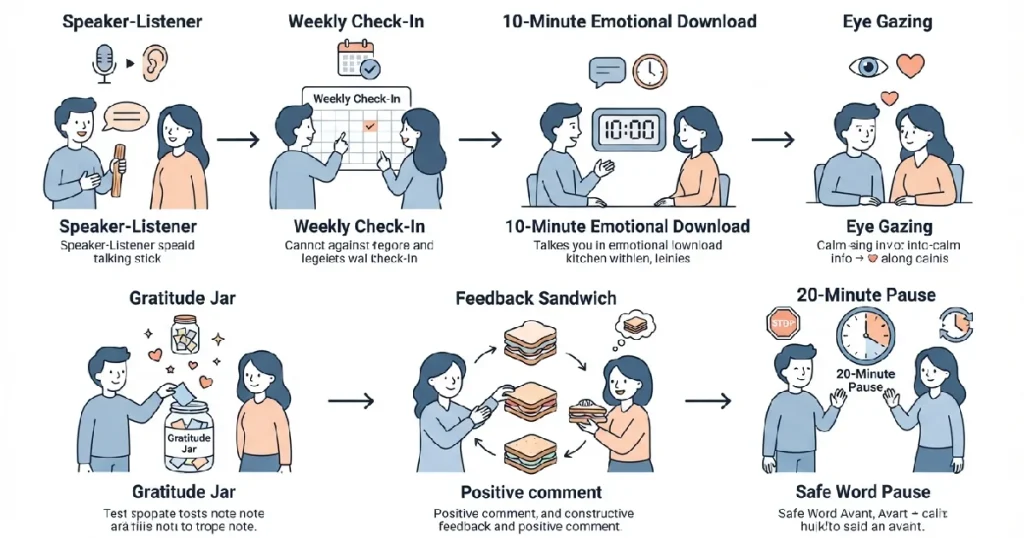
Think of emotional flooding like a smoke alarm going off while you’re simply making toast. The alarm doesn’t care that nothing is actually on fire. It just screams, and no amount of logic turns it off right away. You have to step back, let the smoke clear, and reset the sensor.
Every exercise below works the same way. Each one gives your nervous system a chance to reset before, during, or after conflict, so you can actually hear the person across the table instead of just surviving the alarm.
1. The Speaker-Listener Technique: An Active Listening Technique That Works
Grab any small object, a pen, a coaster, a TV remote. Whoever holds it is the only one allowed to talk.
The speaker gets two uninterrupted minutes to share one specific issue using “I” statements, like “I felt hurt when…” instead of “You always…” No blame, no history lesson about last Tuesday.
The listener’s only job is to repeat back what they heard, without adding a rebuttal, a fix, or a “yeah, but.” Something like, “So what I’m hearing is you felt dismissed when I checked my phone during dinner.”
Then you swap the object and switch roles.
This active listening technique feels mechanical at first. That’s the point. It forces you to slow down enough to actually register what your partner said instead of rehearsing your comeback while they’re still talking.
2. The Weekly Relationship Check-In: A Couples Therapy Exercise at Home
Pick one recurring 30-minute slot each week. Sunday evening after the kids are asleep works well for a lot of couples.
Structure it in three parts. Spend ten minutes on what went well this week, naming specific moments, not vague compliments. Spend ten minutes on one thing that needs adjusting, using the speaker-listener format above. Spend the last ten minutes on logistics, calendars, or upcoming stressors.
Most couples in this situation don’t realize that resentment doesn’t announce itself. It just quietly accumulates until date night stops happening at all.
This exercise works because it gives resentment nowhere to hide for more than seven days.
3. The 10-Minute Daily Emotional Download: A Simple Relationship Communication Exercise
Set a timer for ten minutes every evening. Each of you takes a turn sharing what’s weighing on you outside the relationship. Work stress, a hard phone call with a parent, a bad night’s sleep.
The rule that makes this exercise work is strict. The listening partner offers only empathy and validation. No fixing, no advice, just something like, “That sounds exhausting, I’m glad you told me.”
Think of this as building a small wall around the two of you, with the outside world on one side and your partnership on the other. Couples who feel like teammates against shared stress tend to report far higher satisfaction than couples who feel like they’re managing life alone under the same roof.
4. The Non-Verbal Eye-Gazing Exercise for Improving Emotional Intimacy
Sit facing your partner, knees almost touching, and hold eye contact in complete silence for three to five minutes. No talking. No phones.
You will probably laugh within the first thirty seconds. That’s not a failure. It’s your nervous system trying to break the tension because sustained eye contact without words is genuinely rare and a little vulnerable for most adults.
Push through the giggles and stay with it. Prolonged eye contact activates a process researchers call co-regulation, where two nervous systems begin to sync their heart rate and breathing simply by being present with each other. It’s a similar biological mechanism to what calms a crying infant when a parent holds them close.
Couples who practice this often report feeling closer within minutes, without saying a single word.
5. The Gratitude and Appreciation Jar: A Daily Communication Exercise for Couples
Keep a small jar somewhere visible, on the kitchen counter or a nightstand. Every day, each of you writes one specific thing you appreciated about the other and drops it in.
Specific matters here. “Thanks for being great” doesn’t rewire much of anything. “Thank you for grabbing my coffee order right without me asking this morning” does. The brain responds to detail, not generic praise.
At the end of the week, sit down together and read every slip out loud. Most couples in conflict develop a kind of tunnel vision where they only notice what’s going wrong. This exercise trains the opposite habit on purpose.
6. The Sandwiched Feedback Exercise: Conflict Resolution for Couples Made Simple
When you need to raise something that bothers you, wrap it between two honest compliments.
Start with real appreciation: “I love how present you are with the kids.” Then state the specific change you’re asking for: “Can we split the bedtime routine more evenly? I’ve been feeling stretched thin most nights.” Close with reassurance: “I’m not upset with you, I just want us both less exhausted.”
This isn’t about softening the truth into mush. It’s about giving your partner’s defense system a reason to stay open instead of bracing for an attack. Most people hear the first sentence of a hard conversation and decide within seconds whether to listen or defend. Genuine appreciation buys you those seconds.
7. The Safe Word De-escalation Drill: A Conflict Resolution Tool for Couples
Pick a word together, when you’re calm, that either of you can say the instant a conversation starts sliding into flooding. Something neutral, or even a little silly, works best. Some couples use “pineapple.” Others use “timeout.”
When either partner says the word, the conversation stops immediately. No last jab, no “fine, but one more thing.” You both step away for a minimum of 20 minutes.
That number isn’t random. Once your body releases stress hormones like adrenaline and cortisol during an argument, it takes roughly 20 minutes for your heart rate to return to baseline. Trying to keep talking before that window closes means you’re negotiating with a nervous system still primed for battle.
Use the 20 minutes for something calming, a walk, music, deep breathing, not stewing over your rebuttal. Then return once you can actually hear each other again.
15 Conversation Starters and Templates to Use With These Communication Exercises for Couples

Bring these into your check-ins, your daily download, or a quiet evening with no agenda.
- “What is something I did this week that made you feel deeply loved, and what did I do that made you feel distant?”
- “What is a fear or anxiety you’re carrying right now that you haven’t shared with me yet?”
- “I really love how you handled that situation earlier, because it showed me how much you care about our family.”
- “On a scale of 1 to 10, how connected to me do you feel today, and what can we do to raise that number?”
- “If we could change one repeating pattern in our relationship, which one would you fix first?”
- “I want to talk about [topic], but I’m worried it will come out wrong. Can you help me unpack it safely?”
- “How did your family handle anger growing up, and how do you see that shaping our arguments now?”
- “What does physical closeness mean to you right now, and how can I support that better this week?”
- “I realize that when I said [action], it made you feel [emotion]. I’m truly sorry for my part in that.”
- “You seem overwhelmed tonight. Do you need me to just listen, or do you want help solving it?”
- “In what ways have we grown closer over the past year, and where do you feel we’re stalling?”
- “Thank you for handling [chore or task] today, it really took a weight off my shoulders.”
- “What’s a dream or goal you have for your personal life right now that I can help you reach?”
- “Is there any area of our relationship where you feel your boundaries are being crossed or ignored?”
- “I’m still holding onto some hurt about [event]. I want to let it go, but I need us to talk about it once more.”
Use these as often as you like. Just don’t skip the moment when these exercises reach their limit.
When At-Home Communication Exercises for Couples Aren’t Enough
These seven exercises solve a communication problem. They were never built to solve a safety problem, and it helps to know the difference.
If your relationship involves ongoing infidelity, active addiction, or any pattern where one partner controls, threatens, or frightens the other, no worksheet or jar full of notes is going to fix that. Those situations call for a licensed professional, not a Sunday night check-in.
A review published by the National Center for Biotechnology Information found that structured clinical approaches, including Emotion-Focused Therapy, a method that helps couples identify and reshape the deeper emotions driving their conflict, produced stronger and longer-lasting results for couples in entrenched conflict than self-guided efforts alone.
If you’ve practiced several of these exercises consistently for a month and you’re still stuck in the exact same fight, that’s not a failure. It’s information. It usually means there’s a deeper wound, maybe from childhood, maybe from a past betrayal, that needs a trained third person in the room to help unpack it safely.
Reaching out for that support isn’t giving up on your relationship. It’s often the moment couples finally stop treating each other like the enemy and start treating the pattern as the real problem.
Putting These Communication Exercises for Couples Into Practice Tonight
You don’t need all seven exercises tonight. Trying to overhaul your entire communication style in one evening usually backfires and leaves both of you more discouraged than before.
One place to start is what I call the One-and-Done Rule. Pick exactly one exercise from this list. Practice it daily or weekly for one full week before adding anything else. Mastery of one small habit beats a half-hearted attempt at seven.
Consider starting with the 10-minute daily emotional download if your relationship feels more distant than volatile. Consider the safe word drill first if you’re both stuck in frequent, intense arguments.
A useful question to ask yourself before bed tonight: which exercise on this list would my partner most want me to try first? Their answer might surprise you, and asking it out loud is already one of the better communication exercises for couples you’ll try all week.
The Real Point of Communication Exercises for Couples
Picture that same dinner table from the beginning of this piece. The one with the silence, and the remote control doing more talking than either of you.
Now picture a small jar sitting in the middle of it, half full of folded notes. Picture a timer set for ten minutes, and two people actually looking at each other while they talk.
That shift doesn’t require a dramatic breakthrough or a two-hour conversation about the state of your marriage. It requires one exercise, tried on one ordinary Tuesday, then tried again the next day.
Communication in a relationship isn’t a fire that either burns or goes out. It’s a muscle. Muscles get stronger through small, repeated, occasionally awkward reps, not one heroic workout.
Pick one exercise from this list. Try it tonight. That’s the whole assignment.
My Closing Remarks
In my practice, I’ve watched couples transform not through one big conversation, but through small, slightly awkward rituals like these, repeated on ordinary nights. The eye-gazing exercise tends to surprise people the most. Couples walk in expecting it to feel silly and walk out saying it felt like meeting each other again for the first time in years. You don’t need a perfect relationship to start. You just need ten minutes and a willingness to feel a little uncomfortable before it gets easier.
More Related Stories for You
- Curious what it means when your partner expresses affection through words instead of actions? Read What It Really Means When He Calls You Beautiful for a closer look at decoding verbal affection in relationships.
About The Author