
 Sara Carmen
Your body remembers what your mind wants to forget. Here’s how to date again without losing yourself in the process.
Key Points
- Dating after narcissistic abuse means learning to tell the difference between an actual red flag and an old wound waking up.
- Your hypervigilance isn’t paranoia. It’s a nervous system doing exactly the job it was trained to do.
- A single low-stakes boundary test can reveal more about a new partner than three months of late-night texting ever will.
Contents
Table of Contents
Most people walk into a first date wondering if they’ll like the person across from them. You walk in wondering if you can trust yourself enough to know the difference between chemistry and danger.
Someone might watch you laugh at his joke over coffee and think you seem relaxed and easy to talk to. What they don’t see is the quiet math running underneath: too nice, too fast, too interested. Is this the start of something good, or the start of something that ends the same way the last one did?
Someone might notice you canceled a second date after he texted “good morning beautiful” following one dinner. What they don’t see is that your body remembered a different man who said almost the exact same thing three years ago, right before everything turned.
That gap between what you want and what your body allows has a name. It’s called cognitive dissonance, and it is not a character flaw.
Here’s the part almost no one tells you: your picker was never broken. It got trained by a very convincing teacher.
This guide walks through why self-trust unravels after prolonged manipulation, how to read your nervous system’s alarms without letting them run the show, and why a small boundary test can tell you more about a new partner in one week than months of texting ever could.
Why Self-Trust Shatters After Narcissistic Abuse
Trust in yourself is built on something psychologists call an internal locus of evaluation. It simply means you know your own experience is real without needing someone else to confirm it. You feel hurt, and you know you’re hurt. You feel unsafe, and you act on it.
Prolonged gaslighting slowly moves that locus outside of you. Over time, your reality starts running through a filter that isn’t yours anymore. You wait for a reaction before deciding how you feel about your own life.
Researchers sometimes describe the result as a form of post-traumatic self-esteem damage, a pattern where survivors quietly absorb their abuser’s criticisms as fact long after the relationship ends. A recent Sage Journals study on post-separation psychological adjustment found that survivors of narcissistic partner abuse often show measurable, lasting drops in self-concept clarity, meaning they genuinely struggle to answer basic questions about who they are and what they want.
This is why you keep replaying old arguments looking for the moment you were “too sensitive.” This is why a compliment from a new date can feel like it needs fact-checking.
That’s not weakness. That’s wiring.
Your self-doubt isn’t proof that your judgment is bad. It’s proof that someone worked very hard, for a very long time, to convince you it was.
Somatic Mapping: Reading Your Nervous System Triggers While Dating
You cannot think your way back into feeling safe. That’s the part that frustrates most people in early recovery, because logic tells you the new person is kind, and your body disagrees anyway.
This is where somatic awareness comes in, meaning attention to the physical sensations in your body rather than only the thoughts in your head. Your nervous system after narcissistic abuse works something like a home security system installed during a robbery. It doesn’t just warn you about real danger anymore. It screams at the mail carrier.
Picture this on an actual date. Your date takes an hour to text back and your chest tightens instantly. Your shoulders creep up toward your ears while you scan his face for the smallest shift in mood. That racing, bracing, urgent feeling is a trauma trigger, not information about him.
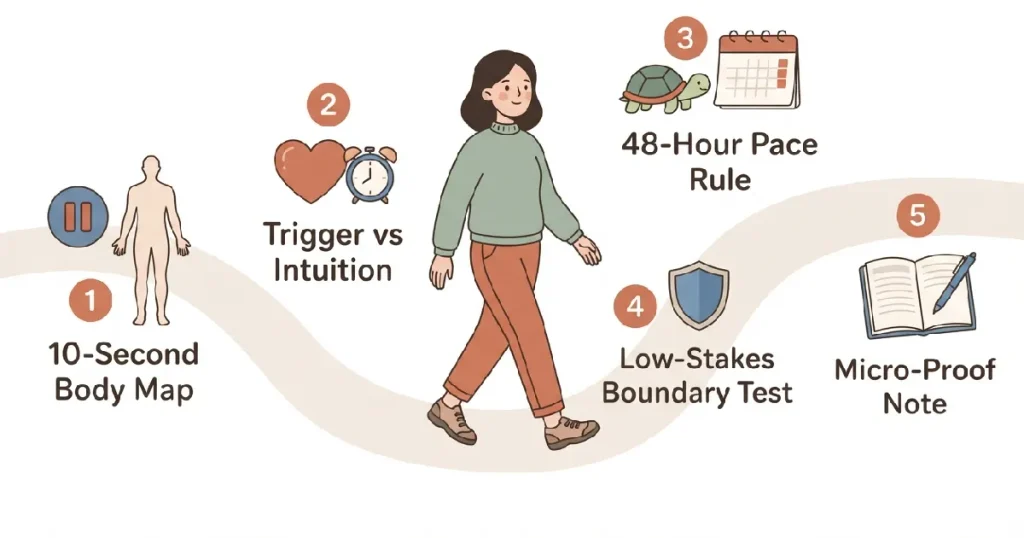
True intuition feels almost boring by comparison. It’s quiet. It’s a calm, grounded knowing in your gut, not a five-alarm fire in your chest. Anxiety says “something is wrong, do something now.” Intuition says “something is off, and I have time to notice it.”
One useful practice: after a date, sit for two minutes and simply notice your body. Is your jaw tight? Is your breathing shallow? Did your shoulders drop when he walked away, or did they finally soften?
A steady, emotionally consistent partner can actually set off a false alarm at first, a process related to what psychologists call co-regulation, where your nervous system slowly learns safety by borrowing it from someone else’s calm. If stability feels unfamiliar right now, that discomfort doesn’t mean it’s wrong. It usually means it’s new.
Here’s something you won’t find in most recovery advice: your nervous system isn’t trying to sabotage your love life. It’s trying to finish a job it never got to complete, which is proving to itself that you can say no and survive it. Every time you set a small boundary and nothing bad happens, you’re not just dating better. You’re literally teaching your body a fact it never got to learn the first time around.
Love Bombing vs Healthy Love: Why Calm Can Feel Boring
Dating apps reward speed. A profile with intense energy, constant messaging, and grand declarations often gets more attention than one built on quiet consistency, which makes learning the difference between love bombing and healthy love genuinely harder now than it was a generation ago.
Love bombing looks like destiny talk within days, pressure to define the relationship fast, and a spark so intense it feels almost dizzying. That intensity is real, but it’s also chemical. High stress hormones combined with unpredictable, intermittent attention create a dopamine loop your brain reads as excitement.
Healthy love looks almost unglamorous next to that. It’s someone who respects your timeline, takes accountability without a fight, and creates a baseline you’d honestly describe as calm.
According to research summarized in an NCBI study on the neurobiology of traumatic stress, the brain’s stress and reward systems become tangled together during prolonged trauma, which is part of why intermittent affection from a difficult partner can feel more compelling than steady affection from a safe one. This is trauma bonding recovery in its most physical form. You’re not weak for missing the intensity. You’re detoxing from a chemical pattern your body got used to surviving on.
That’s why a genuinely kind, reliable partner can feel oddly flat at first. Your body isn’t bored. It’s withdrawing.
Spotting Red Flags Early With the Low-Stakes Boundary Test

There’s a common pitfall in early dating after abuse: trauma dumping, or sharing painful history too soon. It feels like honesty, but it often hands a predatory dater a map of exactly where your vulnerabilities live.
A far more useful tool is what I call the low-stakes boundary test, something I regularly walk clients through in my practice. You intentionally set a small, low-risk boundary early on, then simply watch how the other person responds.
Now What: Building Nervous System Trust One Interaction at a Time
Rebuilding self-trust doesn’t happen through one big insight. It happens through small, repeatable evidence.
The Two-Minute Body Check. After any date or heavy text exchange, pause and scan your body head to toe. Notice tension, breath, and posture. This trains you to catch a somatic signal before it turns into a spiral.
The Boundary Ladder. Start with the smallest possible boundary, like changing a date time, before moving to bigger ones, like discussing exclusivity. Each small success becomes proof your voice is safe to use.
The Evidence Journal. Keep a short running list of moments where your gut was right, even about small things. One useful question to ask yourself here: what did my body know before my mind caught up?
The 48-Hour Pace Rule. Before agreeing to any milestone, whether that’s meeting family or saying “I love you,” give yourself two full days before responding. Urgency is a manipulation tool. Time is a filter it can’t survive.
Reclaiming Your Narrative While Dating After Narcissistic Abuse
Trauma bonding recovery isn’t a straight line, and one triggered evening doesn’t erase the progress behind you. Feeling your chest tighten on a good date isn’t proof you’re back at square one. It’s proof your body is still paying attention, just louder than necessary sometimes.
Picture that same coffee date from the beginning, the one where you sat quietly calculating whether he was too nice. You still notice the thought. But now you also notice your breath, your shoulders, the quiet difference between an old alarm and real information. That noticing is the whole skill.
Self-trust doesn’t return all at once. It returns in small, boring, unglamorous moments where you honor a boundary and nothing bad happens.
You are not learning to love without fear. You are learning to love with your eyes open.
My Closing Remarks
In my years working with survivors of manipulative relationships, the ones who heal fastest aren’t the ones who avoid dating altogether. They’re the ones who date slowly, on purpose, treating every small boundary as data instead of a test they might fail. Your caution isn’t damage. It’s discernment still finding its footing. Be patient with it. It’s working harder for you than you realize.
More Related Stories for You
- Curious what these patterns look like from the other side? Learning to recognize narcissist traits in men early can make your next low-stakes boundary test even easier to read.
About The Author