Sara Carmen

Nothing physical happened. So why does it feel like the whole marriage quietly moved out of the house?
Key Takeaways
- Emotional relationship cheating has three structural markers, and none of them require touching.
- The strongest of the emotionally cheating signs is timing: who hears your news first, and who gets edited out.
- Trust returns in a fixed order, and skipping a phase resets the clock, usually at 2 a.m.
Quick answer: Emotional relationship cheating is a secret, emotionally intimate bond outside your relationship that redirects loyalty, honesty, and romantic energy away from your partner. It usually starts as an ordinary friendship. Three markers define it: secrecy, emotional intimacy that outranks the partnership, and unspoken sexual chemistry.
Contents
Table of Contents
His phone lands face down on the counter, the way it always does now. Later you hear him laugh at something on the screen, and the answer comes back flat: “It’s just Dana from work. We’re friends.”
You believe him. You also feel sick, and you can’t explain why without sounding possessive.
That gap is where emotional cheating lives. In my practice, the hardest cases rarely involve a hotel receipt. They involve a friendship that slowly became the place where all the real news went.
Psychologist Shirley Glass described this as a reversal of walls and windows: the wall goes up between partners while a window opens to someone else (Glass & Staeheli, 2003). Below you get a structural test you can run tonight, the signs that hide in timing, and seven moves that rebuild trust in the right order.
Secret 1: The Emotional Cheating Meaning Is Structural

Most emotional affair cheating follows the same three-part shape. Glass’s clinical criteria were secrecy, emotional intimacy beyond what the partnership receives, and sexual chemistry both people notice and never name (Glass & Staeheli, 2003).
Touch is optional. Architecture is the whole story.
Intent is a poor test. Plenty of people cross the line while sincerely believing they are loyal, because they measure fidelity by what their body has avoided.
In her clinical sample, 82% of unfaithful partners said the affair began with someone who was “just a friend,” often a coworker. The risk usually walks in wearing a badge and knowing your schedule.
Put the friendship through this table
| Signal | Close friendship | Emotional affair |
|---|---|---|
| Secrecy | You mention them at dinner, unprompted | Their name vanishes from your stories |
| First disclosure | Your partner hears big news first | They hear it first, most days |
| Content | Surface venting, shared jokes | Marriage complaints, fears, fantasies |
| Chemistry | Warm, uncharged | A spark both silently agree to ignore |
| After contact | You come home lighter and share it | You come home quieter and need space |
| When asked | You get curious | You explain why the question is unfair |
| Access | Your partner could read the thread and shrug | Reading it would end your week |
Two rows in the right column deserve a conversation. Four or more, holding steady for a month, is a pattern.
The edge cases most lists get wrong
- The work spouse: shared stress builds intimacy fast. Watch whether the friendship shrinks when your partner joins the group chat.
- The ex who checks in: history plus a private channel is a window with old wiring.
- An AI companion or a stranger in DMs: no body, same architecture.
- A therapist or coach: paid, boundaried, one-way disclosure. That wall protects your relationship.
Secret 2: Emotionally Cheating Signs Hide in Timing
Content can be scrubbed. Timing can’t.
A common pitfall we frequently see: someone reads 400 messages, finds nothing sexual, and decides they’re paranoid while the marriage keeps leaking through habits nobody logged. The signs of emotional cheating that hold up in daylight are behavioral.
Consider a seven-day observation instead of a midnight phone raid. Log three things once a day:
- First tell: who heard the day’s biggest news first, you or someone else?
- Screen behavior: any flip, tilt, or walk-out that happens for one specific contact?
- Re-entry mood: after messaging that person, does your partner move toward you or away?
Three matching days tell you more than one flirty line. You are measuring redirection, and redirection is the injury.
Log one more marker: comparison thinking. Gottman describes a negative comparison habit where a partner stacks you against someone who only sees their best hours. You lose a contest you never entered.
Why “nothing happened” hurts this much
Glass argued that emotional betrayal can damage a marriage more than extramarital sex, because the sharing itself was the marriage’s main asset (Glass & Staeheli, 2003). Clinicians call the aftermath betrayal trauma.
Your attachment system had this person filed as a safe base. When the base routes warmth elsewhere, your body reads threat and starts scanning. Sleep drops, timestamps get checked, and hypervigilance moves in.
There’s also no single event to point at, so the hurt arrives without a receipt. That’s what makes people doubt themselves: grieving a loss they can’t document. For the signals that show up away from the phone, our companion piece on the patterns that often precede physical cheating fills in the rest.
Secret 3: Emotional Affair Recovery Only Works in Order
Emotional relationship cheating breaks trust in a sequence, so repair has to run in sequence too. Gottman’s Trust Revival Method moves through Atone, Attune, Attach (Gottman & Silver, 2012).
- Atone: full responsibility, full disclosure, zero defensiveness, real transparency about devices and whereabouts.
- Attune: rebuild the daily habit of knowing each other’s inner world, including needs that went unspoken for years.
- Attach: physical and emotional reconnection, once safety exists.
Couples stall when they start at Attach. A weekend away in month two, while the other person is still texting, buys three good days and a worse crash.
Two traps that reset the clock
Trickle disclosure. Facts released in slices (“we only had lunch,” then “twice,” then “he stayed over once”) force the hurt partner to re-grieve from zero. One complete timeline beats six partial ones.
Permanent policing. Gottman’s method includes genuine transparency, and it works. Open access with no end date turns one partner into a warden and the other into a teenager. The couples who improve fastest in our sessions set a review date: full access now, revisit at 90 days, taper on evidence rather than mood.
When repair is the wrong call
Continued contact, contempt, or stonewalling when you ask are stop signs. So is “I’ll stop when you stop checking.” One person cannot carry both halves of a repair attempt.
Practical What-To-Do-Next: Secrets 4 to 7
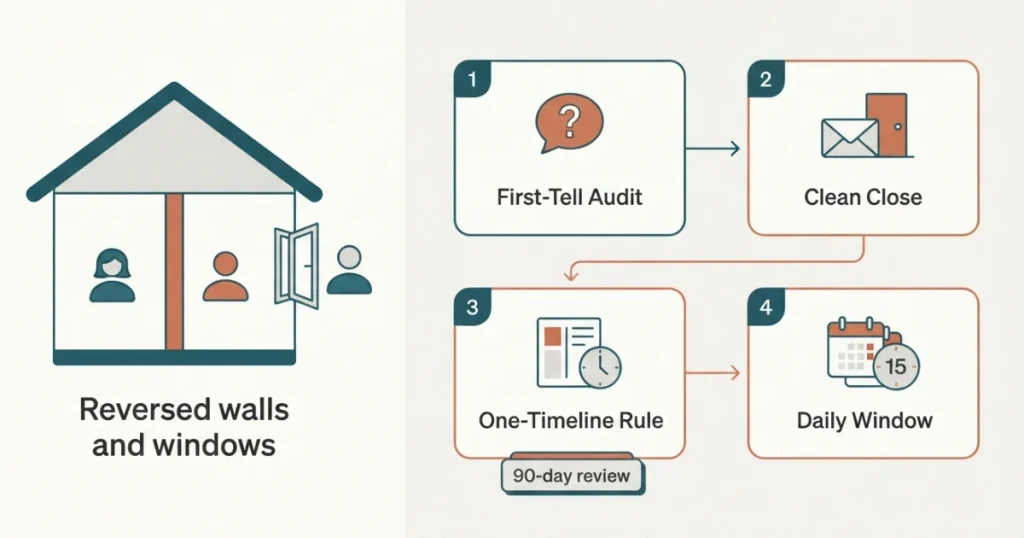
Secret 4: The First-Tell Audit
One place to begin is a single low-heat question at a calm moment: “When you got that promotion news, who did you want to tell first?” Then stay quiet.
Notice what shifts when you ask about priority instead of flirting. First-tell priority is hard to deflect, and the honest answer usually lands before the defense does.
Secret 5: The Clean Close
Consider testing a written ending instead of a slow fade. Ghosting leaves a door ajar, and both people know it.
Send this while your partner is in the room: “I crossed lines in this friendship that hurt my marriage. I’m ending contact so I can repair it. Please don’t reach out again.”
Then change the structure behind the promise. Move work threads to email, skip the one-on-one lunches, and let your partner see the sent message. Digital boundaries beat verbal reassurance.
Secret 6: The One-Timeline Rule
Schedule 90 minutes, phones off, ideally with a counselor present. The involved partner writes the full disclosure timeline beforehand and hands it over once: facts in one column, feelings in the other.
After that, questions get answered inside a daily 20-minute window rather than at 2 a.m. The hurt partner gets answers, and both nervous systems get a bedtime.
Secret 7: The Daily Window
Gottman’s attunement phase runs on small, boring repetitions: 15 minutes each evening on stress unrelated to the affair, plus one 25-minute check-in weekly.
Try this script: “What did I do this week that made you feel picked first? What’s one thing you needed and didn’t ask me for?”
Track six weeks of it. Predictability is what the body is waiting for.
Frequently Asked Questions
We never touched or flirted. Can it still be cheating?
If the bond is secret, gets the deepest disclosure first, and carries unspoken chemistry, it meets the clinical definition of an emotional affair. Touch was never the deciding factor.
How long does rebuilding trust actually take?
Gottman’s team puts no fixed clock on the three phases. Expect months of atonement before daily habits feel natural, with setbacks around anniversaries and fresh stress. Progress looks like fewer daily check-ins.
Is an AI companion or online-only friend cheating?
Judge the structure: hidden channel, first-dibs disclosure, romantic charge. A private bond that drains your partnership counts, even with nobody in the room.
Where This Leaves You
Back to the phone on the counter. You still have no proof of anything, and you no longer need proof to speak.
You have a structural test, a seven-day log instead of a 2 a.m. raid, a closing script, and a sequence that keeps repair from starting in the wrong place.
Trust grows back when the truth becomes boring, predictable, and shared with you first.
My Closing Remarks
I’ve watched good people drift into these friendships while telling themselves nothing was happening, and I’ve watched their partners lose sleep trying to name it. Neither one needed a lecture; they needed a map and a few honest sentences. If you take one thing from me tonight, take the first-tell question. Ask it gently, then listen all the way to the end.
More Related Stories for You
Ready to move from diagnosis into repair? This walkthrough of what rebuilding trust actually looks like week by week picks up where this piece stops.
About The Author