Sara Carmen

Why does “how was your day?” get three words, while one good question at midnight gets his whole childhood?
Key Takeaways
- Most deep questions to ask your boyfriend fail because they sound like tests, and the fix has more to do with timing and specificity than the question itself.
- Arthur Aron’s famous closeness study found that gradual, mutual self-disclosure builds intimacy faster than any single dramatic question.
- His silence usually says more about the moment than about his feelings for you, and three calm conversations can tell you which is which.
Quick answer: Deep questions to ask your boyfriend are open-ended questions about his history, fears, and hopes that invite stories instead of one-word answers. Start with low-stakes questions about his past, ask one at a time in a relaxed moment, and answer them yourself first.
Contents
Table of Contents
You’re two episodes deep on the couch, his phone finally face-down, and you ask how he’s really doing. “I’m good.” Three words, closed door. We’ve all stood at that door wondering the same thing: if he wanted me to know him, wouldn’t he just talk?
That question can quietly turn into a story about you. Maybe you’re too much. Maybe he’s hiding something.
Usually neither is true. What’s running the show is a loop couples researchers call the demand-withdraw pattern: one partner pushes for closeness, the other feels examined and pulls back, which makes the first partner push harder.
This piece gives you 15 questions sorted by emotional risk, the delivery rules that keep his defenses down, and a plain way to read what his answers (and his silences) actually mean.
Why He Goes Quiet: The Mechanics Behind “I’m Fine”
Two things explain most shallow answers, and neither is a character flaw.
The first is physiological. John Gottman’s lab found that once heart rate climbs past roughly 100 beats per minute during a tense exchange, people lose the ability to listen well (Gottman & Silver, 2015). He calls this emotional flooding. A surprise “where is this relationship going?” right before bed can trigger the same body state as an argument, even when your tone is gentle.
The second is structural. Questions with a correct answer stop being questions. “Are you happy with me?” is an audit, and he’ll answer the way anyone answers an audit: carefully. If you’ve been googling “deep questions to ask boyfriend” at midnight, the list was never the missing piece; the conditions were.
Gottman’s counterweight is a concept he calls love maps: a working knowledge of your partner’s inner world, updated constantly through small bids for connection. A bid is any attempt to connect, from “look at this” to “I had a weird dream.” Deep questions work when they feel like one more bid, and fail when they feel like a summons.
The research backs the gentle approach. In Arthur Aron’s 1997 experiment, pairs of strangers traded increasingly personal questions for 45 minutes and reported feeling strikingly close afterward (Aron et al., 1997). The active ingredients were reciprocity and gradual escalation. Nobody was handed 200 questions and told to fire away.
15 Deep Questions to Ask Your Boyfriend, Sorted by Depth

Work through the tiers in order, even if you’ve been together for years. Aron’s escalation principle is the reason: emotional safety first, depth second. The best questions to ask your boyfriend about his feelings also share one trait: they’re specific enough to answer.
Tier 1: His Story (Low Risk, Real Depth)
- “What’s something you believed at 15 that you’ve completely changed your mind about?” You get his growth story without asking him to confess anything.
- “What’s the last thing you did that made you proud, even though nobody clapped?” Listen for where his self-worth actually lives.
- “How did your family handle a bad day when you were growing up: talk it out, go quiet, or power through?” Family habits under pressure often carry straight into adult relationships, so this answer explains a lot of his silence.
- “Who knows you best outside of us, and what do they see that most people miss?” A window into his support system, and his place in it.
- “What’s a compliment someone gave you years ago that stuck?” Small question, surprisingly tender answers.
Tier 2: His Fears and Wiring (Save These for a Warm Moment)
- “What’s a worry you’ve never said out loud because it sounds small?” The phrase “sounds small” gives his shame an exit, which is exactly why he’ll answer.
- “When do you feel most like yourself, and when do you feel like you’re performing?” Watch which rooms in his life get which version of him.
- “What did money mean in your house growing up: safety, stress, freedom, or scorekeeping?” Concrete, answerable, and quietly revealing about your future arguments.
- “What’s something you want that you’re a little embarrassed to want?” Ambition and vulnerability in one package.
- “What’s the hardest you’ve ever worked on something that didn’t work out?” You’ll learn how he handles loss, which matters more than how he handles success.
Tier 3: Deep Romantic Questions to Ask Your Boyfriend About the Two of You
These carry the most weight because the answers involve you. Ask them when you’re both rested and connected, after Tier 1 and 2 conversations have gone well.
- “When did you first feel safe with me, like you could stop editing yourself?” His answer shows you exactly what builds his trust.
- “What’s something I do that makes you feel loved that I probably don’t realize?” Free instructions for loving him better.
- “Is there anything you’ve wanted to tell me but couldn’t find the right moment for?” Then hold the silence. This question needs room.
- “What does a good life together look like on an ordinary Tuesday ten years from now?” A concrete future question gets real answers where “where is this going?” gets panic. If you’re wondering whether he’s already thinking long-term, watch for these quiet signs your boyfriend is going to propose.
- “What’s one thing you need more of from me, and one thing you need less of?” The bravest question on the list. Only ask it if you can hear the answer without defending yourself.
How to Ask So He Actually Answers
Most deep talks to have with your boyfriend go better side by side than face to face. Walking, driving, cooking: the shared activity absorbs the intensity, and he can think without feeling watched.
Timing matters more than wording. Use this quick filter:
| Green light | Red light |
|---|---|
| A walk, drive, or shared chore | Mid-argument, or the hour after one |
| Weekend morning with nowhere to be | The 30 seconds before sleep |
| Right after he’s shared something small | “We need to talk” as the opener |
| A heads-up text for slow processors | Doorway hellos, mid-game, phone in hand |
A few rules do the heavy lifting:
- One deep question per conversation. Stacking questions turns intimacy into an intake interview.
- When he goes quiet, count seven slow seconds before rescuing him. Most people compose answers in silence, and interrupting restarts the clock.
- Follow-up questions beat new questions. “What was that like for you?” goes deeper than switching topics.
- Never argue with an honest answer. Active listening means receiving it first and responding later; correcting his first real disclosure teaches him that honesty costs extra.
- Answer your own question first, briefly. That’s Aron’s principle of reciprocal self-disclosure: mutual sharing builds closeness, one-sided sharing builds pressure.
Edge cases worth planning for:
- Avoidant attachment: if closeness reliably makes him retreat (a pattern attachment theory describes in detail), give him the question in advance and an easy exit. Pressure shrinks his answers; space grows them.
- Long-distance communication: voice notes beat live calls for heavy questions. He can compose, re-record, and send the honest version.
- New relationship (under three months): stay in Tier 1. Tier 3 questions before trust exists read as commitment interviews.
- Acute crisis: grief, job loss, family illness. Skip the questions entirely and offer presence. Depth can wait a week.
Reading His Answers Without Playing Detective
A question list can start a conversation. Only patterns can tell you the truth. Use these rules:
- If “I don’t know” comes with a thinking face and he returns to the topic later, you’re watching a slow processor. If it comes with an eye-roll and a topic-kill every single time, that’s stonewalling, and the pattern itself deserves the conversation.
- If his words and his behavior disagree across a few weeks, believe the behavior. Stated values are aspirations; calendars and effort are data.
- If an answer stings, the question did its job. Finding a real incompatibility at month eight beats discovering it at year five.
Give any new pattern three relaxed attempts before drawing conclusions. One bad night is a data point. Three is a pattern.
One honest trade-off: if there’s contempt, fear, or constant humiliation in the relationship, deep questions are the wrong tool. That’s a safety and repair problem, and no wording fixes it.
Four Ways to Start the Conversation Tonight
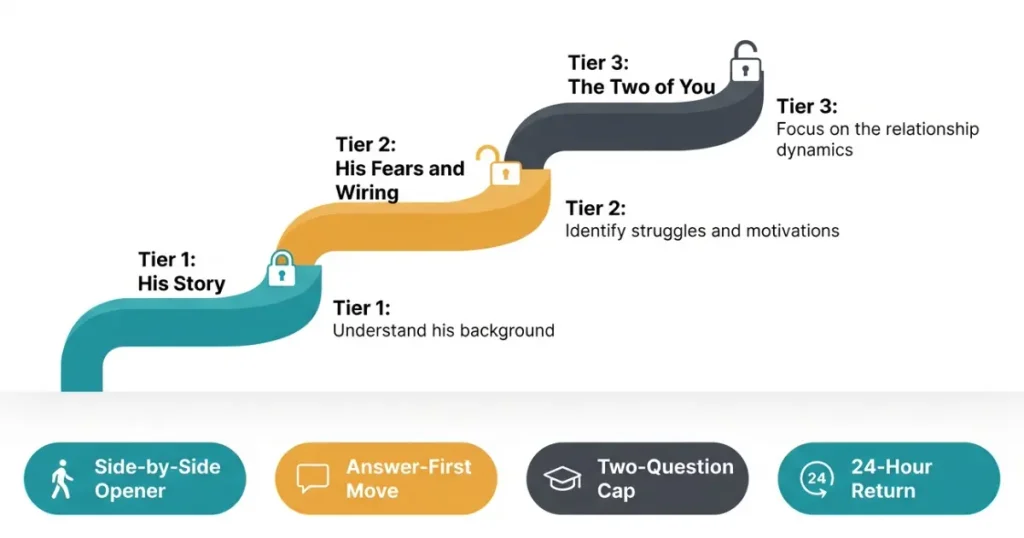
Skip the candlelit summit meeting. These deep conversation starters for couples work because they lower the stakes.
- The Side-by-Side Opener. On a walk or drive, try: “Random question. What’s something you believed at 15 that you’ve totally changed your mind about?” The activity carries the weight; you just steer.
- The Answer-First Move. Try disclosing something small, then hand him the mic: “I realized today I still get nervous calling my dad. Who’s the hardest person for you to be honest with?” Going first turns the question into an exchange.
- The Two-Question Cap. Ask one question, add one follow-up (“What was that like?”), then let the conversation drift somewhere warm. Ending on ease makes him willing to come back.
- The 24-Hour Return. The next day, try: “You mentioned you miss how close you and your brother were. I’ve been thinking about that.” Returning to his words is a bid of your own, and it tells him his inner world is worth remembering.
Frequently Asked Questions
What if he says “I don’t know” to every question?
Send the question ahead of time in a low-pressure text; many people need to compose answers privately before saying them aloud. If it persists across weeks of calm attempts, ask about the pattern itself: “Do these questions feel like tests to you?”
How often should we have deep talks?
One focused question a week is plenty for most couples. Spaced, voluntary conversations build emotional intimacy; nightly marathons train avoidance.
Can deep questions backfire early in a relationship?
Yes, when they sound like commitment interviews before trust exists. Stay in Tier 1 for the first few months and let the deeper tiers arrive naturally.
Picture that couch again. Same boyfriend, same phone, same “I’m good.” Now you have a map instead of a mystery: which tier you’re in, when to ask, how to go first, and how to let his silence finish its work. The door opens from his side. Your job is to make it safe enough that he wants to open it.
You can’t ask someone into openness, but you can make the truth the easiest thing to say.
My Closing Remarks
Here’s what I keep coming back to: curiosity beats confrontation every time. The moment a question becomes a test, both people lose. So ask because you want to know him, and let the answer be whatever it is.
When he finally says the thing he’s never said, resist the urge to grade it. Just say thank you. That’s how the next truth gets told.
More Related Stories for You
When you want smiles instead of soul-baring, keep the momentum with these lighter romantic questions to ask your boyfriend.
About The Author